

10 reales vellon – Spain
Add to wishlist
Spain
Context
Material
References
KM: #
Numista: #103183
Value
Bullion value: $29.30
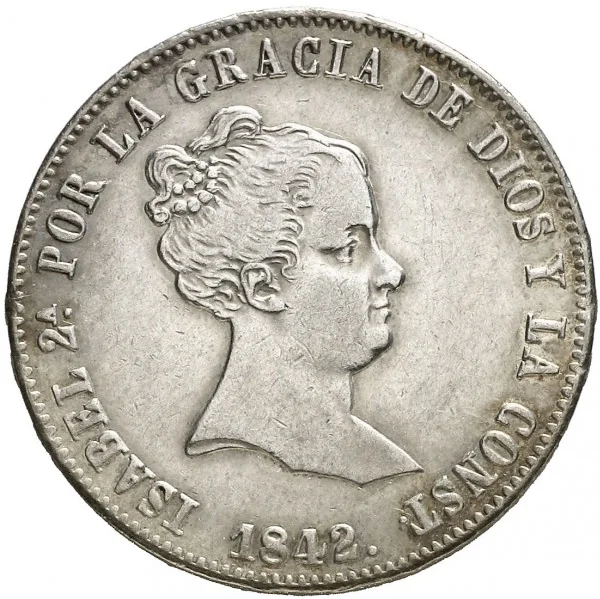
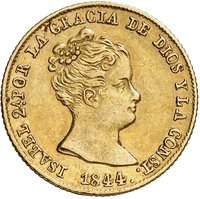
Obverse
Description:
Queen Isabella II facing right.
Inscription:
ISABEL 2A. POR LA GRACIA DE DIOS Y LA CONST ·
1842.
1842.
Translation:
ISABELLE II. BY THE GRACE OF GOD AND THE CONSTITUTION ·
1842.
1842.
Script: Latin
Language: Spanish
Engraver: Mariano González de Sepúlveda Salazar
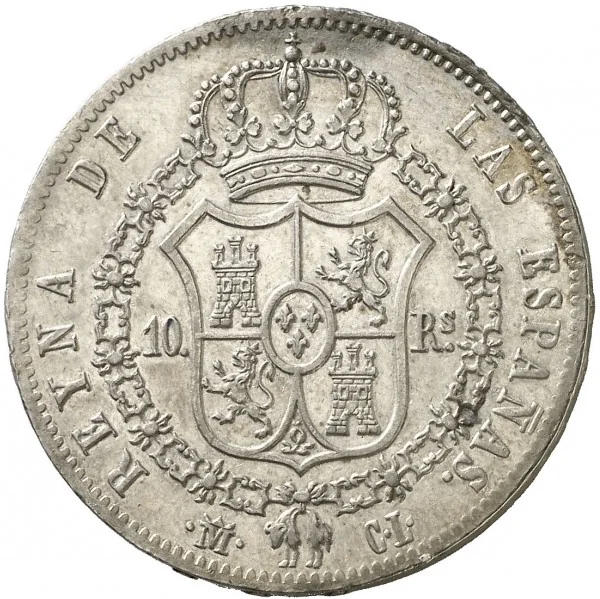
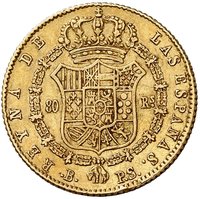
Reverse
Description:
Crowned Spanish coat of arms with the Golden Fleece.
Inscription:
REYNA DE LAS ESPAÑAS.
10. RS.
· M · C·L·
10. RS.
· M · C·L·
Translation:
Queen of the Spains.
10 Reales.
Mexico City Mint.
10 Reales.
Mexico City Mint.
Script: Latin
Language: Spanish
Engraver: Mariano González de Sepúlveda Salazar
Edge
Categories
| Symbols> Coat of Arms |
Mints
| Name | Mark |
|---|---|
| Royal Mint of Madrid | (M) |
| Royal Mint of Seville | S |
Mintings
| Year | Mint Mark | Mintage | Quality | Collection |
|---|---|---|---|---|
| 1840 | MCL | — | ||
| 1840 | MDG | — | ||
| 1841 | MCL | — | ||
| 1841 | SRD | — | ||
| 1842 | SRD | — | ||
| 1842 | MCL | — | ||
| 1843 | MCL | — | ||
| 1843 | SRD | — | ||
| 1844 | MCL | — |
Historical background
In 1840, Spain was grappling with a chaotic and fragmented monetary system, a legacy of the political instability and regional divisions of the early 19th century. The Peninsular War and the subsequent loss of the American colonies had severely depleted the state's finances, leading to chronic budget deficits. The government, under the regency of María Cristina and later General Espartero, resorted to excessive issuance of paper money (vales reales and other debt instruments) which circulated alongside a multitude of older, debased coins. This resulted in a severe lack of public confidence in the currency, rampant inflation, and a complex system where the actual value of money varied significantly by region and transaction.
The core of the problem was the coexistence of two distinct units of account: the real de vellón (used for everyday transactions and tied to the depreciating paper) and the real de plata (linked to the silver standard). The disparity between them created a dual-price system and facilitated widespread speculation. Furthermore, the circulation of obsolete coins from different reigns, alongside counterfeit and clipped coins, made commerce difficult. The state's inability to control the money supply or guarantee the value of its currency stifled economic development and complicated both domestic trade and international exchanges.
This monetary disarray was a direct reflection of Spain's broader struggle to form a modern, centralized nation-state following the First Carlist War (1833-1840). The victorious liberal government recognized that economic modernization required a uniform and stable currency. Consequently, the period around 1840 set the stage for the major monetary reform that would come in 1848 with the introduction of the escudo as a step toward the eventual creation of the peseta in 1868, which would finally unify the national currency system on a decimal, bimetallic standard.
The core of the problem was the coexistence of two distinct units of account: the real de vellón (used for everyday transactions and tied to the depreciating paper) and the real de plata (linked to the silver standard). The disparity between them created a dual-price system and facilitated widespread speculation. Furthermore, the circulation of obsolete coins from different reigns, alongside counterfeit and clipped coins, made commerce difficult. The state's inability to control the money supply or guarantee the value of its currency stifled economic development and complicated both domestic trade and international exchanges.
This monetary disarray was a direct reflection of Spain's broader struggle to form a modern, centralized nation-state following the First Carlist War (1833-1840). The victorious liberal government recognized that economic modernization required a uniform and stable currency. Consequently, the period around 1840 set the stage for the major monetary reform that would come in 1848 with the introduction of the escudo as a step toward the eventual creation of the peseta in 1868, which would finally unify the national currency system on a decimal, bimetallic standard.
💎 Extremely Rare