

1 maravedi – Spain
Add to wishlist
Spain
Context
Material
References
KM: #
Numista: #18516
Obverse
Description:
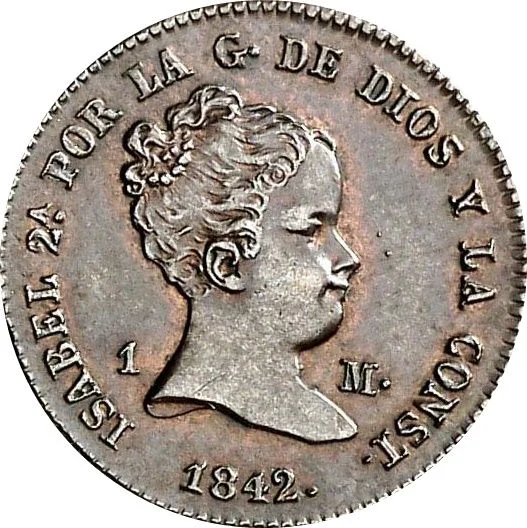
Young Isabel II facing right.
Inscription:
ISABEL 2A. POR LA G· DE DIOS Y LA CONST·
1 M·
1842.
1 M·
1842.
Translation:
Isabel 2nd. By the Grace of God and the Constitution.
1 M.
1842.
1 M.
1842.
Script: Latin
Language: Spanish
Engraver: Mariano González de Sepúlveda Salazar
Reverse
Description:
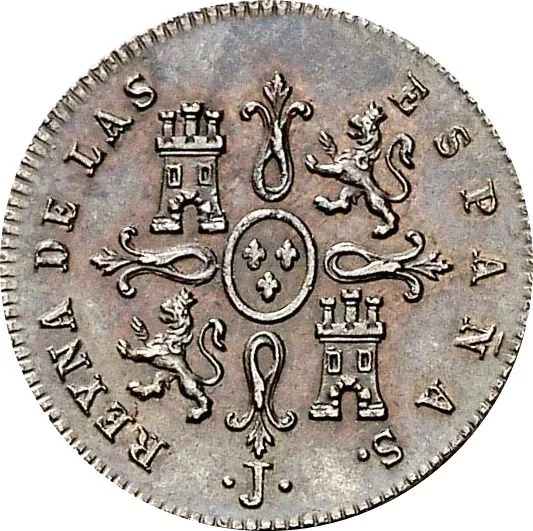
Cross of Pelayo with Castile-León lions and a Bourbon fleur-de-lis oval.
Inscription:
REYNA DE LAS ESPAÑAS.
· J ·
· J ·
Translation:
Queen of the Spains.
· J ·
· J ·
Script: Latin
Language: Spanish
Engraver: Mariano González de Sepúlveda Salazar
Edge
Categories
| Animal> Feline |
| Building> Castle or fortification |
| Symbol> Fleur-de-lis |
| Symbol> Cross |
Mints
| Name | Mark |
|---|---|
| Royal Mint of Madrid | — |
| Royal Mint of Segovia | — |
| Jubia Mint | J |
Historical background
In 1842, Spain's currency situation was characterized by profound instability and fragmentation, a legacy of the political and economic turmoil of the early 19th century. The state was deeply indebted from the Napoleonic Wars and the subsequent loss of its American colonies, leading to chronic budget deficits. To finance itself, the government relied heavily on issuing paper money (cédulas and vales reales), which had severely depreciated. The monetary system was a chaotic mix of coins from different reigns, foreign currencies (especially French francs), and largely discredited paper, with no unified national currency in effective circulation.
This period fell within the moderate decade (Década Moderada) of Isabella II's reign, during which Finance Minister Alejandro Mon attempted significant reform. His pivotal law of 1848 was already in preparation, aiming to establish a new, decimal-based national currency: the escudo, divided into 100 céntimos. However, in 1842, this reform was still on the horizon. The most trusted medium of exchange remained physical silver and gold, but these were in short supply, often hoarded or exported, exacerbating the scarcity of reliable money for everyday commerce.
Consequently, the economy suffered from a lack of confidence, high transaction costs, and regional inconsistency. Prices and contracts were often referenced to the old real or even foreign coinage, creating a complex and inefficient environment for trade and investment. The currency chaos of 1842 thus reflected the broader struggle of the Spanish state to assert central authority and modernize its economy, a process that would only begin to find resolution with the monetary reforms of the late 1840s.
This period fell within the moderate decade (Década Moderada) of Isabella II's reign, during which Finance Minister Alejandro Mon attempted significant reform. His pivotal law of 1848 was already in preparation, aiming to establish a new, decimal-based national currency: the escudo, divided into 100 céntimos. However, in 1842, this reform was still on the horizon. The most trusted medium of exchange remained physical silver and gold, but these were in short supply, often hoarded or exported, exacerbating the scarcity of reliable money for everyday commerce.
Consequently, the economy suffered from a lack of confidence, high transaction costs, and regional inconsistency. Prices and contracts were often referenced to the old real or even foreign coinage, creating a complex and inefficient environment for trade and investment. The currency chaos of 1842 thus reflected the broader struggle of the Spanish state to assert central authority and modernize its economy, a process that would only begin to find resolution with the monetary reforms of the late 1840s.
💎 Very Rare