

2½ centavos – Colombia
Add to wishlist
Colombia
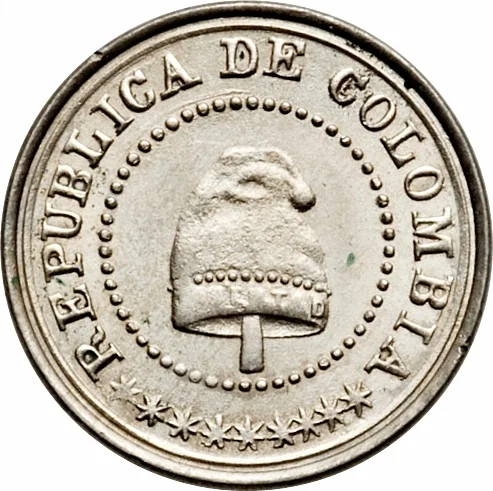
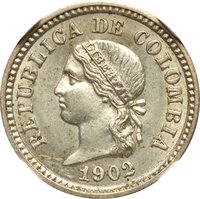
Obverse
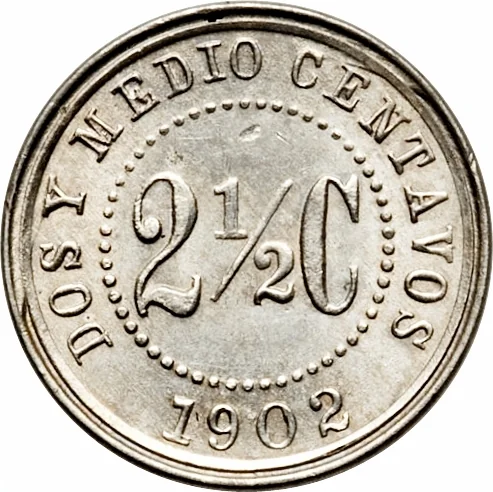
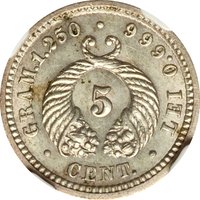
Reverse
Edge
Categories
| Symbol> Phrygian cap |
Mints
| Name | Mark |
|---|---|
| Scovill Manufacturing Company | — |
Mintings
| Year | Mint Mark | Mintage | Quality | Collection |
|---|---|---|---|---|
| 1900 | — | — | ||
| 1902 | — | 400,000 |
Historical background
In 1900, Colombia was in a state of profound monetary disarray and transition, a direct consequence of the devastating Thousand Days' War (1899–1902). The conflict shattered the national economy, leading to the suspension of specie payments and the collapse of the government's credit. The pre-war currency, the Colombian peso, which had been theoretically backed by gold since 1871, became virtually inconvertible. To finance the war, both the Conservative government and Liberal rebels resorted to printing massive amounts of inconvertible paper money, leading to rampant inflation and a severe loss of public confidence in the currency. The country operated with a chaotic mix of old gold coins, depreciated paper notes, and even foreign currencies in some regions.
This period marked the definitive end of the gold standard in practice, though it would not be officially abandoned until 1931. The monetary system fractured along political lines, with different regions and factions issuing their own notes, further complicating commerce. The value of the paper peso plummeted dramatically against gold, creating a vast gap between the "paper peso" used in daily life and the "gold peso" used for international trade and large contracts. This effective bimetallic system, with a wildly fluctuating exchange rate between the two units, created uncertainty and hindered economic recovery.
Therefore, the currency situation at the dawn of the 20th century was one of crisis and fragmentation. The foundational challenge for the coming decades would be to restore monetary unity and stability after the war. The eventual solution, beginning in the early 1900s, involved the creation of a central bank (the Banco de la República in 1923) and a long, difficult process of retiring the depreciated paper money, ultimately aiming to re-establish a single, trusted national currency.
This period marked the definitive end of the gold standard in practice, though it would not be officially abandoned until 1931. The monetary system fractured along political lines, with different regions and factions issuing their own notes, further complicating commerce. The value of the paper peso plummeted dramatically against gold, creating a vast gap between the "paper peso" used in daily life and the "gold peso" used for international trade and large contracts. This effective bimetallic system, with a wildly fluctuating exchange rate between the two units, created uncertainty and hindered economic recovery.
Therefore, the currency situation at the dawn of the 20th century was one of crisis and fragmentation. The foundational challenge for the coming decades would be to restore monetary unity and stability after the war. The eventual solution, beginning in the early 1900s, involved the creation of a central bank (the Banco de la República in 1923) and a long, difficult process of retiring the depreciated paper money, ultimately aiming to re-establish a single, trusted national currency.
💎 Extremely Rare