

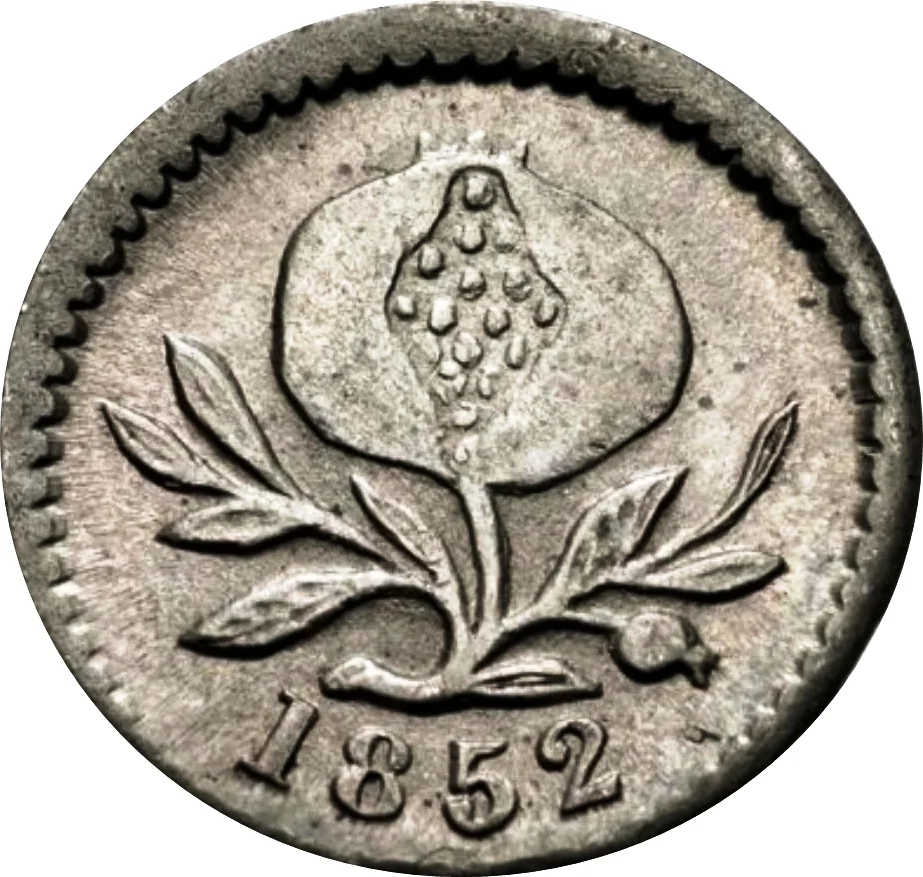
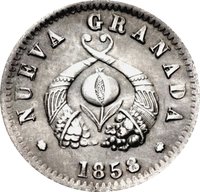
Obverse
Description:
Pomegranate: A jewel-toned fruit with sweet-tart seeds.
Inscription:
1852
Script: Latin
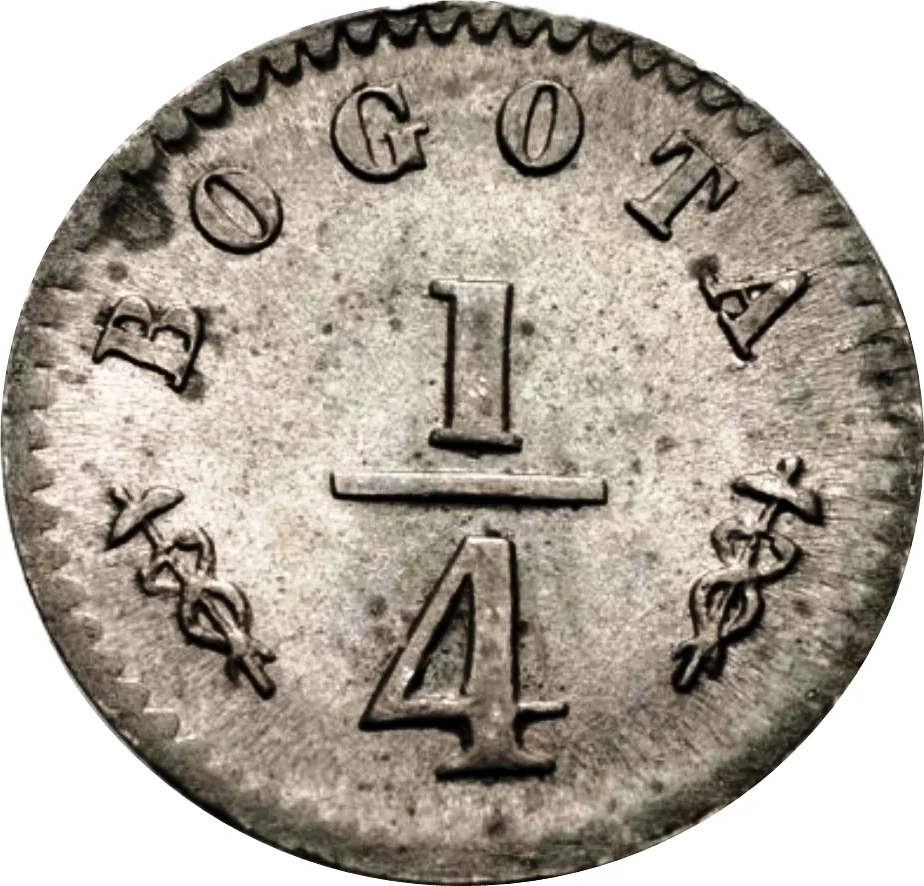
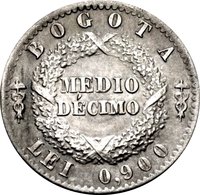
Reverse
Description:
Denomination with caduceus flanking "1/4," no stars below.
Inscription:
BOGOTA
1/4
1/4
Script: Latin
Edge
Mints
| Name | Mark |
|---|---|
| Bogota Mint | — |
Mintings
| Year | Mint Mark | Mintage | Quality | Collection |
|---|---|---|---|---|
| 1852 | — | — | ||
| 1858 | — | — |
Historical background
In 1852, Colombia, then known as the Republic of New Granada, was in a state of profound monetary disarray. The nation lacked a unified, state-issued currency. Instead, the economy operated on a chaotic system of multiple, competing mediums of exchange. These included a limited supply of worn and clipped Spanish colonial coins, a fluctuating influx of foreign gold and silver coins from trade (primarily British sovereigns, French francs, and coins from neighboring nations), and a vast quantity of privately issued paper money from various regional banks and commercial houses, which were often of dubious value and led to frequent defaults.
This fragmented system was a direct consequence of the political and fiscal decentralization that followed independence. The federalist constitution of 1850 granted significant autonomy to the provinces, including the power to charter banks and authorize currency issuance with little central oversight. The result was an unstable and inflationary environment where the value and acceptability of money could change from one town to the next, severely hampering internal trade, credit, and economic planning. The central government in Bogotá, with its own chronic budget deficits, had limited ability to impose monetary order or guarantee the value of any circulating medium.
The situation created intense debate between liberales radicales, who favored free banking and decentralization, and conservatives, who advocated for a strong central bank and a uniform, metallic currency. The year 1852 itself was a pivotal point, as the government began to seriously confront the crisis. It initiated steps toward reform, most notably by considering proposals to establish a national bank and to decimalize the coinage system, moving away from the old Spanish colonial real. These early efforts would eventually culminate in the monetary reforms of the 1850s and 1860s, which introduced the peso as the official decimal currency, though true stability remained elusive for decades.
This fragmented system was a direct consequence of the political and fiscal decentralization that followed independence. The federalist constitution of 1850 granted significant autonomy to the provinces, including the power to charter banks and authorize currency issuance with little central oversight. The result was an unstable and inflationary environment where the value and acceptability of money could change from one town to the next, severely hampering internal trade, credit, and economic planning. The central government in Bogotá, with its own chronic budget deficits, had limited ability to impose monetary order or guarantee the value of any circulating medium.
The situation created intense debate between liberales radicales, who favored free banking and decentralization, and conservatives, who advocated for a strong central bank and a uniform, metallic currency. The year 1852 itself was a pivotal point, as the government began to seriously confront the crisis. It initiated steps toward reform, most notably by considering proposals to establish a national bank and to decimalize the coinage system, moving away from the old Spanish colonial real. These early efforts would eventually culminate in the monetary reforms of the 1850s and 1860s, which introduced the peso as the official decimal currency, though true stability remained elusive for decades.
✨ Legendary