

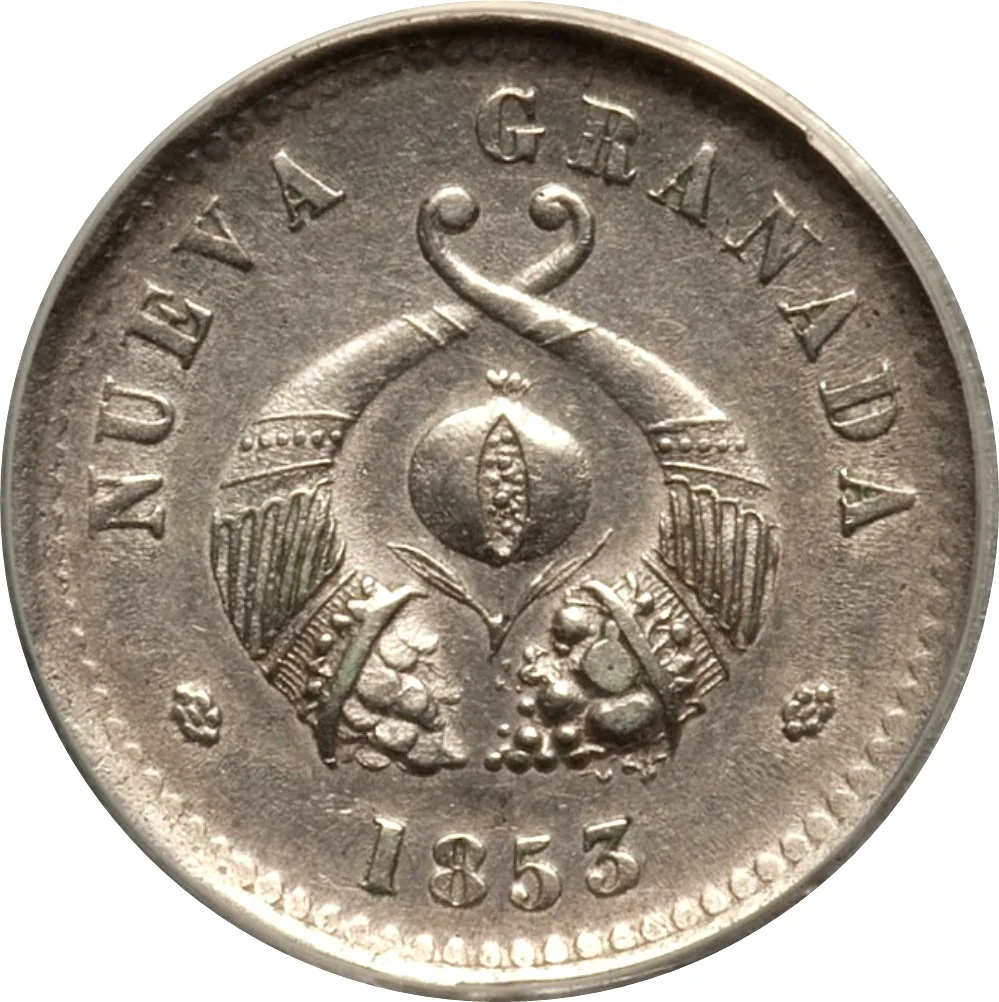

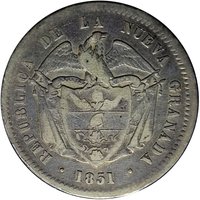
Obverse
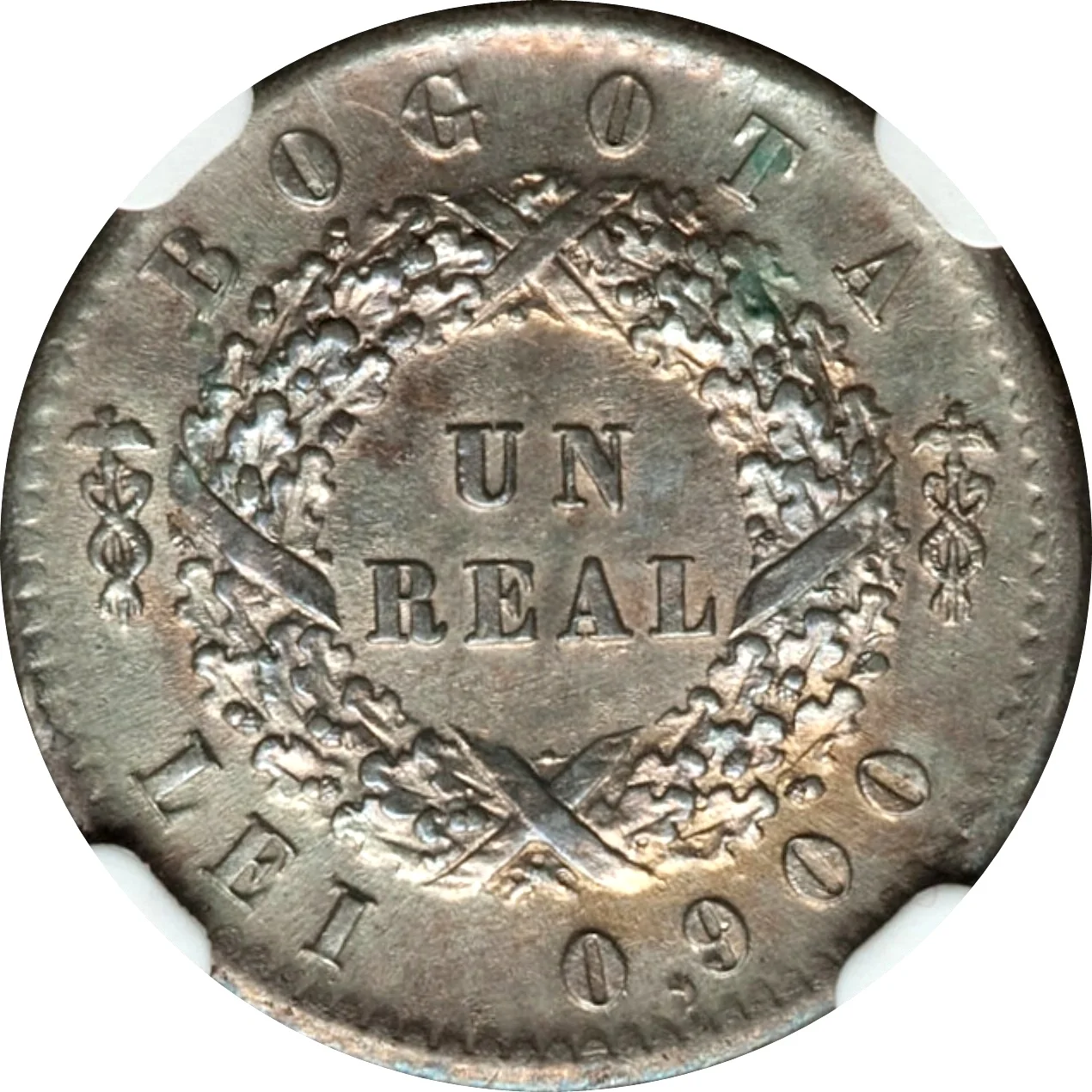
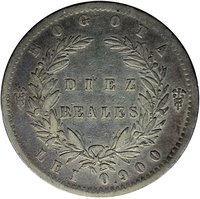
Reverse
Description:
Top: mint, centre: wreath with denomination, sides: caduceus, bottom: fineness.
Inscription:
BOGOTA
UN
REAL
LEI 0,900
UN
REAL
LEI 0,900
Script: Latin
Edge
Reeded
Mints
| Name | Mark |
|---|---|
| Bogota Mint | BOGOTA |
Mintings
| Year | Mint Mark | Mintage | Quality | Collection |
|---|---|---|---|---|
| 1851 | — | — | ||
| 1852 | — | — | ||
| 1853 | — | — |
Historical background
In 1851, Colombia was navigating the complex monetary landscape of the Granadine Confederation, a decentralized republic following the dissolution of Gran Colombia. The currency situation was characterized by profound disorder and regional fragmentation. The national government in Bogotá struggled to impose a unified monetary system across its sovereign states, which often issued their own currencies or continued to use a chaotic mix of foreign and obsolete coins. Spanish colonial reales, British sovereigns, and even French francs circulated alongside locally minted coinage, leading to bewildering exchange rates and hindering national commerce.
This monetary anarchy was rooted in both political weakness and a severe shortage of precious metals for minting. The Confederation lacked the centralized authority and economic strength to enforce a single, trusted currency. Consequently, much of the economy still relied on a cumbersome system of moneda macuquina—clipped and irregularly shaped silver pieces from the colonial era—whose value was determined by weight and purity in each transaction. This environment fostered widespread counterfeiting and eroded public trust in any form of money, stifling economic development and credit systems.
The situation prompted ongoing debates among federalists and centralists about monetary reform, viewing a unified currency as essential for national cohesion. While the 1850s saw various legislative attempts to standardize the system around a decimal-based peso, effective reform would remain elusive until after the Rionegro Constitution of 1863 and, more definitively, the establishment of the Banco Nacional in 1880. Thus, 1851 represents a point within a prolonged period of monetary transition, marked more by confusion and regional disparity than by stable, nationally managed currency.
This monetary anarchy was rooted in both political weakness and a severe shortage of precious metals for minting. The Confederation lacked the centralized authority and economic strength to enforce a single, trusted currency. Consequently, much of the economy still relied on a cumbersome system of moneda macuquina—clipped and irregularly shaped silver pieces from the colonial era—whose value was determined by weight and purity in each transaction. This environment fostered widespread counterfeiting and eroded public trust in any form of money, stifling economic development and credit systems.
The situation prompted ongoing debates among federalists and centralists about monetary reform, viewing a unified currency as essential for national cohesion. While the 1850s saw various legislative attempts to standardize the system around a decimal-based peso, effective reform would remain elusive until after the Rionegro Constitution of 1863 and, more definitively, the establishment of the Banco Nacional in 1880. Thus, 1851 represents a point within a prolonged period of monetary transition, marked more by confusion and regional disparity than by stable, nationally managed currency.
🌟 Limited