

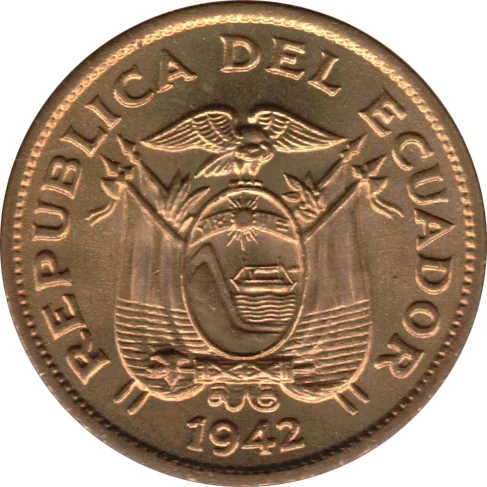
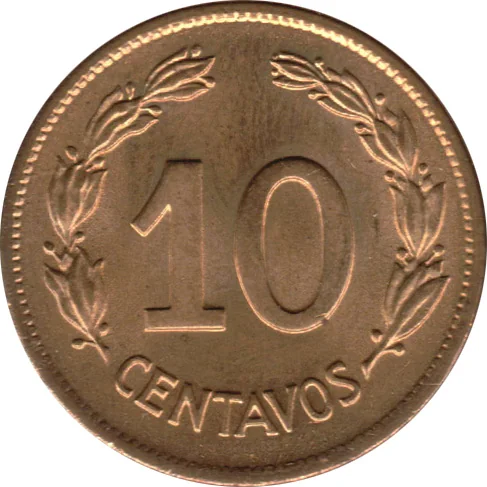
10 centavos – Ecuador
Add to wishlist
Ecuador
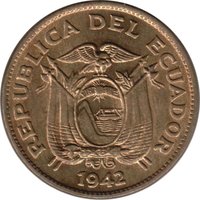
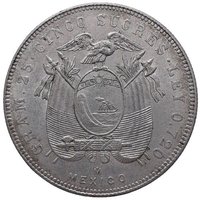
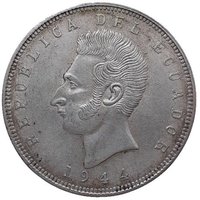
Obverse
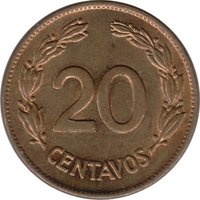
Reverse
Edge
Plain
Categories
| Symbols> Coat of Arms |
| Symbol> Wreath |
Mints
| Name | Mark |
|---|---|
| United States Mint of Philadelphia | — |
Mintings
| Year | Mint Mark | Mintage | Quality | Collection |
|---|---|---|---|---|
| 1942 | — | 5,000,000 |
Historical background
In 1942, Ecuador’s currency situation was fundamentally defined by its recent adoption of the U.S. dollar as its official currency, a dramatic and unique monetary reform enacted just two years prior in 1940. This move was a direct response to a severe and prolonged economic crisis. The national currency, the sucre, had been rendered nearly worthless by hyperinflation, massive fiscal deficits, and a collapse in public confidence following years of political instability and the devastating economic effects of the Great Depression. By fixing the sucre to the dollar at a rate of 13.5 sucres per dollar and making the U.S. currency legal tender for all transactions, the government of President Carlos Alberto Arroyo del Río sought immediate stabilization.
The reform was largely successful in halting hyperinflation and restoring basic monetary order, but it came at a significant cost and under unusual circumstances. Ecuador effectively surrendered its monetary sovereignty to the United States, ceding control over its money supply and exchange rate policy. Furthermore, the decision was heavily influenced by geopolitical pressures, as the United States, seeking hemispheric solidarity at the onset of World War II, provided financial backing and political support for the dollarization plan. This arrangement tied Ecuador's economy closely to U.S. economic policy and the inflow of dollar reserves.
Consequently, by 1942, the currency situation was one of fragile stability. While daily commerce operated on a dual-currency basis with the dollar providing a reliable unit of account, the underlying structural weaknesses of Ecuador's economy—such as its dependence on a few agricultural exports—remained unaddressed. The government’s ability to respond to economic shocks was now severely limited, and the benefits of stabilization were unevenly distributed, primarily aiding the coastal agro-export elite and foreign interests. Thus, the currency regime, while curbing the immediate monetary chaos, entrenched a new form of external dependency that would shape Ecuador's economic trajectory for decades.
The reform was largely successful in halting hyperinflation and restoring basic monetary order, but it came at a significant cost and under unusual circumstances. Ecuador effectively surrendered its monetary sovereignty to the United States, ceding control over its money supply and exchange rate policy. Furthermore, the decision was heavily influenced by geopolitical pressures, as the United States, seeking hemispheric solidarity at the onset of World War II, provided financial backing and political support for the dollarization plan. This arrangement tied Ecuador's economy closely to U.S. economic policy and the inflow of dollar reserves.
Consequently, by 1942, the currency situation was one of fragile stability. While daily commerce operated on a dual-currency basis with the dollar providing a reliable unit of account, the underlying structural weaknesses of Ecuador's economy—such as its dependence on a few agricultural exports—remained unaddressed. The government’s ability to respond to economic shocks was now severely limited, and the benefits of stabilization were unevenly distributed, primarily aiding the coastal agro-export elite and foreign interests. Thus, the currency regime, while curbing the immediate monetary chaos, entrenched a new form of external dependency that would shape Ecuador's economic trajectory for decades.
🌱 Fairly Common