

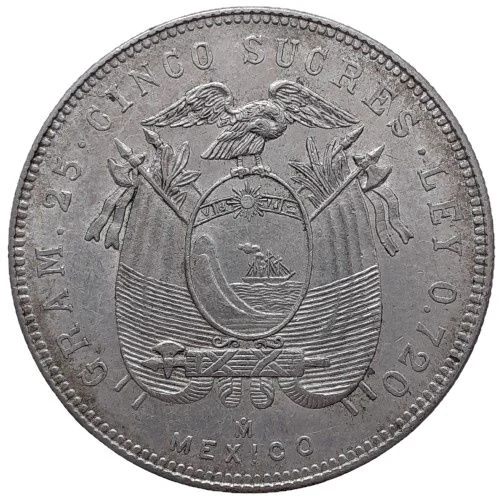
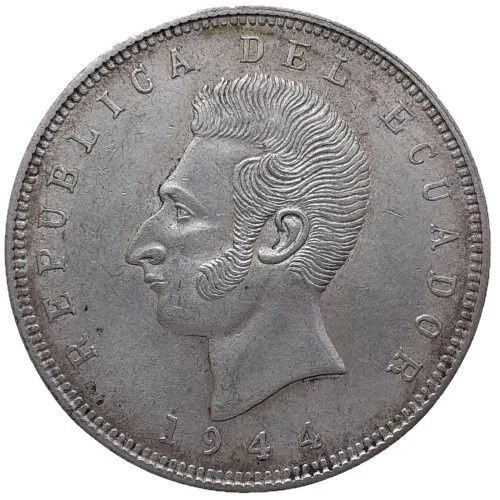
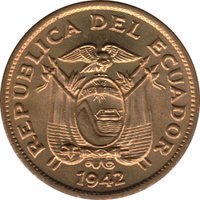
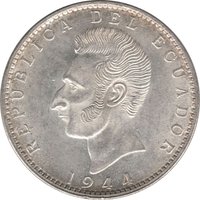
Obverse
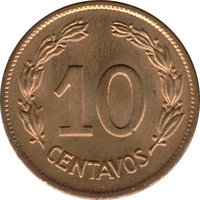
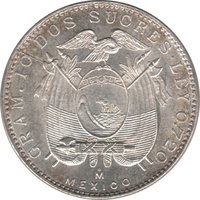
Reverse
Edge
Reeded
Categories
| Person> Military leader |
| Person> Politician |
| Symbols> Coat of Arms |
Mints
| Name | Mark |
|---|---|
| Mexican Mint | Mo |
Historical background
In 1943, Ecuador’s currency situation was defined by its recent and pivotal transition to the sucre as its sole official currency, following the dissolution of the Central Bank of Ecuador's private consortium and its nationalization in 1937. This period fell within the broader era of President Carlos Arroyo del Río’s administration (1940-1944), a time of significant economic strain despite the global context of World War II. While the war disrupted traditional trade, it also created demand for Ecuadorian exports like balsa wood and rubber, providing some foreign exchange earnings. However, the country grappled with inflationary pressures and a complex monetary system still in the process of consolidation under full state control.
The exchange rate was officially pegged, but the economy operated under a de facto dual system. The Central Bank maintained a fixed official rate for government transactions and essential imports, while a parallel, less favorable market rate existed for other transactions, reflecting persistent pressures on the sucre. This instability was rooted in structural issues: a reliance on volatile agricultural exports (primarily cacao, which was recovering from disease, and emerging bananas), limited industrialization, and recurring fiscal deficits that often led the government to finance itself through money creation by the central bank.
Ultimately, the currency situation of 1943 was one of fragile management during a turbulent global period. The institutional framework for a modern, unified monetary policy was newly established but not yet fully tested. Economic challenges, including the political fallout from the 1941 border war with Peru and domestic discontent, would soon culminate in the May 1944 "Glorious Revolution" that overthrew Arroyo del Río. This upheaval set the stage for further monetary and economic policy shifts in the postwar era, as Ecuador continued to wrestle with the balance between external stability and internal growth.
The exchange rate was officially pegged, but the economy operated under a de facto dual system. The Central Bank maintained a fixed official rate for government transactions and essential imports, while a parallel, less favorable market rate existed for other transactions, reflecting persistent pressures on the sucre. This instability was rooted in structural issues: a reliance on volatile agricultural exports (primarily cacao, which was recovering from disease, and emerging bananas), limited industrialization, and recurring fiscal deficits that often led the government to finance itself through money creation by the central bank.
Ultimately, the currency situation of 1943 was one of fragile management during a turbulent global period. The institutional framework for a modern, unified monetary policy was newly established but not yet fully tested. Economic challenges, including the political fallout from the 1941 border war with Peru and domestic discontent, would soon culminate in the May 1944 "Glorious Revolution" that overthrew Arroyo del Río. This upheaval set the stage for further monetary and economic policy shifts in the postwar era, as Ecuador continued to wrestle with the balance between external stability and internal growth.
🌱 Common