

Chile

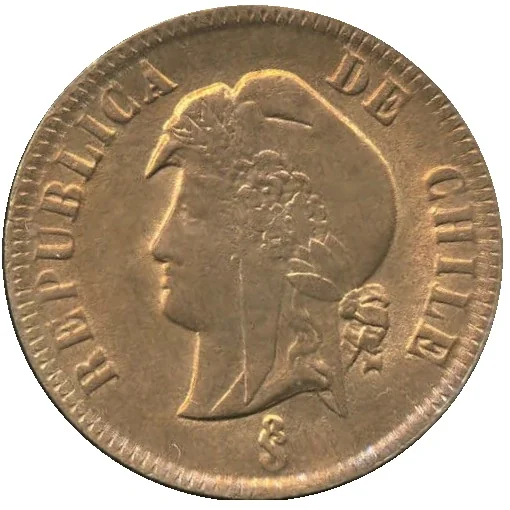
Obverse
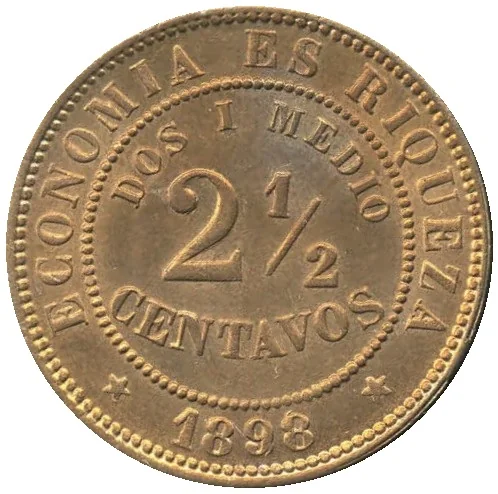
Reverse
Description:
Circle denomination, date beneath.
Inscription:
ECONOMIA ES RIQUEZA
DOS I MEDIO
2½ CENTAVOS
1898
DOS I MEDIO
2½ CENTAVOS
1898
Script: Latin
Edge
Plain
Categories
| Symbol> Allegory |
| Symbol> Phrygian cap |
Mintings
| Year | Mint Mark | Mintage | Quality | Collection |
|---|---|---|---|---|
| 1886 | So | 381,000 | ||
| 1887 | So | 500,000 | ||
| 1895 | So | 366,000 | ||
| 1896 | So | 172,000 | ||
| 1898 | So | 2,177,000 |
Historical background
In 1886, Chile's currency situation was characterized by the dominance of the paper peso, a fiat currency that had been introduced during the War of the Pacific (1879–1883) to finance the conflict. To meet wartime expenses, the government under President Domingo Santa María had suspended the convertibility of banknotes into gold or silver, a system known as the curso forzoso (forced circulation). This led to a significant depreciation of the paper peso against the metallic peso, creating a dual-currency system where prices and contracts were often negotiated with the distinction in mind. The economy was thus operating with an unstable, depreciated currency, which fueled inflation and created uncertainty for both domestic commerce and international trade.
The post-war period saw intense political and economic debate between oreros (proponents of a return to the gold standard) and papeleros (those who favored retaining the flexible paper system to stimulate the economy). The papelero position held sway in 1886, as the government, facing substantial public debt and a need for economic reactivation, was reluctant to contract the money supply through a return to convertibility. This policy aimed to promote exports, whose revenues were needed to service foreign debt, and to fund ambitious state-led development projects in railways and infrastructure. However, the resulting inflation effectively acted as a tax on the populace and creditors.
Consequently, the financial landscape of 1886 was one of fragile stability, built on continued fiduciary emission. The paper peso's value was not anchored to a metallic reserve but was managed through government decree and limited by laws attempting to control the amount of banknote issuance. This environment set the stage for the severe financial crises that would follow in the early 1890s, triggered by political instability and excessive speculation. Thus, the currency situation of 1886 represented a deliberate, if risky, transitional phase where the state prioritized economic growth and fiscal flexibility over monetary orthodoxy.
The post-war period saw intense political and economic debate between oreros (proponents of a return to the gold standard) and papeleros (those who favored retaining the flexible paper system to stimulate the economy). The papelero position held sway in 1886, as the government, facing substantial public debt and a need for economic reactivation, was reluctant to contract the money supply through a return to convertibility. This policy aimed to promote exports, whose revenues were needed to service foreign debt, and to fund ambitious state-led development projects in railways and infrastructure. However, the resulting inflation effectively acted as a tax on the populace and creditors.
Consequently, the financial landscape of 1886 was one of fragile stability, built on continued fiduciary emission. The paper peso's value was not anchored to a metallic reserve but was managed through government decree and limited by laws attempting to control the amount of banknote issuance. This environment set the stage for the severe financial crises that would follow in the early 1890s, triggered by political instability and excessive speculation. Thus, the currency situation of 1886 represented a deliberate, if risky, transitional phase where the state prioritized economic growth and fiscal flexibility over monetary orthodoxy.
🌱 Fairly Common