

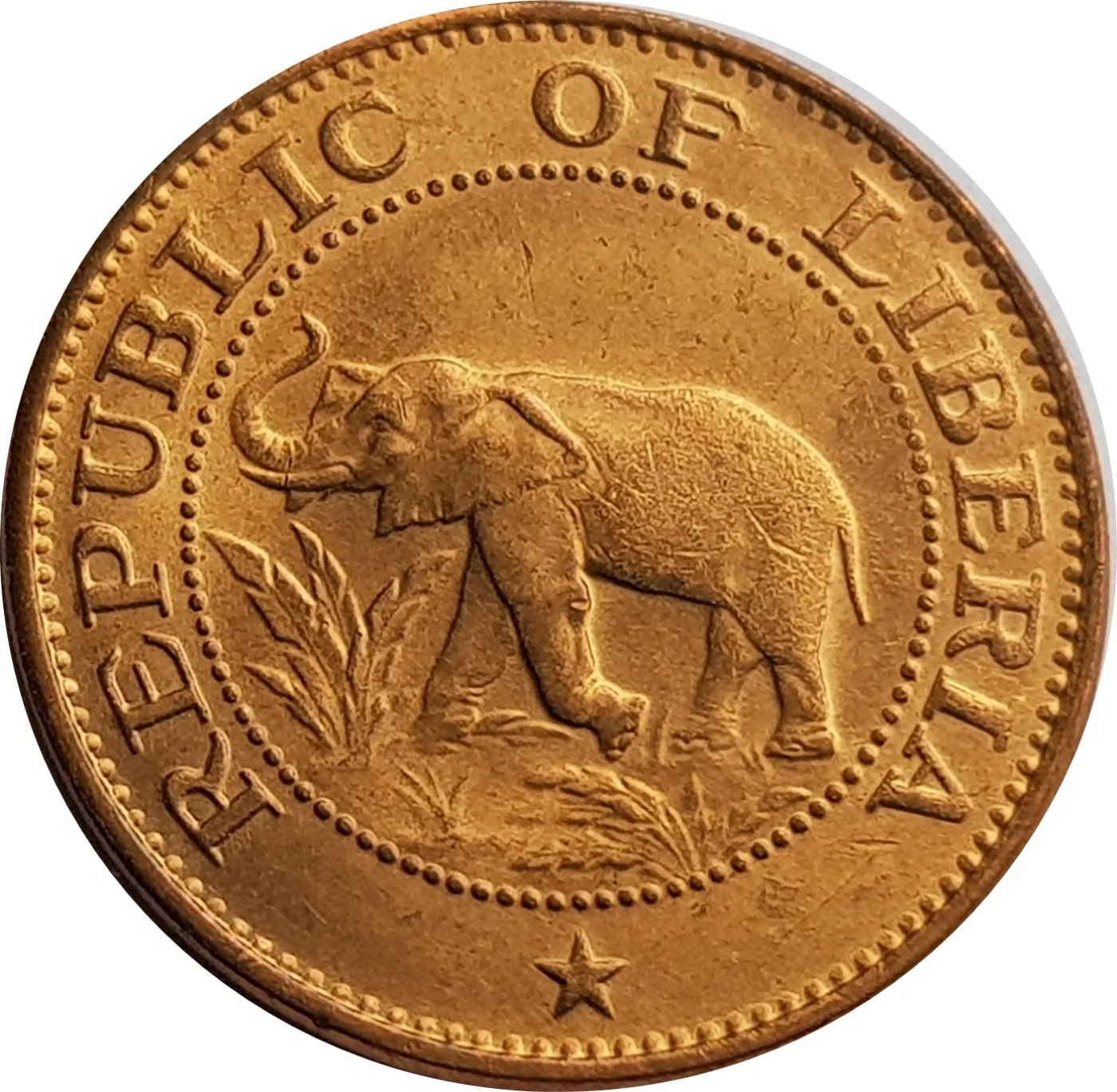
Obverse
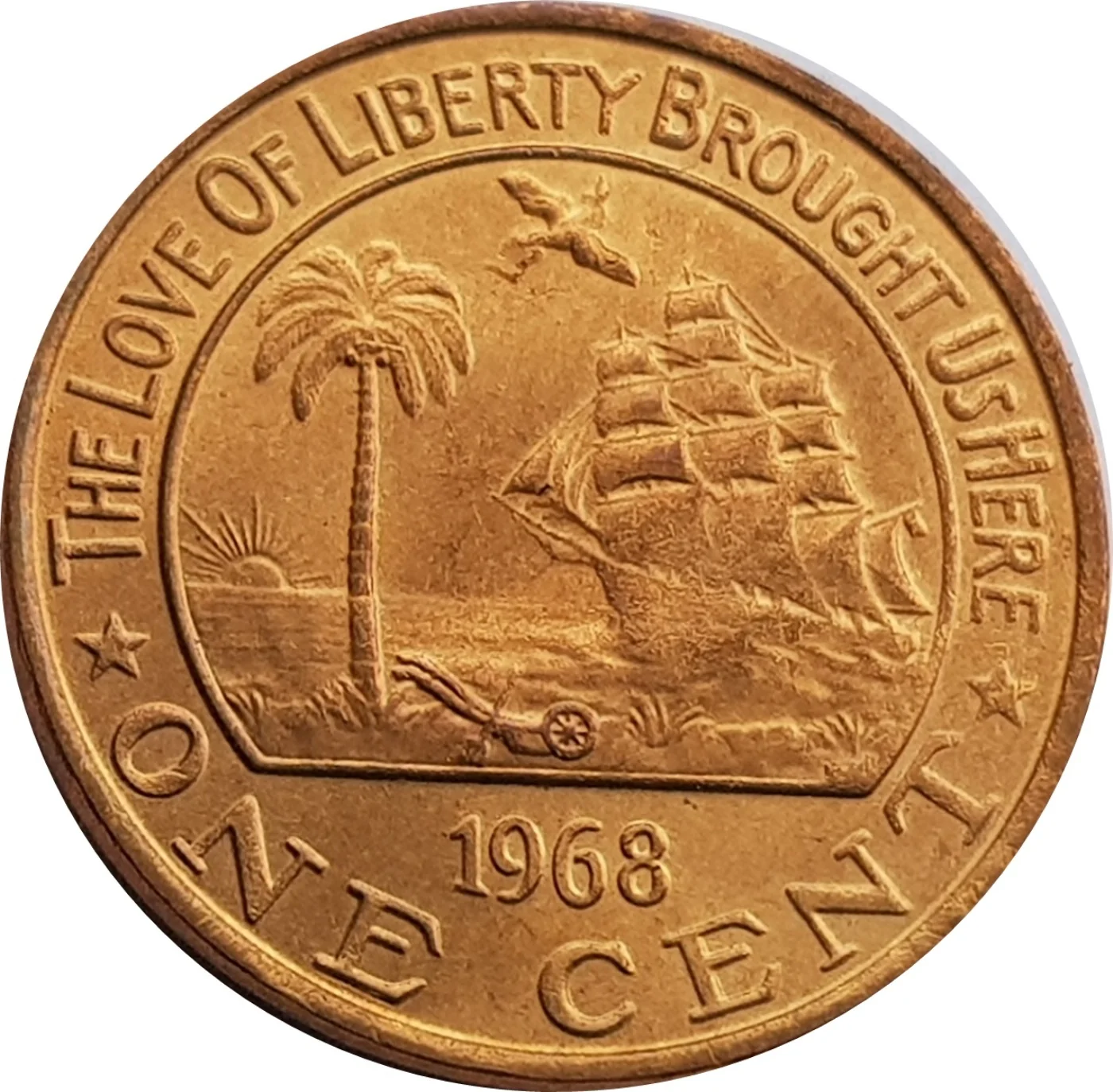
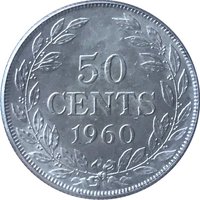
Reverse
Description:
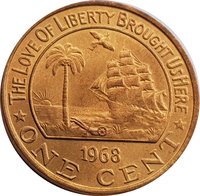
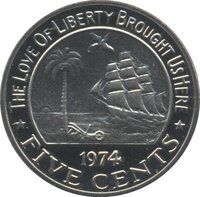
Ship and bird right of palm, inside partial circle above date.
Inscription:
THE LOVE OF LIBERTY BROUGHT US HERE
B.H
1968
ONE CENT
B.H
1968
ONE CENT
Script: Latin
Edge
Plain
Categories
| Plant> Tree |
| Animal> Bird |
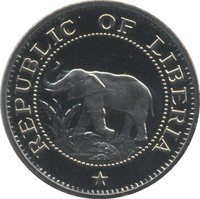
| Animal> Elephant |
| Transportation> Watercraft |
| Symbols> Coat of Arms |
Mints
| Name | Mark |
|---|---|
| Royal Mint (Tower Hill) | — |
| Royal Mint | — |
| United States Mint of Denver | — |
| United States Mint of Philadelphia | — |
| United States Mint of San Francisco | — |
| Franklin Mint | FM |
Mintings
| Year | Mint Mark | Mintage | Quality | Collection |
|---|---|---|---|---|
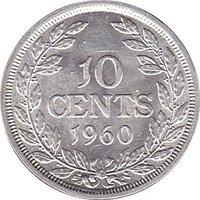
| 1960 | — | 500,000 | ||
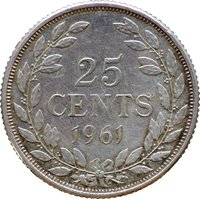
| 1961 | — | 7,000,000 | ||
| 1968 | — | 3,000,000 | ||
| 1968 | — | 14,000 | Proof | |
| 1969 | — | 5,056 | Proof | |
| 1970 | — | 3,464 | Proof | |
| 1971 | — | 3,032 | Proof | |
| 1972 | — | 10,000,000 | ||
| 1972 | — | 4,866 | Proof | |
| 1973 | — | 10,542 | Proof | |
| 1974 | — | 9,362 | Proof | |
| 1975 | — | 5,000,000 | ||
| 1975 | — | 4,056 | Proof | |
| 1976 | — | 1,000 | Proof | |
| 1977 | 1977-1990 | 2,500,920 | ||
| 1977 | — | 920 | Proof | |
| 1978 | FM | 7,311 | Proof | |
| 1983 | FM | 2,500,000 | ||
| 1984 | — | 2,500,000 |
Historical background
In 1960, Liberia's currency situation was defined by its unique relationship with the United States. The official currency was the Liberian dollar (LRD), which was pegged at par with the US dollar. This parity was not merely a policy choice but a practical necessity, as US currency circulated widely and was accepted as legal tender alongside the Liberian issue. This dual-currency system reflected Liberia's deep economic and historical ties with the US, facilitating trade and investment but also tethering the nation's monetary stability to the fiscal policies of a foreign power.
The economy was heavily dependent on exports of raw materials, particularly rubber from Firestone plantations and iron ore from newly developed mines. This export revenue, largely denominated in US dollars, helped support the currency peg. However, the monetary system was relatively underdeveloped, with a limited banking sector and most financial activity concentrated in the capital, Monrovia. The authority responsible for issuing currency was the Bank of Monrovia, a private institution that acted as the government's fiscal agent, as Liberia would not establish a central bank until 1974.
While the peg provided stability, it also exposed Liberia to the limitations of a currency board-style system. The money supply was effectively constrained by the country's holdings of US dollars, limiting the government's ability to use independent monetary policy for economic development. Furthermore, the widespread use of US cash in daily transactions underscored the informal dominance of a foreign currency within the national economy, a situation that presented both convenience and a symbolic challenge to full monetary sovereignty as the nation progressed through the mid-20th century.
The economy was heavily dependent on exports of raw materials, particularly rubber from Firestone plantations and iron ore from newly developed mines. This export revenue, largely denominated in US dollars, helped support the currency peg. However, the monetary system was relatively underdeveloped, with a limited banking sector and most financial activity concentrated in the capital, Monrovia. The authority responsible for issuing currency was the Bank of Monrovia, a private institution that acted as the government's fiscal agent, as Liberia would not establish a central bank until 1974.
While the peg provided stability, it also exposed Liberia to the limitations of a currency board-style system. The money supply was effectively constrained by the country's holdings of US dollars, limiting the government's ability to use independent monetary policy for economic development. Furthermore, the widespread use of US cash in daily transactions underscored the informal dominance of a foreign currency within the national economy, a situation that presented both convenience and a symbolic challenge to full monetary sovereignty as the nation progressed through the mid-20th century.
Series: 1960 Liberia circulation coins
🌱 Very Common