

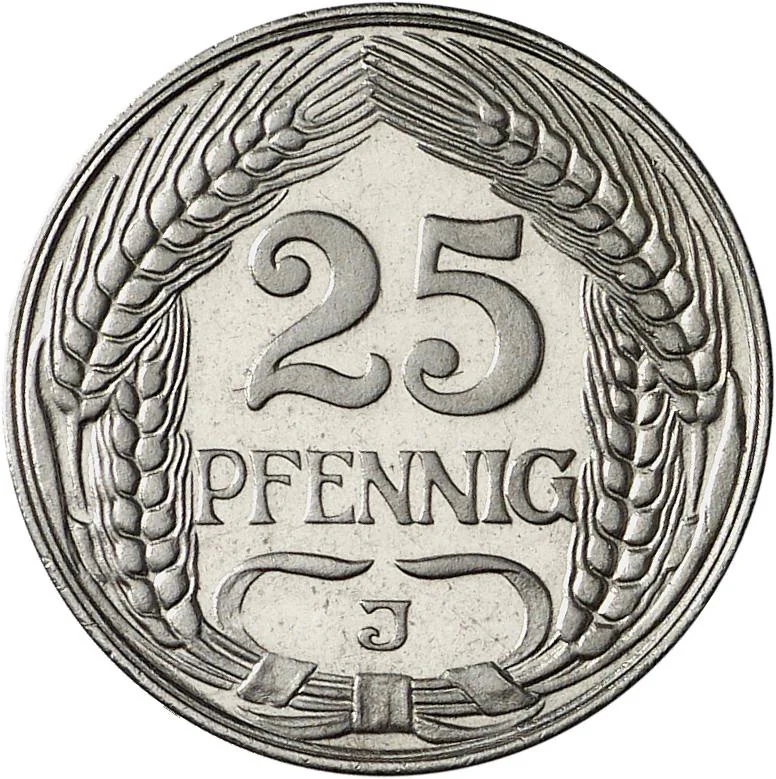
25 pfennigs – Germany
Add to wishlist
Germany
Context
Years: 1909–1912
Issuer: Germany
Ruler: William II
Currency:
(1873—1923)
Demonetization: 1 October 1918
Total mintage: 30,001,796
Material
References
KM: #
Numista: #4715
Obverse
Description:
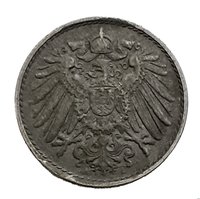
Imperial German Eagle emerging from a circle, with small shield. Lettering and date around rim.
Inscription:
• DEUTSCHES REICH 1909 •
Translation:
German Empire 1909
Script: Latin
Language: German
Engraver: Paul Sturm
Reverse
Description:
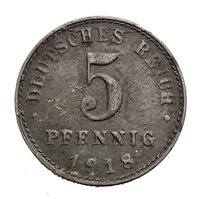
Large central denomination encircled by wheat wreath. Mintmark below.
Inscription:
25
PFENNIG
J
PFENNIG
J
Script: Latin
Engraver: Otto Schultz
Edge
Plain
Mints
| Name | Mark |
|---|---|
| Berlin | A |
| Munich | D |
| Muldenhütten | E |
| Staatliche Münze Baden-Württemberg | F |
| Staatliche Münze Baden-Württemberg | G |
| Hamburgische Münze | J |
Mintings
| Year | Mint Mark | Mintage | Quality | Collection |
|---|---|---|---|---|
| 1909 | D | 1,406,000 | ||
| 1909 | E | 250,000 | ||
| 1909 | F | 400,000 | ||
| 1909 | G | 609,824 | ||
| 1909 | J | 10,000 | ||
| 1909 | A | 962,260 | ||
| 1910 | A | 9,522,312 | ||
| 1910 | D | 1,408,001 | ||
| 1910 | E | 1,242,052 | ||
| 1910 | F | 1,604,747 | ||
| 1910 | G | 329,516 | ||
| 1910 | J | 1,561,260 | ||
| 1911 | A | 3,178,815 | ||
| 1911 | D | 506,109 | ||
| 1911 | E | 746,523 | ||
| 1911 | G | 892,224 | ||
| 1911 | J | 516,871 | ||
| 1912 | A | 2,590,220 | ||
| 1912 | D | 900,291 | ||
| 1912 | F | 1,002,745 | ||
| 1912 | J | 362,026 |
Historical background
In 1909, Germany's currency was firmly underpinned by the gold standard, having transitioned from a silver-based system following unification in 1871. The official currency was the Goldmark, a stable and trusted unit of account backed by the Reichsbank's gold reserves. This system facilitated Germany's rapid industrial expansion and integration into the global financial network, fostering significant domestic and international confidence in the Mark. However, this stability existed within a broader context of growing fiscal strain, as the imperial government, under Chancellor Bernhard von Bülow, was increasingly financing its ambitious naval arms race with Britain and expanding social programs through borrowing rather than taxation.
Beneath the surface of this metallic stability, monetary pressures were building. The Reichsbank's strict adherence to the gold standard limited its ability to expand the money supply freely, creating occasional liquidity crunches. More critically, the government's persistent budget deficits—the so-called "financial reform" crisis of 1909 centered on failed attempts to raise new taxes—meant the state was becoming increasingly reliant on short-term debt instruments. These Reichsschatzanweisungen (Treasury notes) were often monetized by the banking system, a practice that subtly increased the money supply without a corresponding increase in gold backing, planting early seeds for future inflationary risks.
Consequently, while the Mark in 1909 was still considered a pillar of strength, economists and some policymakers were growing concerned about the structural disconnect between sound currency management and unsound public finance. The political deadlock over fiscal reform highlighted the empire's difficulty in reconciling its military ambitions with financial prudence. Thus, the pre-war currency situation was one of robust institutional credibility paradoxically coupled with underlying fiscal vulnerabilities that would be catastrophically exposed under the immense financial pressures of the First World War just a few years later.
Beneath the surface of this metallic stability, monetary pressures were building. The Reichsbank's strict adherence to the gold standard limited its ability to expand the money supply freely, creating occasional liquidity crunches. More critically, the government's persistent budget deficits—the so-called "financial reform" crisis of 1909 centered on failed attempts to raise new taxes—meant the state was becoming increasingly reliant on short-term debt instruments. These Reichsschatzanweisungen (Treasury notes) were often monetized by the banking system, a practice that subtly increased the money supply without a corresponding increase in gold backing, planting early seeds for future inflationary risks.
Consequently, while the Mark in 1909 was still considered a pillar of strength, economists and some policymakers were growing concerned about the structural disconnect between sound currency management and unsound public finance. The political deadlock over fiscal reform highlighted the empire's difficulty in reconciling its military ambitions with financial prudence. Thus, the pre-war currency situation was one of robust institutional credibility paradoxically coupled with underlying fiscal vulnerabilities that would be catastrophically exposed under the immense financial pressures of the First World War just a few years later.
🌱 Very Common