

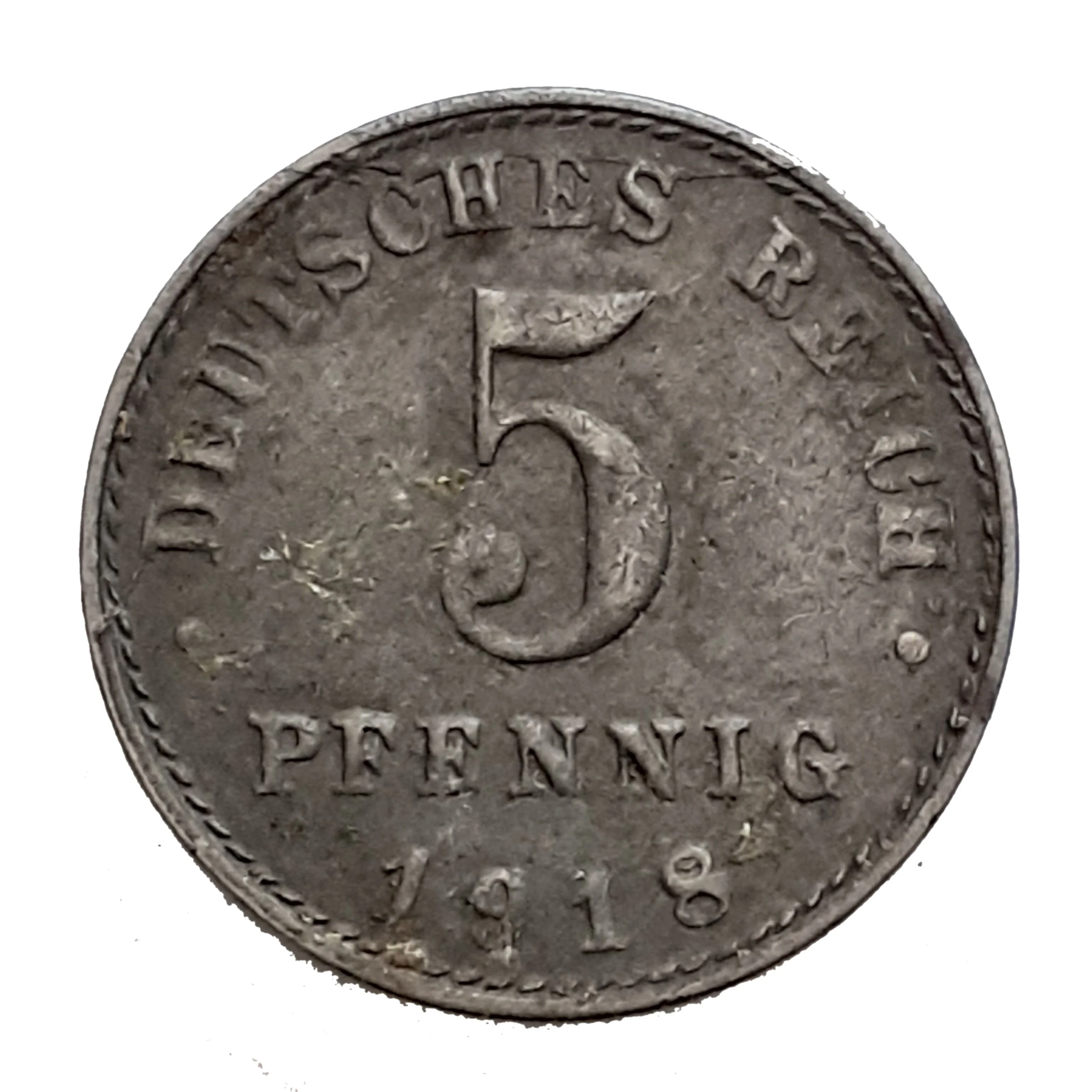
5 Pfennigs – Germany
Germany
Context
Years: 1915–1922
Issuer: Germany 
Ruler: William II
Currency:
(1873—1923)
Demonetization: 11 October 1924
Total mintage: 1,509,269,101
Material
References
KM: #Click to copy to clipboard19
Numista: #2587
Obverse
Description:
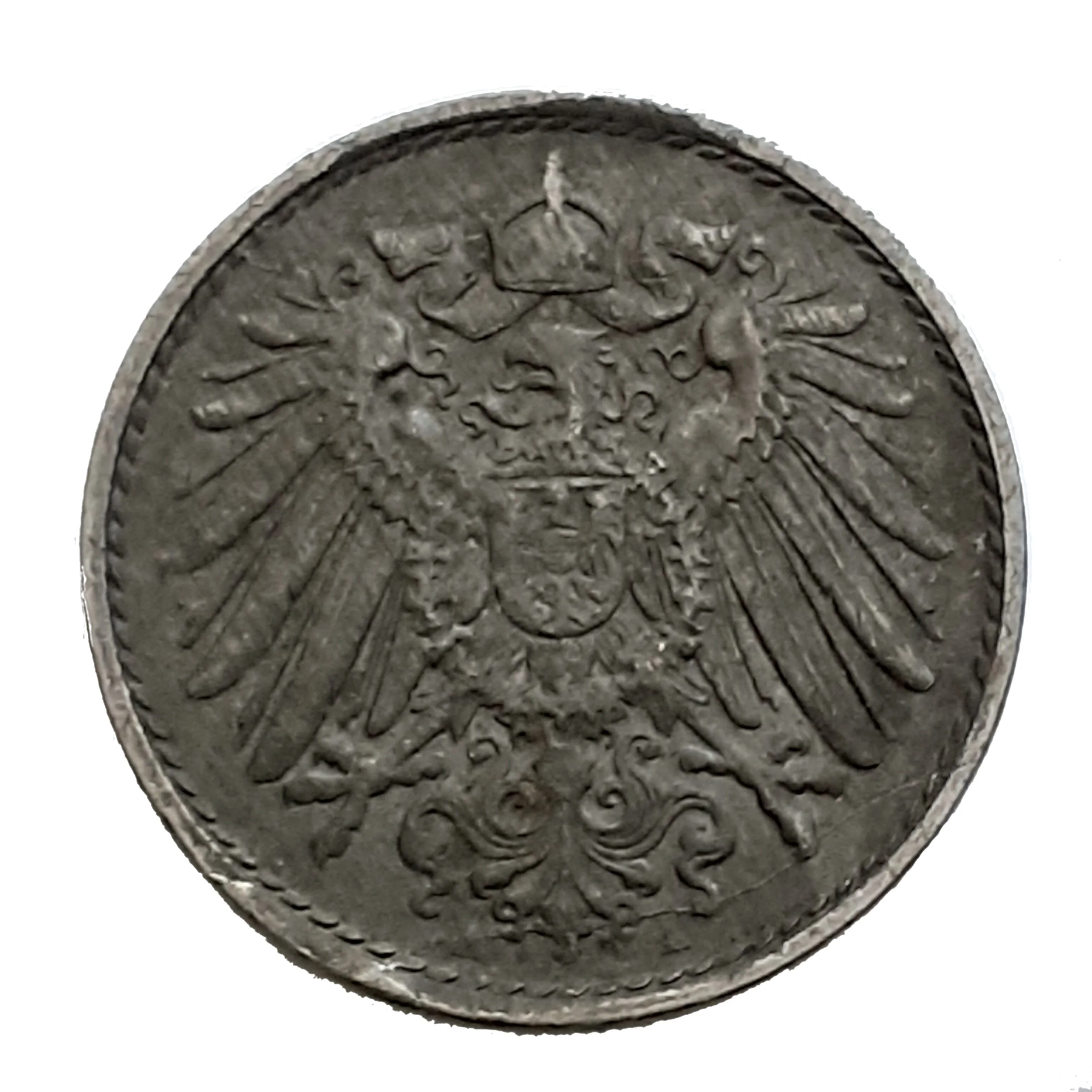
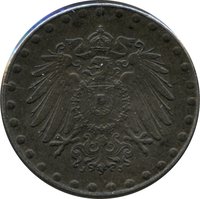
Imperial eagle coat of arms with mintmark repeated below scrollwork.
Inscription:
A A
Script: Latin
Reverse
Edge
Reeded
Mints
| Name | Mark |
|---|---|
| Berlin | A |
| Munich | D |
| Muldenhütten | E |
| Staatliche Münze Baden-Württemberg | F |
| Staatliche Münze Baden-Württemberg | G |
| Hamburgische Münze | J |
Mintings
| Year | Mint Mark | Mintage | Quality | Collection |
|---|---|---|---|---|
| 1915 | A | 34,631,166 | ||
| 1915 | D | 2,020,601 | ||
| 1915 | E | 4,670,000 | ||
| 1915 | F | 3,500,000 | ||
| 1915 | G | 3,675,740 | ||
| 1915 | J | 2,100,000 | ||
| 1916 | A | 51,003,241 | ||
| 1916 | D | 19,590,219 | ||
| 1916 | E | 2,271,795 | ||
| 1916 | G | 5,599,346 | ||
| 1916 | J | 10,252,730 | ||
| 1916 | F | 10,479,455 | ||
| 1917 | A | 87,315,059 | ||
| 1917 | D | 19,581,053 | ||
| 1917 | E | 11,092,000 | ||
| 1917 | F | 10,930,000 | ||
| 1917 | G | 6,719,725 | ||
| 1917 | J | 11,686,000 | ||
| 1918 | D | 29,129,936 | ||
| 1918 | E | 23,600,000 | ||
| 1918 | A | 223,515,570 | ||
| 1918 | F | 24,598,221 | ||
| 1918 | G | 12,696,764 | ||
| 1918 | J | 20,240,000 | ||
| 1919 | A | 112,101,659 | ||
| 1919 | D | 41,162,771 | ||
| 1919 | E | 20,608,000 | ||
| 1919 | F | 32,700,000 | ||
| 1919 | G | 13,925,267 | ||
| 1919 | J | 16,249,010 | ||
| 1920 | E | 11,646,000 | ||
| 1920 | F | 24,300,000 | ||
| 1920 | G | 10,243,807 | ||
| 1920 | J | 16,856,640 | ||
| 1920 | A | 80,299,683 | ||
| 1920 | D | 25,501,923 | ||
| 1921 | A | 143,418,372 | ||
| 1921 | D | 38,132,799 | ||
| 1921 | E | 21,104,000 | ||
| 1921 | F | 24,800,000 | ||
| 1921 | G | 21,289,023 | ||
| 1921 | J | 28,928,224 | ||
| 1922 | A | 89,062,488 | ||
| 1922 | D | 33,920,598 | ||
| 1922 | G | 19,708,394 | ||
| 1922 | E | 19,155,800 | ||
| 1922 | F | 16,436,000 | ||
| 1922 | J | 16,820,022 |
Historical background
By 1915, Germany’s currency situation was defined by the escalating financial pressures of World War I, marking a decisive break from the pre-war gold standard. At the outbreak of war in 1914, the government suspended the convertibility of the Reichsmark into gold, freeing itself from the discipline of metallic reserves. To finance the colossal cost of the conflict, the Reichsbank began a policy of monetizing state debt, essentially printing money to purchase government war bonds. This direct financing method was intended as a temporary measure but established a dangerous precedent of funding the war through monetary expansion rather than taxation or long-term public borrowing.
Consequently, the money supply began to increase significantly, while the production of civilian goods plummeted as the economy was redirected toward war matériel. This growing imbalance between the amount of money in circulation and the availability of consumer goods created the first strong underlying pressures for inflation. While severe hyperinflation was still years away, the foundational mechanics were already in motion. Prices were rising, but the full effect was partially masked by wage and price controls imposed by the state, alongside rationing of essential commodities like food and fuel.
Public confidence in the stability of the Reichsmark remained relatively intact in 1915, sustained by patriotic fervor and the widespread belief in a short, victorious war. However, the financial foundations were eroding. The government and central bank prioritized immediate military needs over currency stability, setting Germany on a path where the value of money became increasingly dependent on the war's outcome. The currency situation of 1915 was thus one of controlled but deliberate devaluation, a hidden economic sacrifice that would only fully unravel in the war’s aftermath and the crises of the early Weimar Republic.
Consequently, the money supply began to increase significantly, while the production of civilian goods plummeted as the economy was redirected toward war matériel. This growing imbalance between the amount of money in circulation and the availability of consumer goods created the first strong underlying pressures for inflation. While severe hyperinflation was still years away, the foundational mechanics were already in motion. Prices were rising, but the full effect was partially masked by wage and price controls imposed by the state, alongside rationing of essential commodities like food and fuel.
Public confidence in the stability of the Reichsmark remained relatively intact in 1915, sustained by patriotic fervor and the widespread belief in a short, victorious war. However, the financial foundations were eroding. The government and central bank prioritized immediate military needs over currency stability, setting Germany on a path where the value of money became increasingly dependent on the war's outcome. The currency situation of 1915 was thus one of controlled but deliberate devaluation, a hidden economic sacrifice that would only fully unravel in the war’s aftermath and the crises of the early Weimar Republic.

🌱 Very Common