

½ mark – Germany
Add to wishlist
Germany
Context
Years: 1905–1919
Issuer: Germany
Ruler: William II
Currency:
(1873—1923)
Demonetization: 20 April 1920
Total mintage: 324,849,679
Material
References
KM: #
Numista: #2340
Value
Bullion value: $6.39
Obverse
Description:
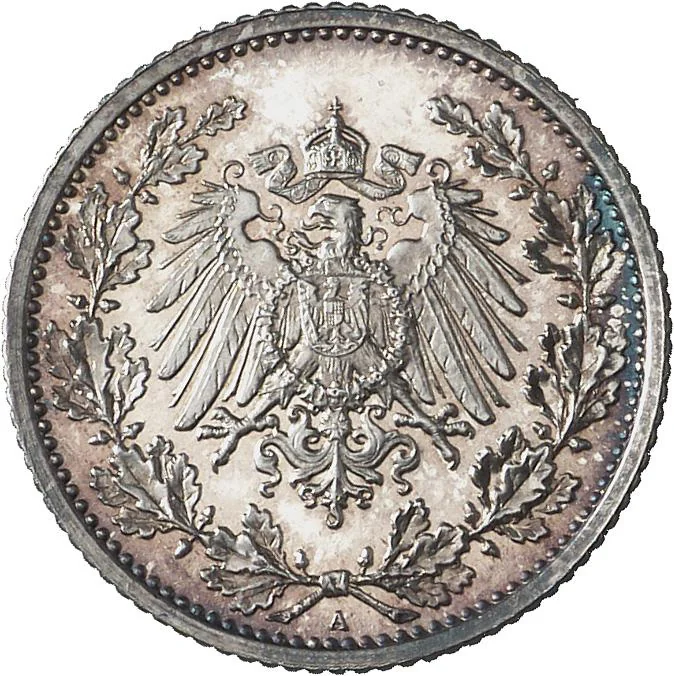
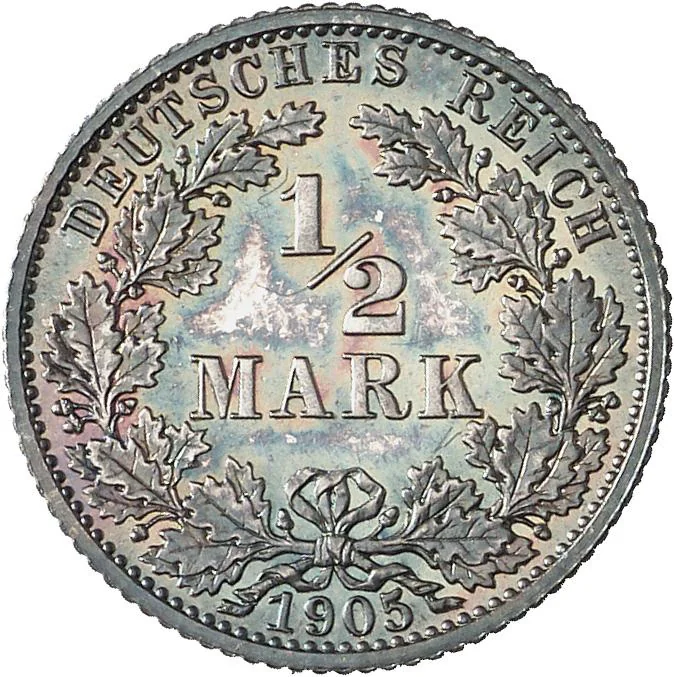
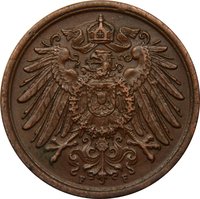
Imperial German Eagle with small shield (second type), within wreath, mintmark below.
Inscription:
A
Script: Latin
Reverse
Edge
Reeded
Mints
| Name | Mark |
|---|---|
| Berlin | A |
| Munich | D |
| Muldenhütten | E |
| Staatliche Münze Baden-Württemberg | F |
| Staatliche Münze Baden-Württemberg | G |
| Hamburgische Münze | J |
Mintings
| Year | Mint Mark | Mintage | Quality | Collection |
|---|---|---|---|---|
| 1905 | A | — | Proof | |
| 1905 | F | 6,310,359 | ||
| 1905 | G | 3,886,200 | ||
| 1905 | G | — | Proof | |
| 1905 | J | 6,315,907 | ||
| 1905 | A | 37,765,933 | ||
| 1905 | E | 4,907,755 | ||
| 1905 | D | 7,636,018 | ||
| 1906 | A | 29,753,852 | ||
| 1906 | D | 11,976,610 | ||
| 1906 | E | 5,821,109 | ||
| 1906 | F | 8,535,644 | ||
| 1906 | G | 4,272,502 | ||
| 1906 | J | 2,179,490 | ||
| 1907 | G | 926,763 | ||
| 1907 | J | 3,268,001 | ||
| 1907 | A | 14,168,313 | ||
| 1907 | D | 2,883,910 | ||
| 1907 | E | 600,000 | ||
| 1907 | F | 1,202,052 | ||
| 1908 | A | 5,018,434 | ||
| 1908 | D | 400,000 | ||
| 1908 | F | 1,000 | ||
| 1908 | G | 675,177 | ||
| 1908 | J | 1,308,500 | ||
| 1908 | E | 591,366 | ||
| 1909 | D | 1,000,832 | ||
| 1909 | E | 745,106 | ||
| 1909 | A | 5,403,769 | ||
| 1909 | F | 999,040 | ||
| 1909 | G | 606,929 | ||
| 1909 | J | 815,000 | ||
| 1911 | A | 2,709,600 | ||
| 1911 | D | 703,000 | ||
| 1911 | E | 375,963 | ||
| 1911 | F | 501,775 | ||
| 1911 | G | 610,000 | ||
| 1911 | J | 417,769 | ||
| 1912 | A | 2,709,400 | ||
| 1912 | D | 703,000 | ||
| 1912 | E | 369,036 | ||
| 1912 | F | 501,224 | ||
| 1912 | J | 399,231 | ||
| 1913 | G | 610,000 | ||
| 1913 | J | 817,000 | ||
| 1913 | A | 5,419,000 | ||
| 1913 | D | 1,406,000 | ||
| 1913 | F | 1,003,000 | ||
| 1913 | E | 745,000 | ||
| 1914 | A | 13,525,298 | ||
| 1914 | D | 328,180 | ||
| 1914 | J | 2,292,000 | ||
| 1915 | E | 3,380,000 | ||
| 1915 | F | 5,309,000 | ||
| 1915 | G | 2,730,000 | ||
| 1915 | J | 2,285,000 | ||
| 1915 | J | — | Proof | |
| 1915 | A | 13,014,879 | ||
| 1915 | D | 5,116,532 | ||
| 1916 | A | 9,749,580 | ||
| 1916 | D | 4,397,288 | ||
| 1916 | E | 1,640,000 | ||
| 1916 | F | 2,410,070 | ||
| 1916 | G | 1,779,141 | ||
| 1916 | J | 1,464,000 | ||
| 1917 | J | 1,038,808 | ||
| 1917 | A | 14,691,548 | ||
| 1917 | D | 978,586 | ||
| 1917 | E | 1,561,329 | ||
| 1917 | F | 450,000 | ||
| 1917 | G | 618,631 | ||
| 1918 | A | 14,622,274 | ||
| 1918 | D | 3,670,442 | ||
| 1918 | E | 2,807,238 | ||
| 1918 | F | 4,010,000 | ||
| 1918 | G | 1,032,314 | ||
| 1918 | J | 3,452,000 | ||
| 1919 | A | 9,123,578 | ||
| 1919 | F | 1,558,961 | ||
| 1919 | J | 1,875,142 | ||
| 1919 | D | 2,195,344 | ||
| 1919 | E | 1,766,947 |
Historical background
In 1905, Germany's currency was firmly anchored to the gold standard under the framework of the Reichsbank Act of 1875. The official currency was the Goldmark, a stable and trusted unit of account backed by the nation's substantial gold reserves. This system, established following the unification of the German Empire, had successfully ended the fragmentation of regional currencies and provided the financial stability that underpinned Germany's rapid industrial expansion. The Reichsbank, as the central bank, was obligated to redeem paper Reichsbanknotes for gold upon demand, ensuring confidence in the monetary system both domestically and in international trade.
Despite this overarching stability, the actual circulation consisted primarily of state-issued paper banknotes and token silver coins. Gold coins, like the 10 and 20 Mark pieces, were legal tender but were less common in everyday transactions, often held as a store of value or used for large settlements. The money supply was carefully managed, but economists and policymakers were engaged in quiet debates about its adequacy to fuel continued economic growth, with some concern that the strict gold coverage rules might be too inflexible during periods of financial stress.
The period was one of calm before the storm. Germany's currency was strong, reflecting the nation's economic power and fiscal discipline. However, the financial demands of the naval arms race with Britain and escalating military preparedness were beginning to strain public finances. While not yet apparent in 1905, the pressures that would eventually lead to the abandonment of the gold standard to fund the First World War, resulting in the disastrous hyperinflation of the early 1920s, were subtly accumulating beneath the surface of this seemingly robust monetary order.
Despite this overarching stability, the actual circulation consisted primarily of state-issued paper banknotes and token silver coins. Gold coins, like the 10 and 20 Mark pieces, were legal tender but were less common in everyday transactions, often held as a store of value or used for large settlements. The money supply was carefully managed, but economists and policymakers were engaged in quiet debates about its adequacy to fuel continued economic growth, with some concern that the strict gold coverage rules might be too inflexible during periods of financial stress.
The period was one of calm before the storm. Germany's currency was strong, reflecting the nation's economic power and fiscal discipline. However, the financial demands of the naval arms race with Britain and escalating military preparedness were beginning to strain public finances. While not yet apparent in 1905, the pressures that would eventually lead to the abandonment of the gold standard to fund the First World War, resulting in the disastrous hyperinflation of the early 1920s, were subtly accumulating beneath the surface of this seemingly robust monetary order.

🌱 Very Common