

1 dinero – Peru
Add to wishlist
Peru
Obverse
Description:
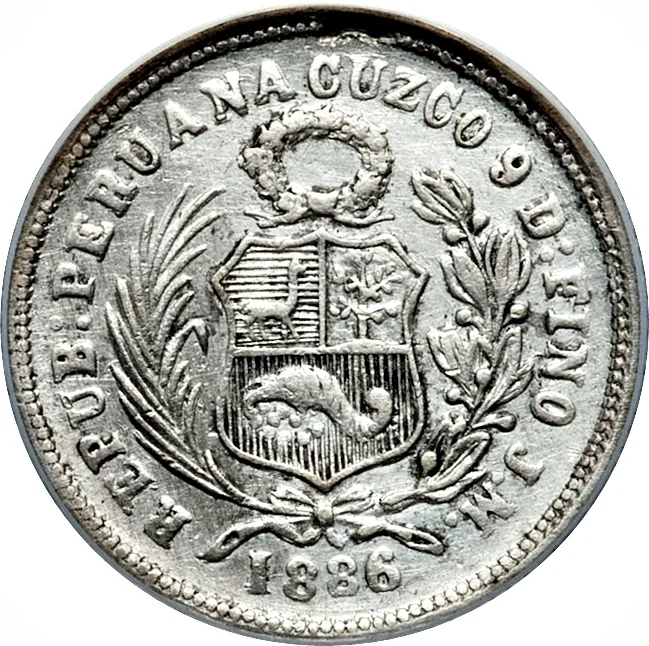
Coat of arms encircled by legend, year below.
Inscription:
REPUB.PERUANA CUZCO 9 D : FINO J.M.
1886
1886
Script: Latin
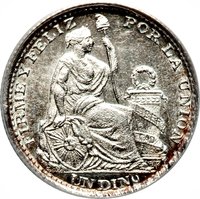
Reverse
Edge
Categories
| Symbol> Phrygian cap |
| Symbol> Sun |
| Animal> Camel |
| Symbols> Coat of Arms |
| Symbol> Cornucopia |
| Symbol> Wreath |
Mints
| Name | Mark |
|---|---|
| Cusco | — |
Mintings
| Year | Mint Mark | Mintage | Quality | Collection |
|---|---|---|---|---|
| 1886 | JM | — |
Historical background
In 1886, Peru was emerging from the devastating War of the Pacific (1879-1884), a conflict that left its economy shattered and its national finances in ruins. The Chilean occupation of Lima had ended only two years prior, and the country was burdened by immense foreign debt and the loss of its nitrate-rich southern territories, a critical source of revenue. The national treasury was virtually empty, and the monetary system was in a state of profound disorder, characterized by a severe shortage of circulating specie (gold and silver coins) and a confusing multiplicity of paper currencies whose value had collapsed during the war.
The currency landscape was a chaotic patchwork. The government had issued vast quantities of unbacked paper money, known as billetes fiscales, to finance the war effort, leading to rampant inflation and a deep public distrust of fiat currency. Alongside this devalued paper circulated Peruvian silver soles, old Bolivian and Chilean coins, and even private banknotes from institutions whose solvency was questionable. The most significant and stable currency in practice was the British gold pound sterling, which became the preferred medium for large transactions and international trade, underscoring the collapse of faith in the national monetary system and the depth of foreign economic influence.
Facing this crisis, the government of President Andrés A. Cáceres, advised by Finance Minister Manuel del Villar, embarked on a rigorous program of fiscal reconstruction. The cornerstone of their monetary policy in 1886 was the effort to restore the silver standard and retire the discredited paper money. This was part of a broader, painful austerity plan negotiated with foreign creditors (the Grace Contract) to restructure the national debt. Thus, the currency situation of 1886 was one of painful transition, defined by the struggle to impose order on monetary chaos, re-establish international credit, and lay the foundation for a single, trusted national currency—a process that would take years to fully accomplish.
The currency landscape was a chaotic patchwork. The government had issued vast quantities of unbacked paper money, known as billetes fiscales, to finance the war effort, leading to rampant inflation and a deep public distrust of fiat currency. Alongside this devalued paper circulated Peruvian silver soles, old Bolivian and Chilean coins, and even private banknotes from institutions whose solvency was questionable. The most significant and stable currency in practice was the British gold pound sterling, which became the preferred medium for large transactions and international trade, underscoring the collapse of faith in the national monetary system and the depth of foreign economic influence.
Facing this crisis, the government of President Andrés A. Cáceres, advised by Finance Minister Manuel del Villar, embarked on a rigorous program of fiscal reconstruction. The cornerstone of their monetary policy in 1886 was the effort to restore the silver standard and retire the discredited paper money. This was part of a broader, painful austerity plan negotiated with foreign creditors (the Grace Contract) to restructure the national debt. Thus, the currency situation of 1886 was one of painful transition, defined by the struggle to impose order on monetary chaos, re-establish international credit, and lay the foundation for a single, trusted national currency—a process that would take years to fully accomplish.
💎 Very Rare