

Obverse
Description:
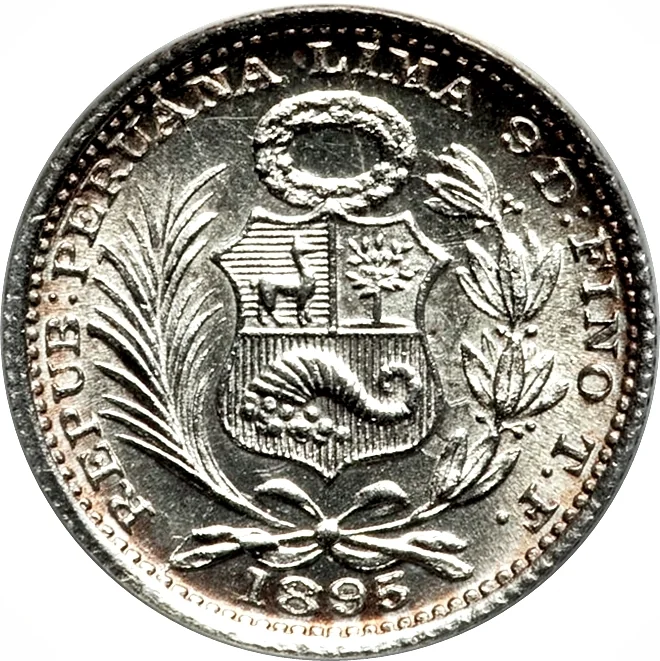
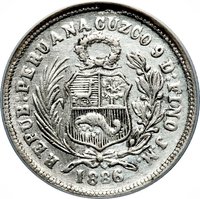
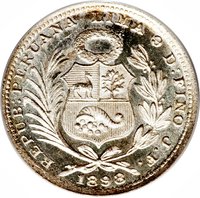
Coat of arms with surrounding legend and date below.
Inscription:
REPUB.PERUANA LIMA 9 D : FINO T.F.
1895
1895
Script: Latin
Reverse
Edge
Reeded
Categories
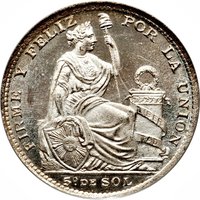
| Symbol> Sun |
| Symbol> Wreath |
| Animal> Camel |
| Symbol> Allegory |
| Symbols> Coat of Arms |
| Symbol> Cornucopia |
| Symbol> Phrygian cap |
Mintings
| Year | Mint Mark | Mintage | Quality | Collection |
|---|---|---|---|---|
| 1888 | — | 10,000 | ||
| 1890 | — | 400,000 | ||
| 1891 | — | 60,000 | ||
| 1892 | — | 69,000 | ||
| 1893 | TF | 23,000 | ||
| 1894 | TF | — | ||
| 1895 | TF | 90,000 | ||
| 1896 | F | — | ||
| 1896 | TF | 534,000 | ||
| 1897 | JF | 511,000 | ||
| 1897 | VN | — | ||
| 1898 | JF | 200,000 | ||
| 1900 | JF | 550,000 | ||
| 1902 | JF | 375,000 | ||
| 1903 | JF | 887,000 | ||
| 1904 | JF | 380,000 | ||
| 1905 | JF | 700,000 | ||
| 1906 | JF | 826,000 | ||
| 1907 | FG | — | ||
| 1907 | JF | 500,000 | ||
| 1908 | FG | — | ||
| 1908 | JF | — | ||
| 1908 | GF | — | ||
| 1909 | FF | — | ||
| 1909 | FG | — | ||
| 1909 | FO | — | ||
| 1910 | JF | — | ||
| 1910 | FG | — | ||
| 1910 | JG | — | ||
| 1911 | FG | — | ||
| 1911 | JF | — | ||
| 1911 | JG | — | ||
| 1912 | FG | — | ||
| 1912 | JF | — | ||
| 1912 | JG | — | ||
| 1913 | FG | — | ||
| 1913 | JF | — | ||
| 1913 | JG | — | ||
| 1916 | FF | — | ||
| 1916 | FG | — | ||
| 1916 | JG | — |
Historical background
In 1888, Peru was navigating the turbulent aftermath of the War of the Pacific (1879-1884), a conflict that had left the nation's economy and fiscal sovereignty in ruins. The war concluded with the Treaty of Ancón, which ceded the nitrate-rich province of Tarapacá to Chile and placed the provinces of Tacna and Arica under Chilean control for a decade. This loss was catastrophic, as nitrate exports had been Peru's primary source of government revenue and foreign currency. The national treasury was empty, foreign debt was in default, and the country faced the monumental task of physical and economic reconstruction without its most valuable export commodity.
The currency situation was characterized by severe instability and a fragmented monetary system. The Peruvian government, under President Andrés A. Cáceres, had resumed payments on its massive external debt through the Grace Contract of 1888, which traded sovereign debt for control of the nation's railways and other assets. Domestically, the silver sol, the official currency, was under intense pressure. Global silver prices were in decline, leading to the flight of full-weight silver coins (Gresham's Law), while debased and counterfeit coins circulated widely. Simultaneously, paper money issued by private banks and even municipalities further complicated the monetary landscape, creating confusion and eroding public trust in the currency.
Consequently, 1888 represented a low point of monetary disarray, setting the stage for future reforms. The government lacked the central authority and bullion reserves to impose a uniform and stable currency. This period of fragmentation and depreciation would eventually lead to the creation of the Banco de Reserva del Perú in the 1920s and the introduction of a new gold-standard sol. However, in the immediate wake of the war, the currency situation reflected a broader national crisis—a struggling state attempting to rebuild its fiscal foundations amidst bankruptcy, territorial loss, and a severely damaged productive capacity.
The currency situation was characterized by severe instability and a fragmented monetary system. The Peruvian government, under President Andrés A. Cáceres, had resumed payments on its massive external debt through the Grace Contract of 1888, which traded sovereign debt for control of the nation's railways and other assets. Domestically, the silver sol, the official currency, was under intense pressure. Global silver prices were in decline, leading to the flight of full-weight silver coins (Gresham's Law), while debased and counterfeit coins circulated widely. Simultaneously, paper money issued by private banks and even municipalities further complicated the monetary landscape, creating confusion and eroding public trust in the currency.
Consequently, 1888 represented a low point of monetary disarray, setting the stage for future reforms. The government lacked the central authority and bullion reserves to impose a uniform and stable currency. This period of fragmentation and depreciation would eventually lead to the creation of the Banco de Reserva del Perú in the 1920s and the introduction of a new gold-standard sol. However, in the immediate wake of the war, the currency situation reflected a broader national crisis—a struggling state attempting to rebuild its fiscal foundations amidst bankruptcy, territorial loss, and a severely damaged productive capacity.

🌱 Common