

2 Francs – France
France
Context
Years: 1806–1807
Issuer: France 
Ruler: Napoleon I
Currency:
(1795—1959)
Demonetization: 17 June 1868
Total mintage: 503,627
Material
References
KM: #Click to copy to clipboard658
Numista: #46566
Value
Bullion value: $25.95
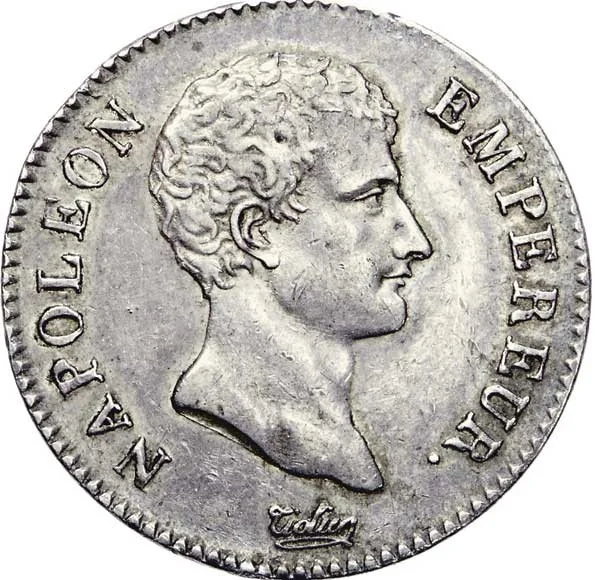
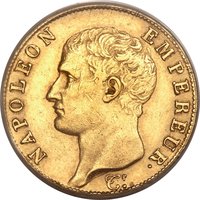
Obverse
Description:
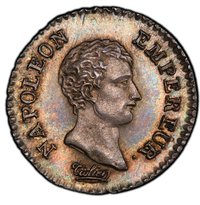
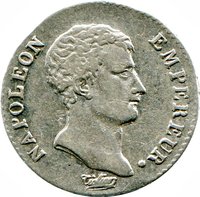
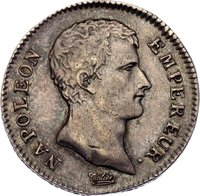
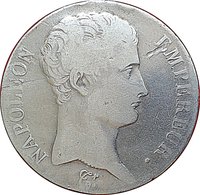
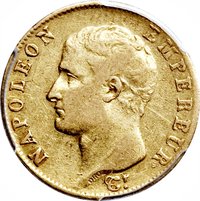
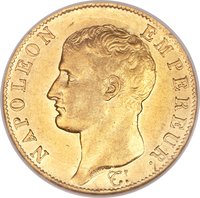
Napoleon's bare head on the right.
Inscription:
NAPOLEON EMPEREUR.
Translation:
NAPOLEON EMPEROR.
Script: Latin
Language: French
Engraver: Pierre-Joseph Tiolier
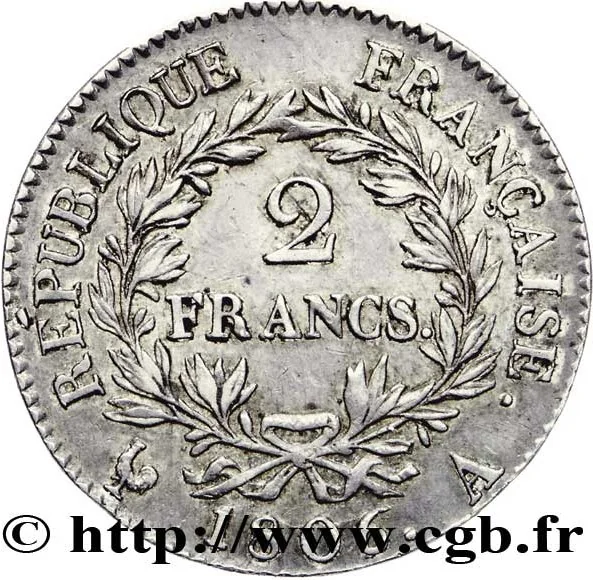
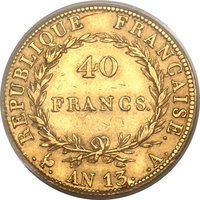
Reverse
Description:
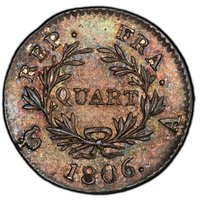
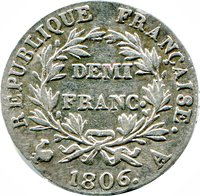
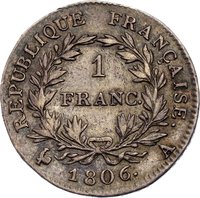
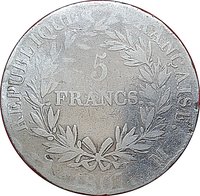
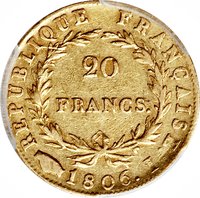
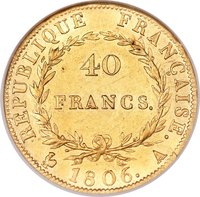
A crown of olive branches tied at the base by a ribbon.
Inscription:
RÉPUBLIQUE FRANÇAISE.
2
FRANCS
2
FRANCS
Translation:
FRENCH REPUBLIC.
2
FRANCS
2
FRANCS
Script: Latin
Language: French
Engraver: Pierre-Joseph Tiolier
Edge
Inscribed in hollow.
Legend:
DIEU PROTEGE LA FRANCE
Translation:
God protect France.
Language: French
Mints
| Name | Mark |
|---|---|
| Monnaie de Paris | A |
| Rouen | B |
| Strasbourg | BB |
| Lyon | D |
| Limoges | I |
| Bordeaux | K |
| Bayonne | L |
| Marseille | MA |
| Perpignan | Q |
| Turin | U |
| Lille | W |
Mintings
Historical background
In 1806, France's currency situation was fundamentally shaped by Napoleon Bonaparte's consolidation of power and his drive for economic stability. The hyperinflation and financial chaos of the Revolutionary assignats and mandats were a recent, traumatic memory. To restore confidence, Napoleon had established the Banque de France in 1800, granting it the exclusive right to issue paper money in Paris. However, the franc itself, officially the franc germinal after the 1803 law that created it, was a bimetallic currency. Its value was firmly pegged to both gold and silver at a fixed ratio, aiming to provide a solid, predictable monetary standard for commerce and state finance.
Despite this reform, the reality in 1806 was one of ongoing strain and limited reach. The Banque de France's notes were trusted in the capital but circulated poorly in the provinces, where a more traditional, specie-based economy persisted. Furthermore, Napoleon's continuous and costly military campaigns, notably against the Third Coalition, placed immense pressure on state finances. The government relied heavily on war indemnities extracted from defeated nations and on forced loans to fund its operations, practices that risked undermining the very stability the new franc was designed to create.
Consequently, 1806 represents a pivotal year of further institutional strengthening. On April 22, Napoleon signed the decree that made the Banque de France a truly national institution, with the exclusive right to issue banknotes across the entire country and under enhanced state control. This move was a direct attempt to unify the monetary space, centralize credit for the state's needs, and finally eradicate the lingering distrust of paper money. Thus, the currency situation was in transition—from the successful establishment of a stable metallic standard to the more challenging project of imposing a unified, state-backed paper currency on a war-driven economy.
Despite this reform, the reality in 1806 was one of ongoing strain and limited reach. The Banque de France's notes were trusted in the capital but circulated poorly in the provinces, where a more traditional, specie-based economy persisted. Furthermore, Napoleon's continuous and costly military campaigns, notably against the Third Coalition, placed immense pressure on state finances. The government relied heavily on war indemnities extracted from defeated nations and on forced loans to fund its operations, practices that risked undermining the very stability the new franc was designed to create.
Consequently, 1806 represents a pivotal year of further institutional strengthening. On April 22, Napoleon signed the decree that made the Banque de France a truly national institution, with the exclusive right to issue banknotes across the entire country and under enhanced state control. This move was a direct attempt to unify the monetary space, centralize credit for the state's needs, and finally eradicate the lingering distrust of paper money. Thus, the currency situation was in transition—from the successful establishment of a stable metallic standard to the more challenging project of imposing a unified, state-backed paper currency on a war-driven economy.
Series: 1806 France circulation coins
💎 Very Rare