

40 francs – France
Add to wishlist
France
Context
Years: 1804–1805
Issuer: France
Ruler: Napoleon I
Currency:
(1795—1959)
Demonetization: 25 June 1928
Total mintage: 372,012
Material
References
KM: #
Numista: #18609
Value
Bullion value: $1807.52
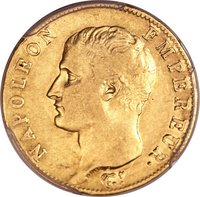
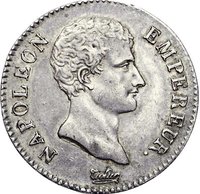
Obverse
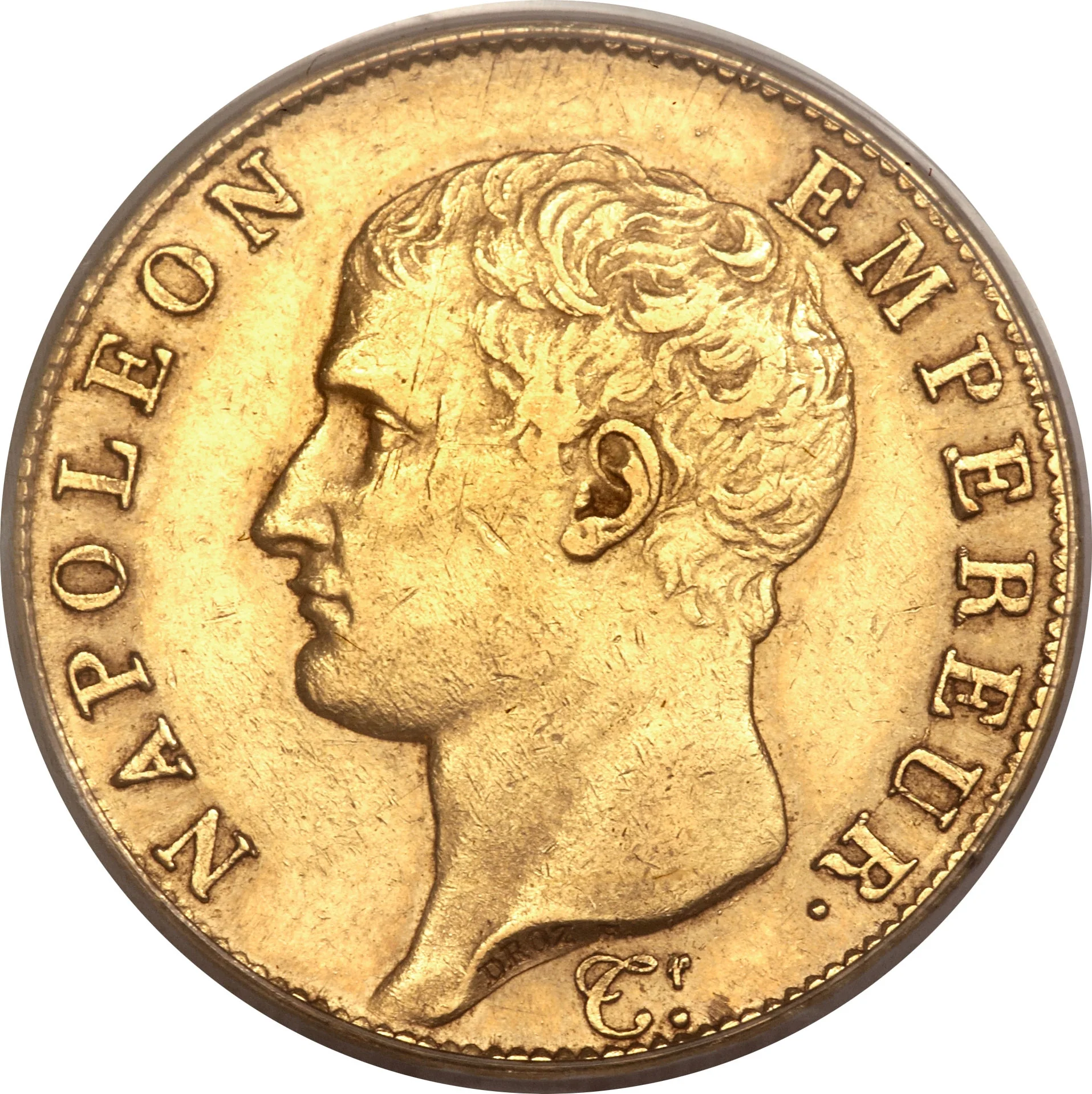
Inscription:
NAPOLEON EMPEREUR.
Translation:
NAPOLEON EMPEROR.
Script: Latin
Language: French
Engraver: Pierre-Joseph Tiolier
Reverse
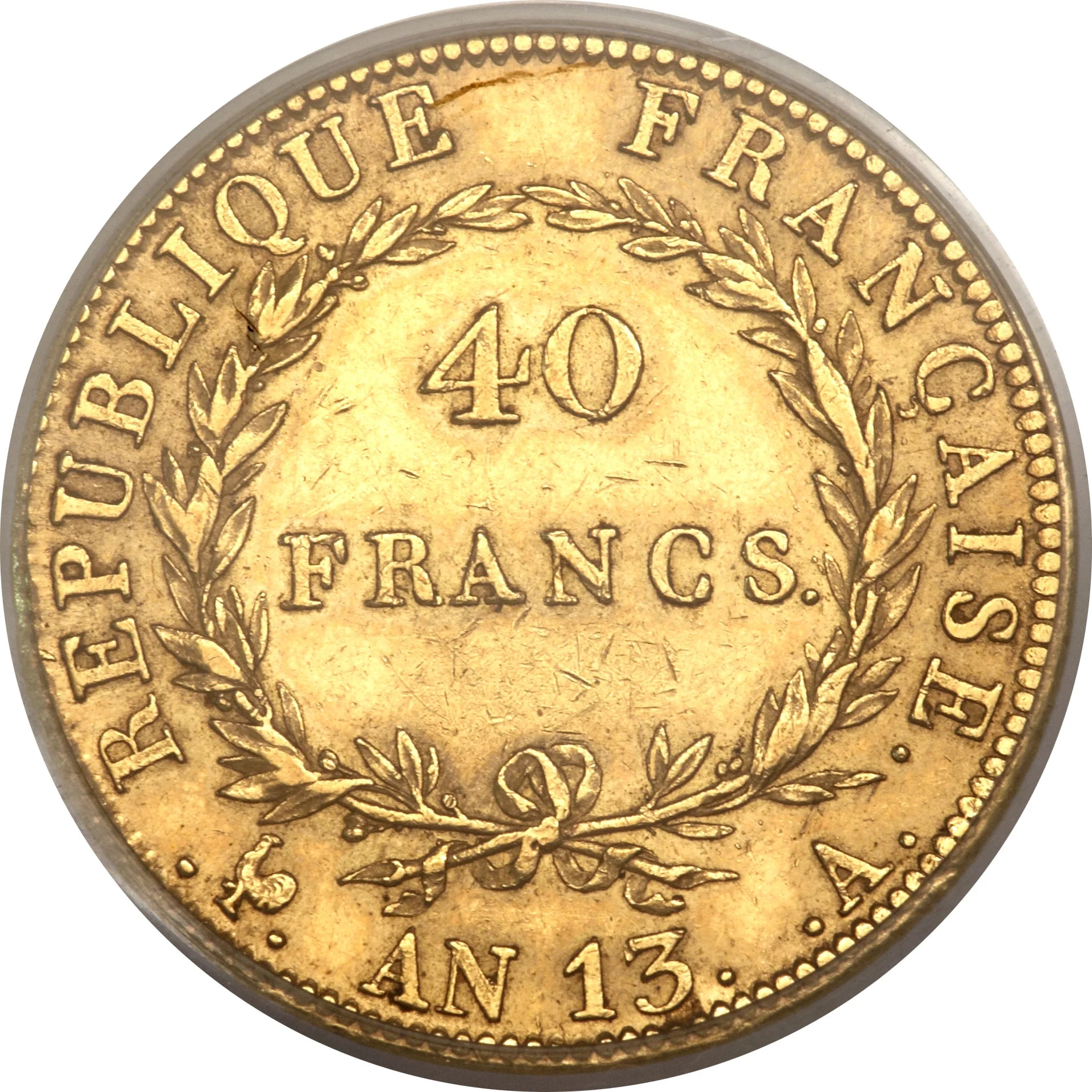
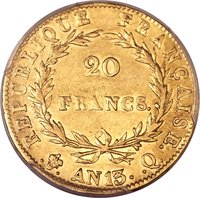
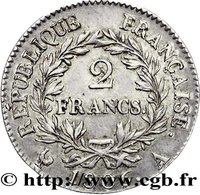
Inscription:
REPUBLIQUE FRANÇAISE.
40
FRANCS.
. . AN 13. .A.
40
FRANCS.
. . AN 13. .A.
Translation:
FRENCH REPUBLIC.
40
FRANCS.
. . YEAR 13. .A.
40
FRANCS.
. . YEAR 13. .A.
Script: Latin
Language: French
Engraver: Pierre-Joseph Tiolier
Edge
Mints
| Name | Mark |
|---|---|
| Monnaie de Paris | A |
| Turin | U |
| Lille | W |
Mintings
| Year | Mint Mark | Mintage | Quality | Collection |
|---|---|---|---|---|
| 1804 | — | 251,191 | ||
| 1805 | — | 120,821 |
Historical background
In 1804, France’s currency situation was in a critical period of stabilization and reform under the Consulate, with Napoleon Bonaparte being proclaimed Emperor in May of that year. The financial chaos of the Revolutionary era—marked by the hyperinflation of the assignat and mandat paper currencies—had been recently addressed. A key achievement was the creation of the Franc Germinal by the law of 7 Germinal, Year XI (March 28, 1803), which established a bimetallic standard. This law defined the franc as containing 4.5 grams of fine silver or 0.290322 grams of fine gold, fixing a legal ratio between gold and silver of 15.5 to 1. This provided a stable, reliable monetary unit for the first time in over a decade.
The reform was orchestrated by Napoleon and his financial experts, notably the Minister of Finance, Martin-Michel-Charles Gaudin. The primary goals were to restore public confidence in the currency, facilitate commerce, and fund the state's operations and military campaigns without resorting to discredited paper money. The new system was managed by the newly established Banque de France (founded in 1800), which held a monopoly on note issuance in Paris. Its notes, convertible into specie (precious metal), began to gain trust, though hard coinage, including the iconic 20-franc gold "Napoléon" coin, remained the dominant and preferred medium for everyday transactions and savings.
Consequently, by 1804, France possessed a modern, stable metallic currency that underpinned its economic revival and imperial ambitions. However, the system faced ongoing pressures. The costs of continuous warfare strained the treasury, leading to increased borrowing and occasional manipulations of the Bank's reserves. Furthermore, while the Franc Germinal brought domestic stability, its bimetallic standard would eventually face international arbitrage pressures as global gold and silver market values fluctuated. Nonetheless, in 1804, the currency framework was a cornerstone of Napoleon's consolidation of power, representing a decisive break from the financial turmoil of the 1790s.
The reform was orchestrated by Napoleon and his financial experts, notably the Minister of Finance, Martin-Michel-Charles Gaudin. The primary goals were to restore public confidence in the currency, facilitate commerce, and fund the state's operations and military campaigns without resorting to discredited paper money. The new system was managed by the newly established Banque de France (founded in 1800), which held a monopoly on note issuance in Paris. Its notes, convertible into specie (precious metal), began to gain trust, though hard coinage, including the iconic 20-franc gold "Napoléon" coin, remained the dominant and preferred medium for everyday transactions and savings.
Consequently, by 1804, France possessed a modern, stable metallic currency that underpinned its economic revival and imperial ambitions. However, the system faced ongoing pressures. The costs of continuous warfare strained the treasury, leading to increased borrowing and occasional manipulations of the Bank's reserves. Furthermore, while the Franc Germinal brought domestic stability, its bimetallic standard would eventually face international arbitrage pressures as global gold and silver market values fluctuated. Nonetheless, in 1804, the currency framework was a cornerstone of Napoleon's consolidation of power, representing a decisive break from the financial turmoil of the 1790s.
⭐ Somewhat Rare