

5 Pesetas – Spain
Spain
Context
Years: 1882–1885
Issuer: Spain 
Ruler: Alfonso XII
Currency:
(1868—2001)
Demonetization: 20 February 1939
Total mintage: 11,355,278
Material
References
KM: #Click to copy to clipboard688
Numista: #14843
Value
Exchange value: 5 ESP
Bullion value: $65.27
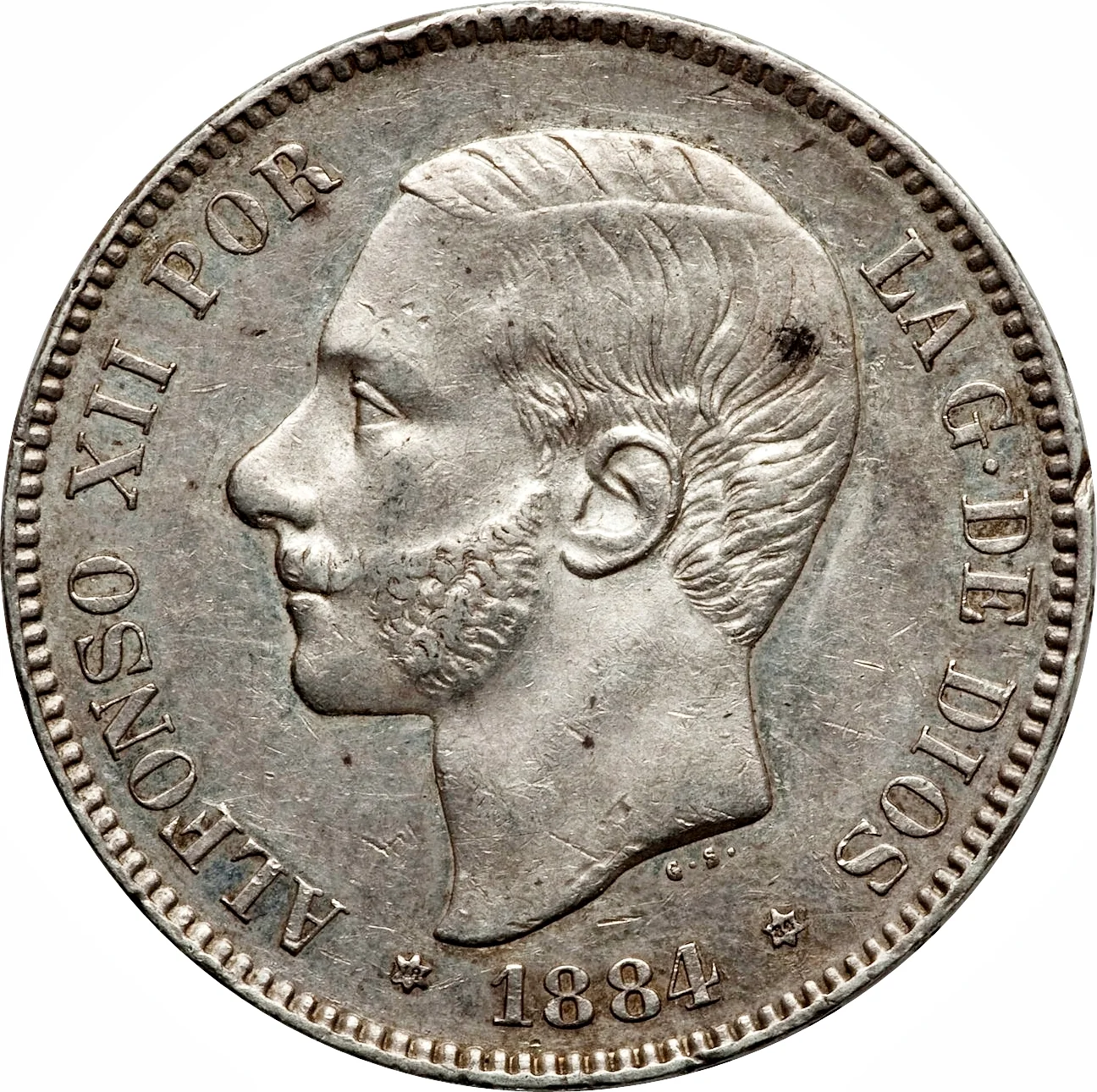
Obverse
Description:
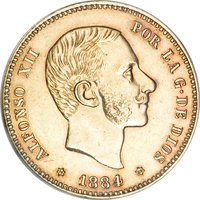
King Alfonso XII facing left.
Inscription:
ALFONSO XII POR LA G· DE DIOS
G· S·
🟌 1884 🟌
G· S·
🟌 1884 🟌
Translation:
By the grace of God, Alfonso XII
Sovereign
🟌 1884 🟌
Sovereign
🟌 1884 🟌
Script: Latin
Language: Spanish
Engraver: Gregorio Sellán y González
Reverse
Description:
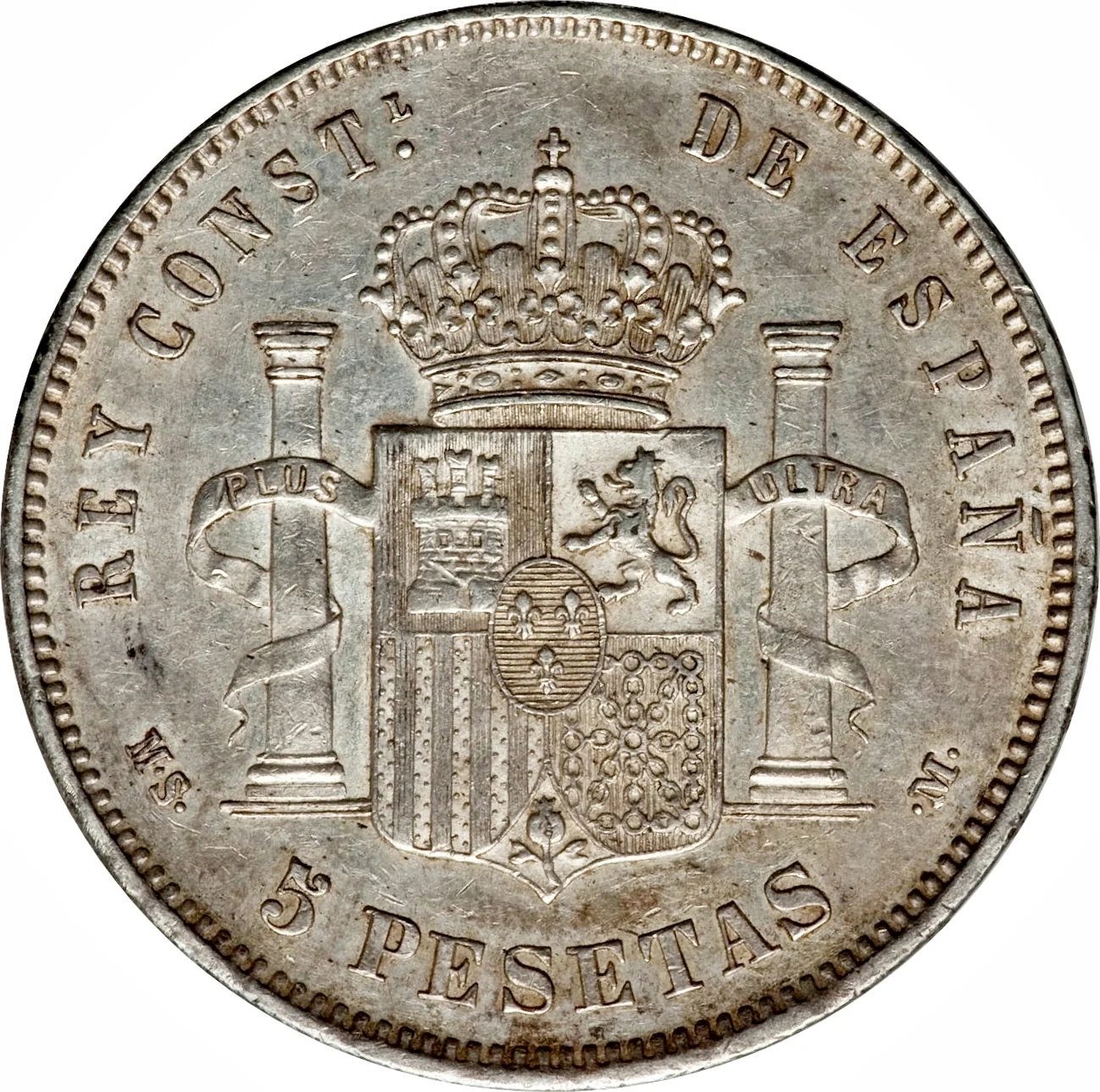
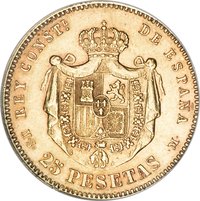
Spanish coat of arms with the Pillars of Hercules.
Inscription:
REY CONSTL. DE ESPAÑA
PLUS ULTRA
M·S· 5 PESETAS ·M·
PLUS ULTRA
M·S· 5 PESETAS ·M·
Translation:
KING CONSTITUTIONAL OF SPAIN
MORE BEYOND
M·S· 5 PESETAS ·M·
MORE BEYOND
M·S· 5 PESETAS ·M·
Script: Latin
Engraver: Gregorio Sellán y González
Edge
27 fleur-de-lis (⚜)
Categories
| Person> Monarch |
| Symbols> Coat of Arms |
Mints
| Name | Mark |
|---|---|
| Royal Mint of Madrid | 🟌 |
Historical background
In 1882, Spain's currency situation was defined by the ongoing struggle to establish a stable and unified monetary system following the political and economic turbulence of the 19th century. The country was officially on a bimetallic standard (gold and silver), as established by the 1868 Latin Monetary Union-inspired law, which introduced the peseta as the sole national currency. However, in practice, the system was strained and effectively operated on a silver standard. Large budget deficits, foreign debt payments, and a lack of substantial gold reserves made maintaining a true gold convertibility impossible, leaving the silver-based peseta vulnerable to international fluctuations in the price of silver.
This period was marked by significant currency depreciation. The global decline in the value of silver, driven by increased production from new mines and the adoption of the gold standard by major trading partners like France and Germany, caused the peseta's external value to fall steadily. This depreciation increased the cost of imports and servicing foreign debt, which was denominated in gold-backed currencies, thereby exacerbating Spain's fiscal problems. Internally, the circulation was chaotic, with older regional coins (like the duro) still in use alongside the peseta, and a proliferation of small-denomination token coins issued by private banks and municipalities to alleviate a chronic shortage of fractional currency.
Consequently, the Spanish government faced mounting pressure to join the international shift toward the gold standard to stabilize trade and finance, but the state's fragile finances and persistent trade deficits made this transition impossible. The debate between metalistas (advocates for a metallic standard) and papelistas (proponents of fiduciary currency) was intense. The year 1882 itself saw no major monetary reform, but it existed within a critical decade of deliberation that would ultimately lead to the de facto "paper standard" of the 1890s, where the peseta, no longer freely convertible, became a managed currency, reflecting Spain's peripheral economic position in Europe.
This period was marked by significant currency depreciation. The global decline in the value of silver, driven by increased production from new mines and the adoption of the gold standard by major trading partners like France and Germany, caused the peseta's external value to fall steadily. This depreciation increased the cost of imports and servicing foreign debt, which was denominated in gold-backed currencies, thereby exacerbating Spain's fiscal problems. Internally, the circulation was chaotic, with older regional coins (like the duro) still in use alongside the peseta, and a proliferation of small-denomination token coins issued by private banks and municipalities to alleviate a chronic shortage of fractional currency.
Consequently, the Spanish government faced mounting pressure to join the international shift toward the gold standard to stabilize trade and finance, but the state's fragile finances and persistent trade deficits made this transition impossible. The debate between metalistas (advocates for a metallic standard) and papelistas (proponents of fiduciary currency) was intense. The year 1882 itself saw no major monetary reform, but it existed within a critical decade of deliberation that would ultimately lead to the de facto "paper standard" of the 1890s, where the peseta, no longer freely convertible, became a managed currency, reflecting Spain's peripheral economic position in Europe.
🌱 Common