

25 Pesetas – Spain
Spain
Context
Years: 1881–1885
Issuer: Spain 
Ruler: Alfonso XII
Currency:
(1868—2001)
Demonetization: 14 March 1937
Total mintage: 1,535,357
Material
References
KM: #Click to copy to clipboard687
Numista: #17627
Value
Exchange value: 25 ESP
Bullion value: $1210.16
Obverse
Description:
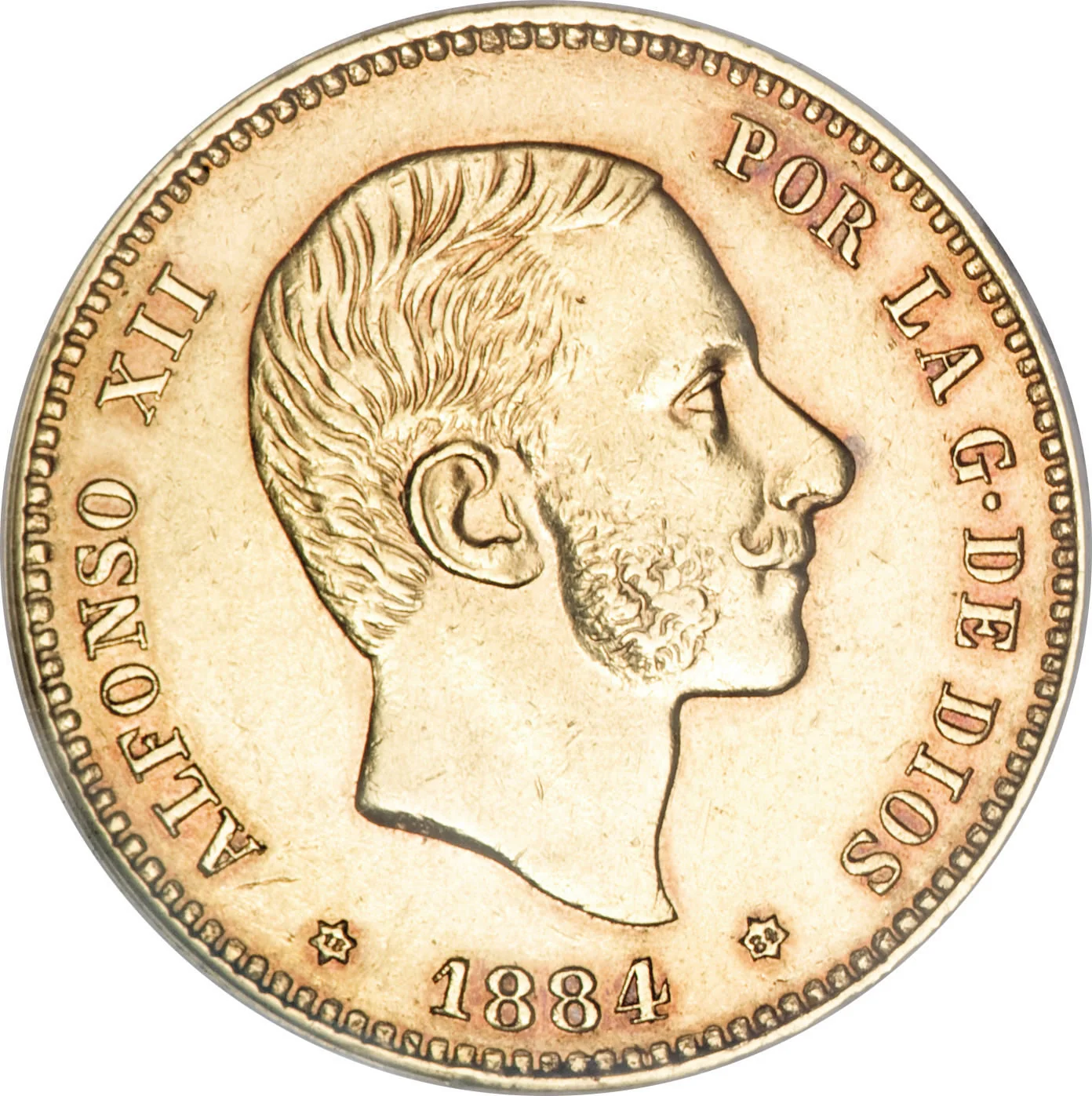
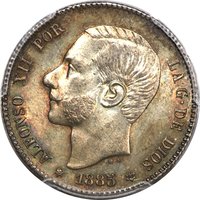
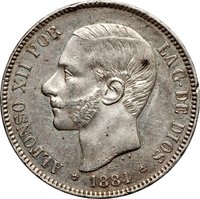
King Alfonso XII facing right.
Inscription:
ALFONSO XII POR LA G· DE DIOS
G· S·
🟌 1884 🟌
G· S·
🟌 1884 🟌
Translation:
By the grace of God, Alfonso XII
Sovereign
🟌 1884 🟌
Sovereign
🟌 1884 🟌
Script: Latin
Language: Spanish
Engraver: Gregorio Sellán y González
Reverse
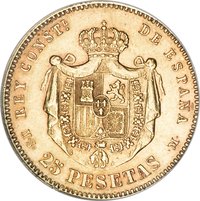
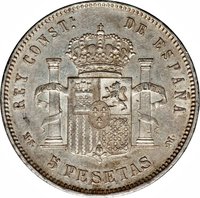
Description:
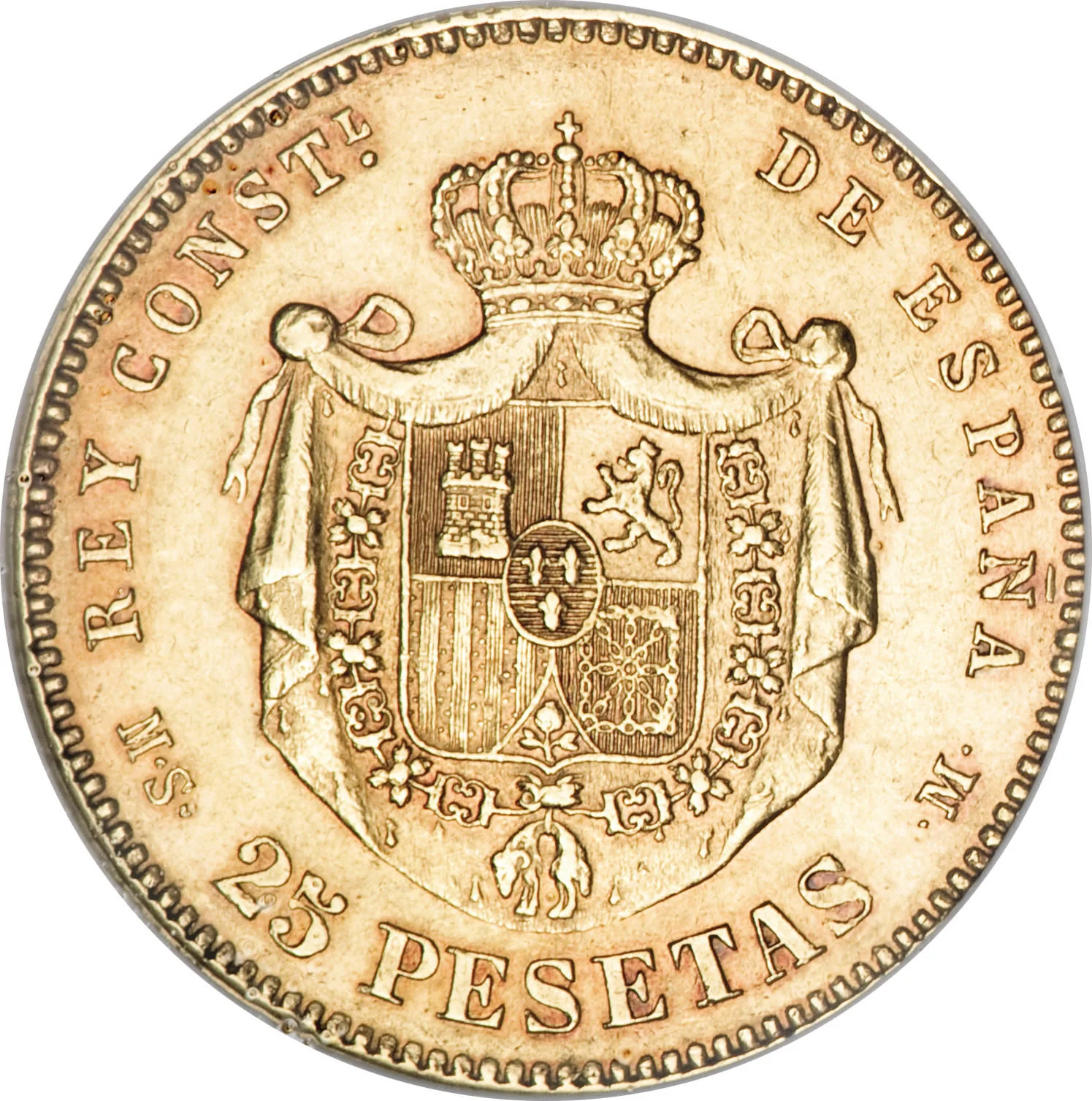
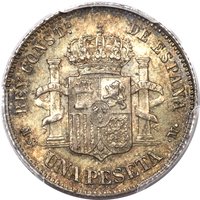
Draped and crowned Spanish coat of arms with the Golden Fleece.
Inscription:
REY CONSTL. DE ESPAÑA
M·S· 25 PESETAS ·M·
M·S· 25 PESETAS ·M·
Translation:
King Constitutional of Spain
M·S· 25 Pesetas ·M·
M·S· 25 Pesetas ·M·
Script: Latin
Language: Spanish
Engraver: Gregorio Sellán y González
Edge
27 fleur-de-lis
Categories
| Person> Monarch |
| Symbols> Coat of Arms |
Mints
| Name | Mark |
|---|---|
| Royal Mint of Madrid | (🟌) |
Mintings
| Year | Mint Mark | Mintage | Quality | Collection |
|---|---|---|---|---|
| 1881 | 🟌 | — | ||
| 1882 | 🟌 | — | ||
| 1883 | 🟌 | — | ||
| 1884 | 🟌 | 1,032,744 | ||
| 1885 | 🟌 | 502,613 |
Historical background
In 1881, Spain's currency situation was defined by its adherence to the Latin Monetary Union (LMU) in principle, though not in strict practice. The nation was on a bimetallic standard, legally valuing both gold and silver coins as legal tender at a fixed ratio. The primary unit was the peseta, introduced in 1868 to replace the old real and standardize the chaotic monetary system. However, the global phenomenon of "the disappearance of silver"—where the market value of silver bullion fell below its official mint price—posed a significant challenge. This led to the widespread hoarding and export of full-bodied gold coins, leaving a circulation increasingly dominated by silver and fractional currency.
The government, led by Prime Minister Práxedes Mateo Sagasta, attempted to address these instability issues. A key reform in 1881 aimed to solidify the gold standard by authorizing the minting of new 25-peseta gold coins (the "científico") and suspending the free coinage of silver for private individuals. This move was intended to curb inflation, attract gold back into reserves, and align Spain more closely with the gold-based systems of major trading partners like Britain and France. In practice, however, silver five-peseta coins remained unlimited legal tender, creating a "limping gold standard" where gold was the official benchmark but large quantities of undervalued silver still circulated at face value.
Consequently, Spain's monetary system in 1881 was in a transitional and somewhat contradictory state. While officially moving toward a gold standard for international credibility and stability, the economy still relied heavily on a bulky silver coinage whose intrinsic value was declining. This created persistent concerns about exchange rate volatility, speculative attacks on currency reserves, and the high cost of living. The situation reflected Spain's broader economic struggles to modernize and integrate fully into the European financial system during the Restauración period.
The government, led by Prime Minister Práxedes Mateo Sagasta, attempted to address these instability issues. A key reform in 1881 aimed to solidify the gold standard by authorizing the minting of new 25-peseta gold coins (the "científico") and suspending the free coinage of silver for private individuals. This move was intended to curb inflation, attract gold back into reserves, and align Spain more closely with the gold-based systems of major trading partners like Britain and France. In practice, however, silver five-peseta coins remained unlimited legal tender, creating a "limping gold standard" where gold was the official benchmark but large quantities of undervalued silver still circulated at face value.
Consequently, Spain's monetary system in 1881 was in a transitional and somewhat contradictory state. While officially moving toward a gold standard for international credibility and stability, the economy still relied heavily on a bulky silver coinage whose intrinsic value was declining. This created persistent concerns about exchange rate volatility, speculative attacks on currency reserves, and the high cost of living. The situation reflected Spain's broader economic struggles to modernize and integrate fully into the European financial system during the Restauración period.
⭐ Rare