

20 Pesetas – Spain
Spain
Context
Years: 1887–1962
Issuer: Spain 
Ruler: Alfonso XIII
Currency:
(1868—2001)
Demonetized: Yes
Total mintage: 2,356,249
Material
References
KM: #Click to copy to clipboard693
Numista: #17587
Value
Exchange value: 20 ESP
Bullion value: $969.51
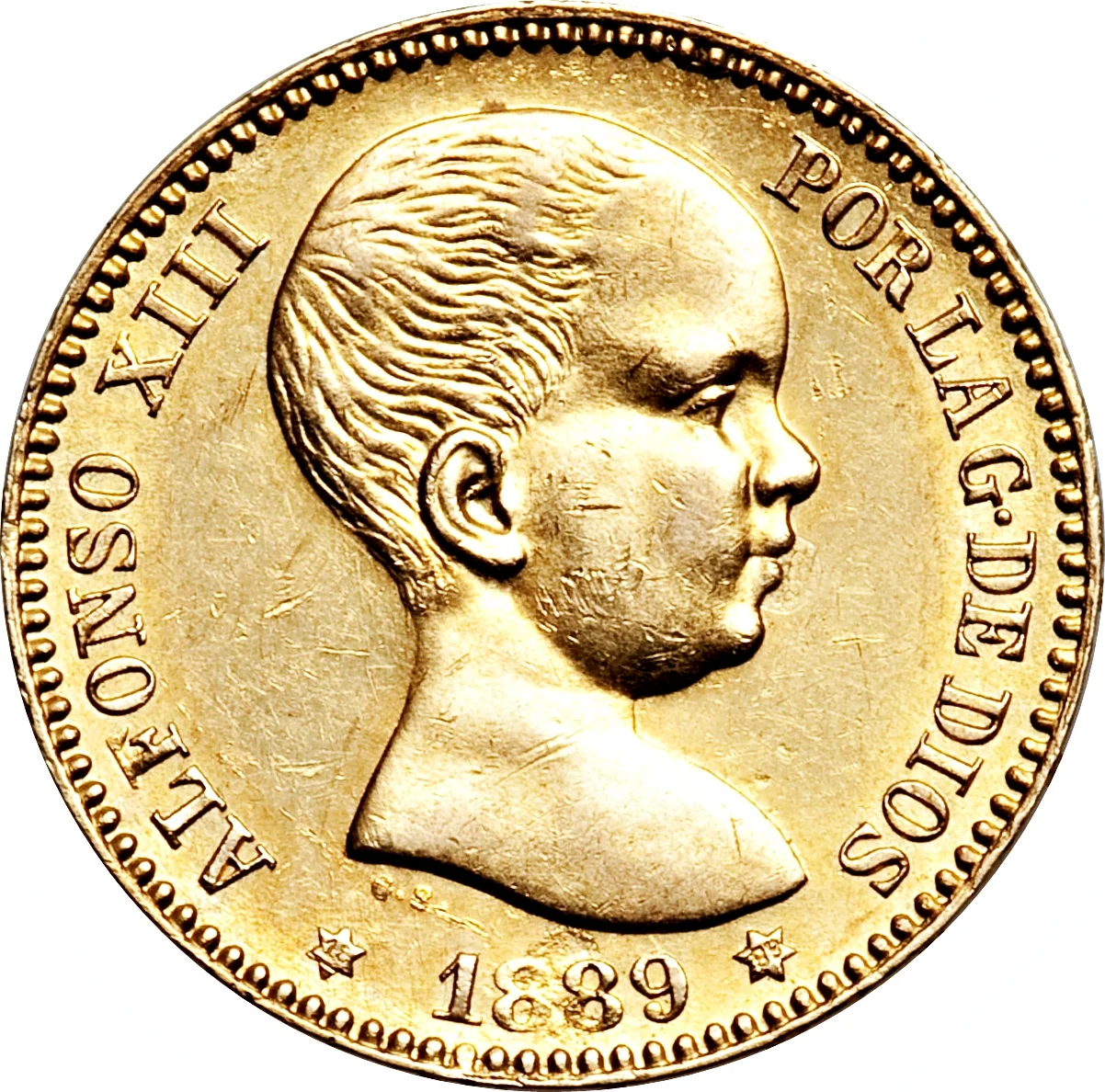
Obverse
Description:
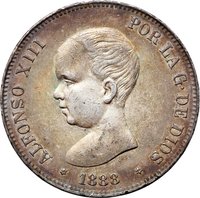
Toddler King Alfonso XIII facing right.
Inscription:
ALFONSO XIII POR LA G· DE DIOS
G· S·
🟌 1889 🟌
G· S·
🟌 1889 🟌
Translation:
ALFONSO XIII BY THE GRACE OF GOD
KING OF SPAIN
🟌 1889 🟌
KING OF SPAIN
🟌 1889 🟌
Script: Latin
Language: Spanish
Engraver: Gregorio Sellán y González
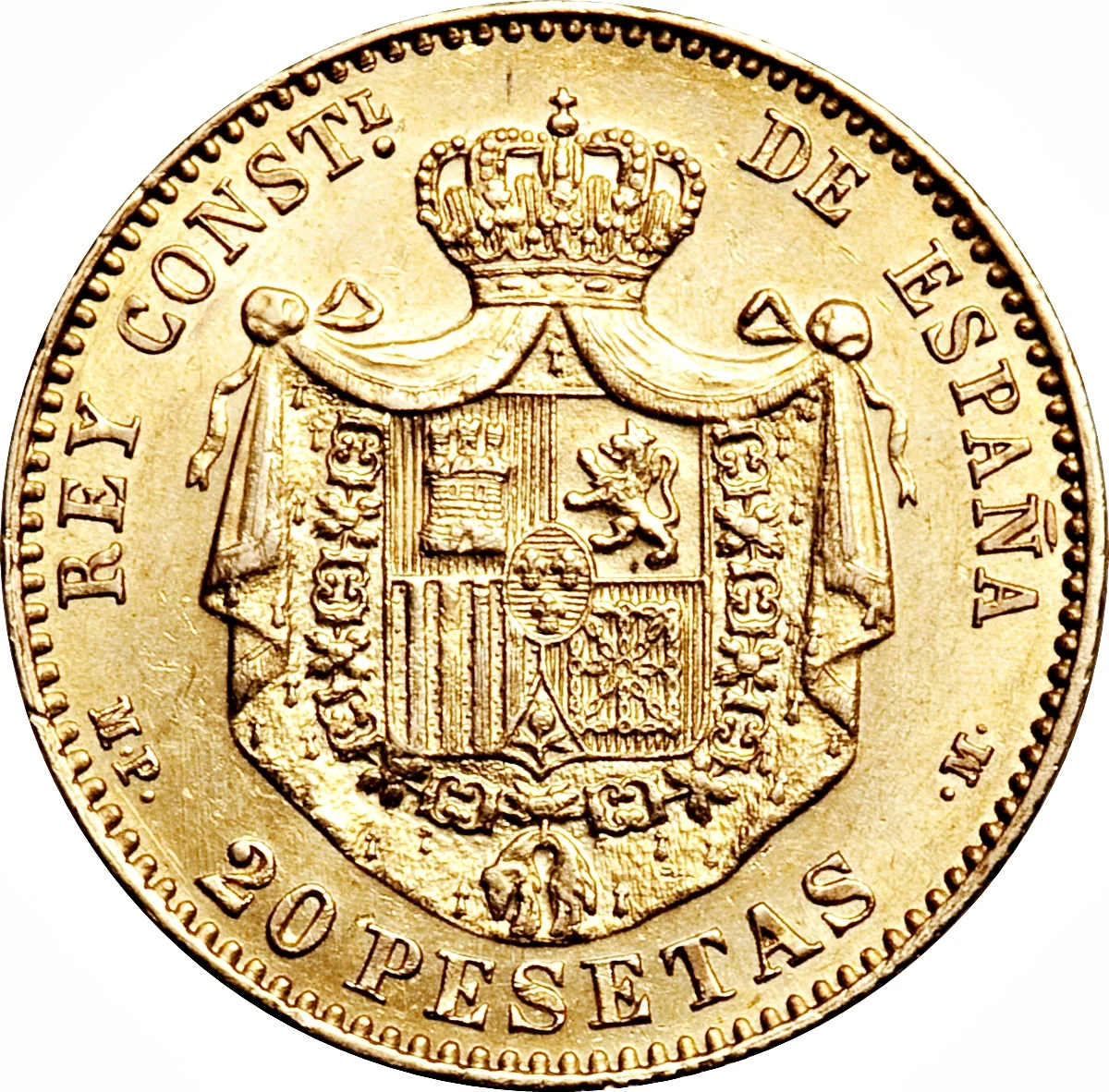
Reverse
Description:
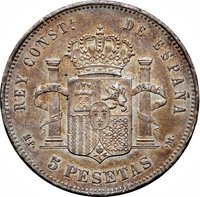
Draped and crowned Spanish coat of arms with the Golden Fleece.
Inscription:
REY CONSTL. DE ESPAÑA
M·P· 20 PESETAS ·M·
M·P· 20 PESETAS ·M·
Translation:
King Constitutional of Spain
M·P· 20 Pesetas ·M·
M·P· 20 Pesetas ·M·
Script: Latin
Language: Spanish
Engraver: Gregorio Sellán y González
Edge
18 fleur-de-lis
Categories
| Symbols> Coat of Arms |
| Person> Monarch |
Mints
| Name | Mark |
|---|---|
| Royal Mint of Madrid | (🟌) |
Mintings
| Year | Mint Mark | Mintage | Quality | Collection |
|---|---|---|---|---|
| 1887 | 🟌 | — | ||
| 1889 | 🟌 | — | ||
| 1890 | 🟌 | 2,344,449 | ||
| 1961 | — | 800 | ||
| 1962 | — | 11,000 |
Historical background
In 1887, Spain operated under the peseta, established as the sole national currency in 1868 following the Glorious Revolution. This decimal currency (1 peseta = 100 céntimos) replaced the complex system of regional and historical coins, symbolizing a modern, unified nation. However, by the late 1880s, Spain was firmly on a de facto silver standard, having legally suspended the free coinage of gold in 1883. This placed it in a vulnerable position within the international monetary system, as major powers like Britain and the emerging economic bloc led by Germany were moving towards or already on the gold standard.
The Spanish economy of the period was characterized by protectionism and relative industrial underdevelopment compared to its northern European neighbors. The reliance on silver created exchange rate instability and hampered foreign investment, as international creditors preferred gold-backed currencies. Furthermore, a significant fiscal deficit, fueled by colonial expenses and domestic spending, led the government to finance itself through borrowing from the Bank of Spain. This resulted in the frequent issuance of paper money beyond the metallic reserves, creating a bimetallic (silver and paper) circulation with a persistent risk of inflation and a gap between the face value of coins and their intrinsic metal worth.
Consequently, 1887 fell within a period of prolonged monetary debate and uncertainty. Policymakers were acutely aware of the pressures to join the gold standard but were constrained by a lack of sufficient gold reserves and a weak balance of payments. The situation was further complicated by political instability. Therefore, the currency scenario was one of fragile stability, underpinned by silver and fiduciary paper, but with growing internal and external pressures that would eventually lead to the formal suspension of the silver standard in the crisis of 1898 following the loss of Spain's final colonies.
The Spanish economy of the period was characterized by protectionism and relative industrial underdevelopment compared to its northern European neighbors. The reliance on silver created exchange rate instability and hampered foreign investment, as international creditors preferred gold-backed currencies. Furthermore, a significant fiscal deficit, fueled by colonial expenses and domestic spending, led the government to finance itself through borrowing from the Bank of Spain. This resulted in the frequent issuance of paper money beyond the metallic reserves, creating a bimetallic (silver and paper) circulation with a persistent risk of inflation and a gap between the face value of coins and their intrinsic metal worth.
Consequently, 1887 fell within a period of prolonged monetary debate and uncertainty. Policymakers were acutely aware of the pressures to join the gold standard but were constrained by a lack of sufficient gold reserves and a weak balance of payments. The situation was further complicated by political instability. Therefore, the currency scenario was one of fragile stability, underpinned by silver and fiduciary paper, but with growing internal and external pressures that would eventually lead to the formal suspension of the silver standard in the crisis of 1898 following the loss of Spain's final colonies.
🌟 Limited