

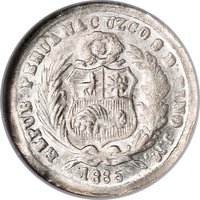
Obverse
Description:
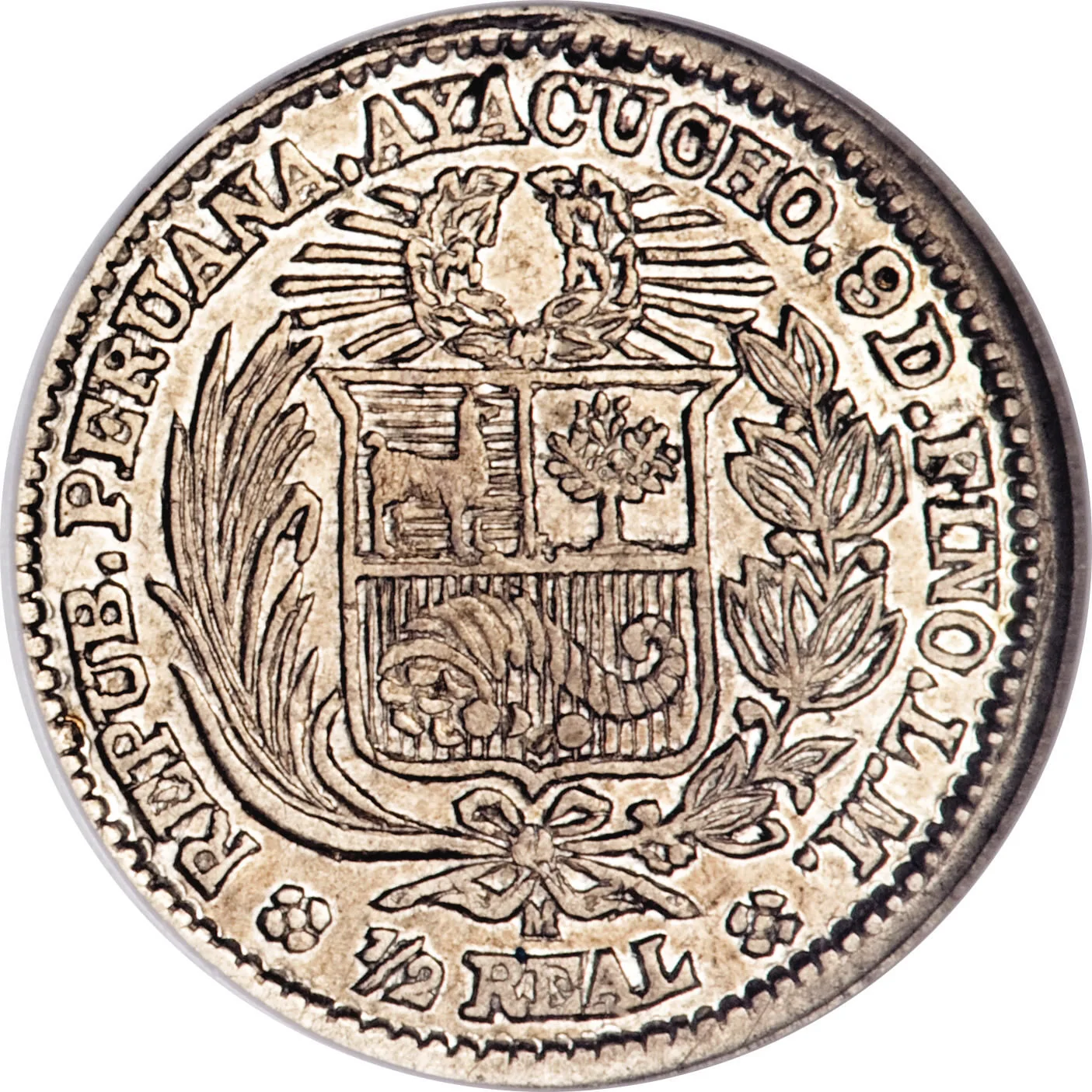
Peruvian coat of arms with legend.
Inscription:
REPUB.PERUANA.AYACUCHO.9D-FINO.L.M.
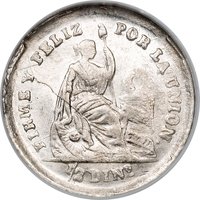
M
1/2 REAL
M
1/2 REAL
Script: Latin
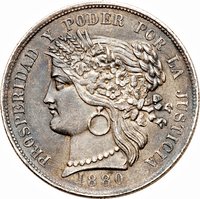
Reverse
Description:
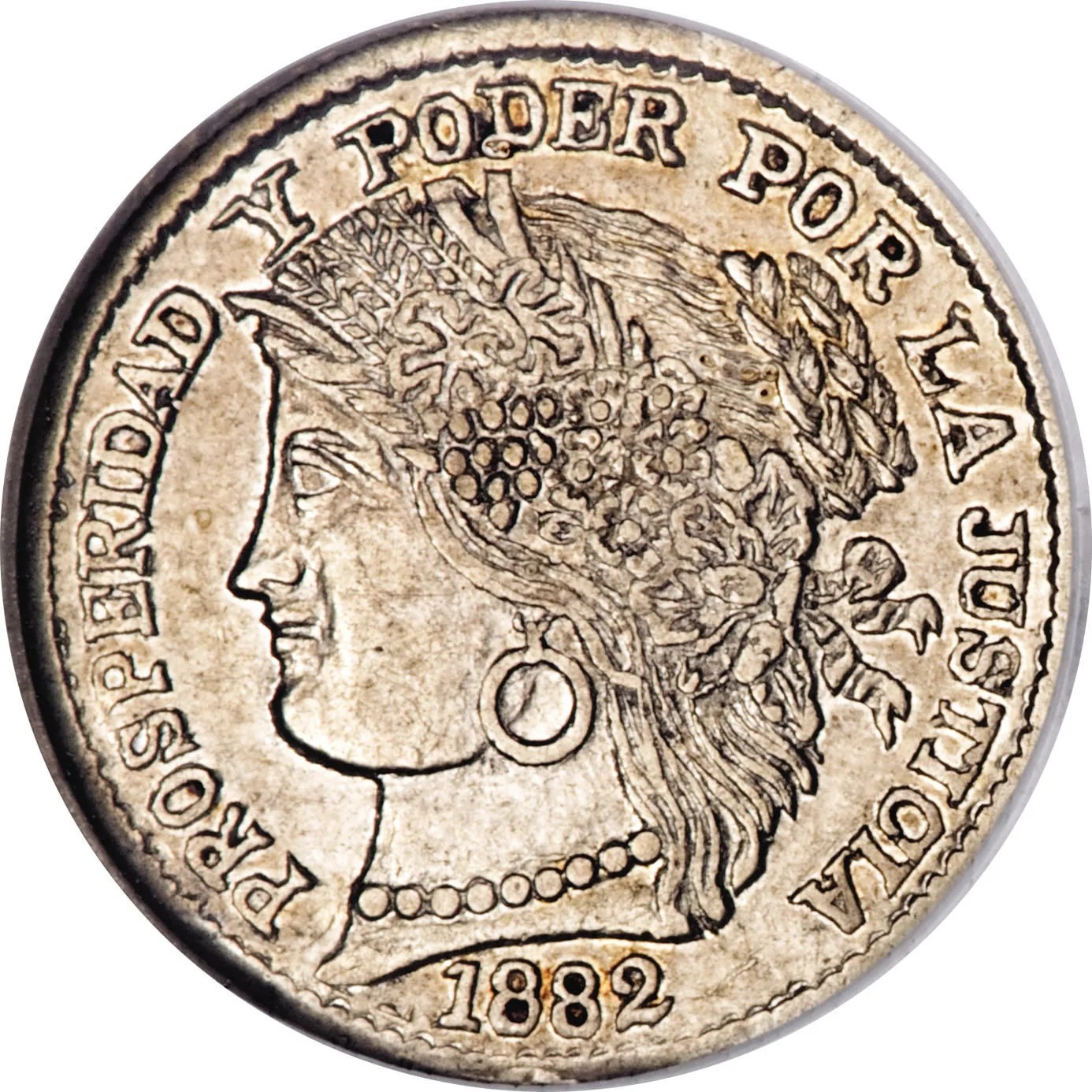
Woman's head left under legend, date at 6 o'clock.
Inscription:
PROSPERIDAD Y PODER POR LA JUSTICIA
1882
1882
Script: Latin
Edge
Mintings
| Year | Mint Mark | Mintage | Quality | Collection |
|---|---|---|---|---|
| 1882 | LM | — |
Historical background
In 1882, Peru found itself in the midst of a profound monetary and economic crisis, a direct consequence of the devastating War of the Pacific (1879-1884). Following the Chilean occupation of Lima in 1881, the Peruvian state had fractured, with a provisional government operating in the highlands while Chilean forces controlled the capital and key coastal regions. This political disintegration shattered the nation's fiscal authority and economic infrastructure. The once-reliable silver currency, based on the sol, was severely undermined as vital silver mines in the central Andes were captured or disrupted, and the Lima Mint fell under foreign control. The result was a critical shortage of official coinage in circulation.
The vacuum was filled by a chaotic proliferation of alternative currencies. Most notably, various jefes políticos (political chiefs) and military leaders in unoccupied regions began issuing their own paper money, known as billetes fiscales or "fiscal bills," to fund their operations and administrations. These issues were rarely backed by specie and their value fluctuated wildly based on local confidence in the issuing authority. Simultaneously, pre-war banknotes from private banks like the Banco del Perú and foreign currencies, particularly Chilean and Bolivian coins, circulated alongside any remaining Peruvian silver. This created a complex and unstable multi-currency system where exchange rates were arbitrary and hyperinflation began to take hold.
This monetary anarchy reflected the broader collapse of the Peruvian state. The lack of a unified currency severely hampered internal trade, crippled government efforts to collect taxes or pay troops, and imposed immense hardship on the civilian population. The situation would only begin to stabilize after the Treaty of Ancón in 1883, which paved the way for a slow and difficult process of monetary reunification and the eventual introduction of a new gold standard, the libra peruana, in the late 1890s. Thus, the currency situation of 1882 stands as a stark symbol of a nation fragmented by war.
The vacuum was filled by a chaotic proliferation of alternative currencies. Most notably, various jefes políticos (political chiefs) and military leaders in unoccupied regions began issuing their own paper money, known as billetes fiscales or "fiscal bills," to fund their operations and administrations. These issues were rarely backed by specie and their value fluctuated wildly based on local confidence in the issuing authority. Simultaneously, pre-war banknotes from private banks like the Banco del Perú and foreign currencies, particularly Chilean and Bolivian coins, circulated alongside any remaining Peruvian silver. This created a complex and unstable multi-currency system where exchange rates were arbitrary and hyperinflation began to take hold.
This monetary anarchy reflected the broader collapse of the Peruvian state. The lack of a unified currency severely hampered internal trade, crippled government efforts to collect taxes or pay troops, and imposed immense hardship on the civilian population. The situation would only begin to stabilize after the Treaty of Ancón in 1883, which paved the way for a slow and difficult process of monetary reunification and the eventual introduction of a new gold standard, the libra peruana, in the late 1890s. Thus, the currency situation of 1882 stands as a stark symbol of a nation fragmented by war.
✨ Legendary