

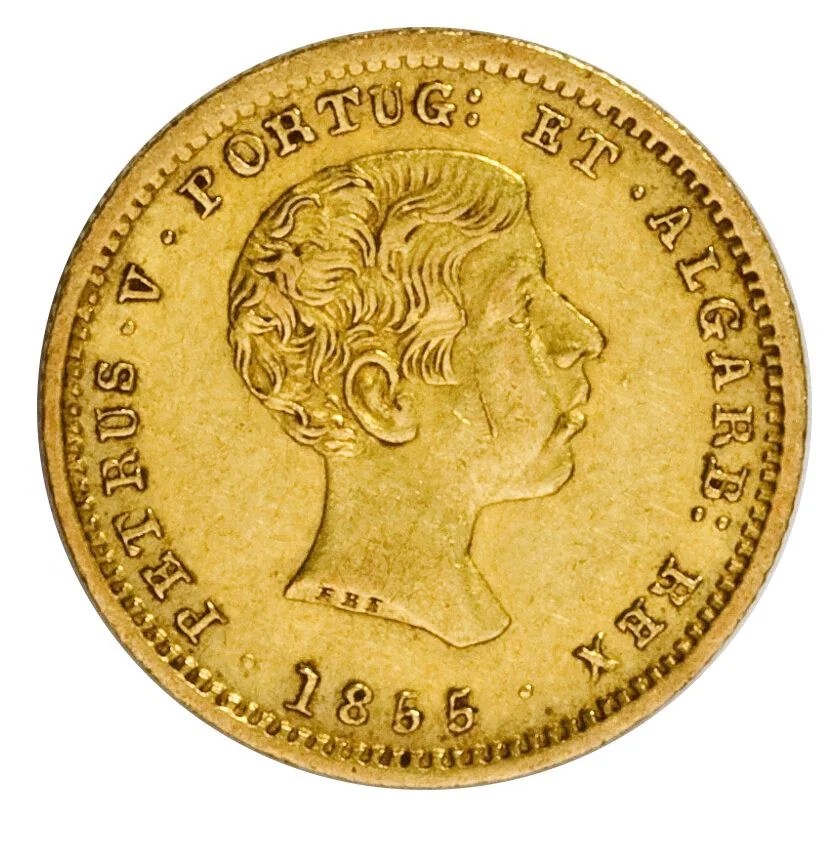

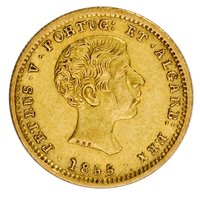
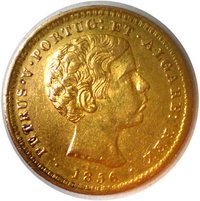
Obverse
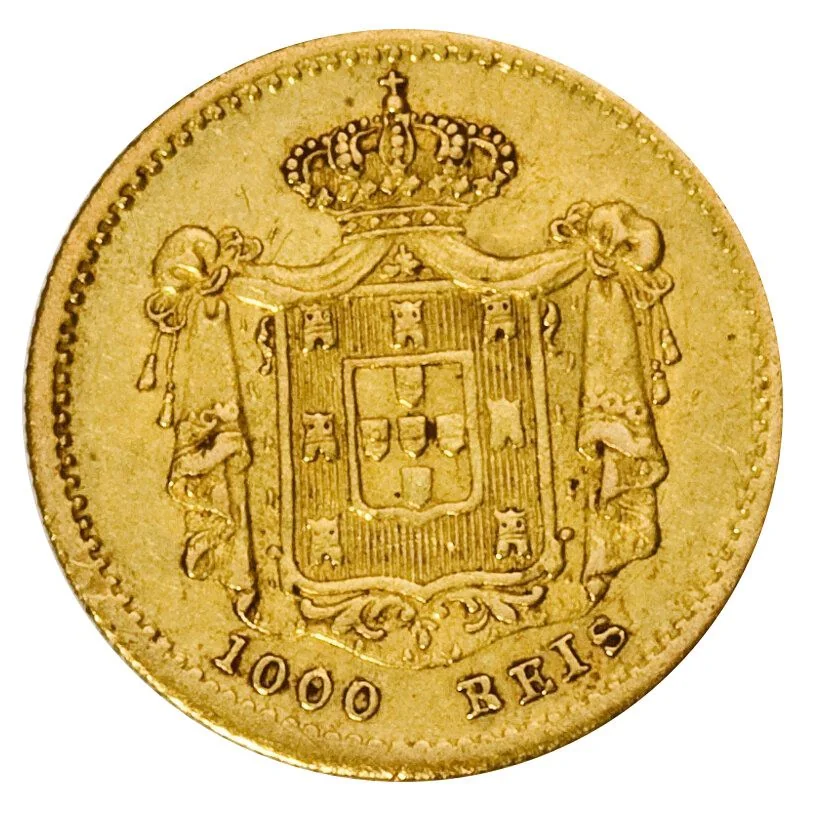
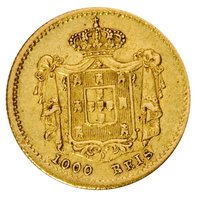
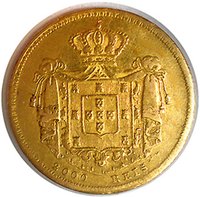
Reverse
Description:
Portuguese coat of arms. Value beneath.
Inscription:
1000 RÉIS
Translation:
One Thousand Réis
Script: Latin
Language: Portuguese
Edge
Reeded
Mints
| Name | Mark |
|---|---|
| Imprensa Nacional - Casa da Moeda | — |
Mintings
| Year | Mint Mark | Mintage | Quality | Collection |
|---|---|---|---|---|
| 1855 | — | 68,057 |
Historical background
In 1855, Portugal’s currency system was in a state of profound disorder, a legacy of the Liberal Wars (1828-1834) and subsequent political instability. The nation operated on a bimetallic standard in theory, but in practice, the monetary landscape was chaotic. A confusing array of coins circulated, including old Portuguese réis, foreign gold coins (like British sovereigns and French francs), and even clipped and counterfeit pieces. The government's chronic budget deficits, often financed by borrowing from the Bank of Portugal (founded in 1846), led to a severe depreciation of paper banknotes, which traded at a significant discount to their face value in metal. This created a dual system where transactions in gold commanded a premium, undermining public confidence and hampering commerce.
The root of the crisis was a severe shortage of precious metal coinage, particularly low-denomination coins for everyday use. Years of trade deficits had drained gold and silver from the country, while the state's inability to guarantee the value of its paper money led to hoarding of specie. Consequently, the economy suffered from a lack of a reliable and uniform medium of exchange, which stifled economic development and complicated both domestic trade and international transactions. The monetary instability reflected the broader weaknesses of the Portuguese state and its struggling economy in the mid-19th century.
Recognizing this crisis as a fundamental obstacle to modernization, the period around 1855 marked the beginning of concerted reform. Under the auspices of the Regeneration government, led by Fontes Pereira de Melo, efforts were initiated to stabilize finances and restore confidence. These efforts would culminate in the decisive monetary reform of 1854, which was being implemented in 1855. This law introduced a new gold standard, making the real a subsidiary unit and defining the coroa (crown) as the primary unit, with the aim of unifying the currency, retiring depreciated paper, and attracting foreign investment through stability. Thus, 1855 stands as a pivotal year of transition from monetary chaos toward a modern, standardized system.
The root of the crisis was a severe shortage of precious metal coinage, particularly low-denomination coins for everyday use. Years of trade deficits had drained gold and silver from the country, while the state's inability to guarantee the value of its paper money led to hoarding of specie. Consequently, the economy suffered from a lack of a reliable and uniform medium of exchange, which stifled economic development and complicated both domestic trade and international transactions. The monetary instability reflected the broader weaknesses of the Portuguese state and its struggling economy in the mid-19th century.
Recognizing this crisis as a fundamental obstacle to modernization, the period around 1855 marked the beginning of concerted reform. Under the auspices of the Regeneration government, led by Fontes Pereira de Melo, efforts were initiated to stabilize finances and restore confidence. These efforts would culminate in the decisive monetary reform of 1854, which was being implemented in 1855. This law introduced a new gold standard, making the real a subsidiary unit and defining the coroa (crown) as the primary unit, with the aim of unifying the currency, retiring depreciated paper, and attracting foreign investment through stability. Thus, 1855 stands as a pivotal year of transition from monetary chaos toward a modern, standardized system.
⭐ Rare