

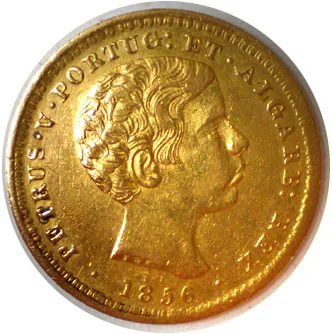
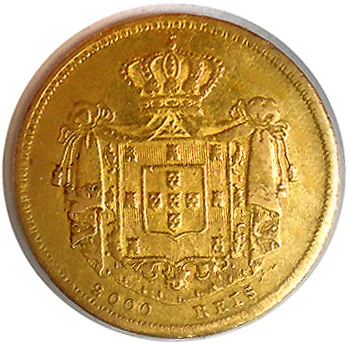
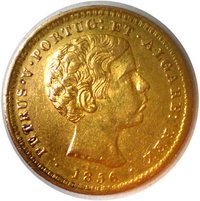
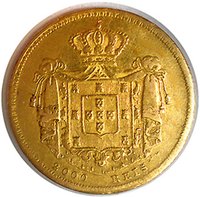
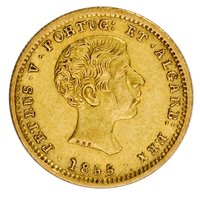
Obverse
Description:
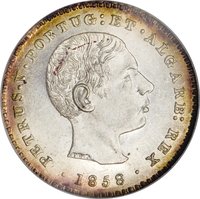
Portrait of Pedro V
Inscription:
PETRUS · V · PORTUG: ET · ALGARB: REX
· 1856 ·
· 1856 ·
Script: Latin
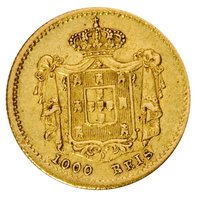
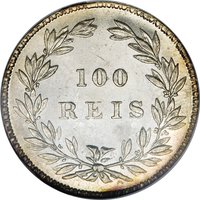
Reverse
Edge
Reeded
Mints
| Name | Mark |
|---|---|
| Imprensa Nacional - Casa da Moeda | — |
Mintings
| Year | Mint Mark | Mintage | Quality | Collection |
|---|---|---|---|---|
| 1856 | — | 37,675 | ||
| 1857 | — | 44,386 |
Historical background
In 1856, Portugal's currency system was in a state of transition and considerable complexity, reflecting the nation's broader economic challenges. The official currency was the Portuguese real (plural: réis), a monetary unit with a history stretching back centuries. However, the country was effectively operating on a bimetallic standard (gold and silver), though the system was unstable. The most significant issue was a severe shortage of actual, physical coinage in circulation, particularly small-denomination coins needed for everyday transactions. This scarcity, a result of persistent trade deficits, government debt, and the outflow of specie, crippled daily commerce and led to widespread use of inconvenient and unreliable substitutes like privately issued tokens and even cut-up pieces of larger coins.
The monetary landscape was further complicated by the widespread circulation of foreign coins, particularly British gold sovereigns and French francs, which were often preferred for larger transactions due to their trusted intrinsic value. Domestically, paper money existed but was not fully trusted; banknotes issued by the Banco de Portugal (founded in 1846) were theoretically convertible into metal, but public confidence was low. This lack of a uniform, reliable, and sufficient circulating medium hindered economic development and was a constant concern for both the government and the business community.
Recognizing the urgent need for reform, the Portuguese government was actively laying the groundwork for a sweeping monetary change. The pivotal moment would come just two years later, in 1854, with the official adoption of the gold standard, although its full implementation took several more years. This reform introduced a new, decimalized currency unit, the real (eventually leading to the escudo in 1911), and aimed to stabilize the currency, restore confidence, and integrate Portugal more fully into the international financial system dominated by gold-based currencies like the British pound. Thus, 1856 represents a critical juncture, a year of lingering monetary disorder immediately preceding a decisive, modernizing reform.
The monetary landscape was further complicated by the widespread circulation of foreign coins, particularly British gold sovereigns and French francs, which were often preferred for larger transactions due to their trusted intrinsic value. Domestically, paper money existed but was not fully trusted; banknotes issued by the Banco de Portugal (founded in 1846) were theoretically convertible into metal, but public confidence was low. This lack of a uniform, reliable, and sufficient circulating medium hindered economic development and was a constant concern for both the government and the business community.
Recognizing the urgent need for reform, the Portuguese government was actively laying the groundwork for a sweeping monetary change. The pivotal moment would come just two years later, in 1854, with the official adoption of the gold standard, although its full implementation took several more years. This reform introduced a new, decimalized currency unit, the real (eventually leading to the escudo in 1911), and aimed to stabilize the currency, restore confidence, and integrate Portugal more fully into the international financial system dominated by gold-based currencies like the British pound. Thus, 1856 represents a critical juncture, a year of lingering monetary disorder immediately preceding a decisive, modernizing reform.
💎 Extremely Rare