

2 thalers – Anhalt-Dessau
Add to wishlist
Germany
Context
Years: 1839–1846
Country: Germany
Issuer: Anhalt-Dessau
Ruler: Leopold IV Frederick
Currency:
Demonetized: Yes
Total mintage: 14,100
Material
References
KM: #
Numista: #46384
Value
Bullion value: $85.37
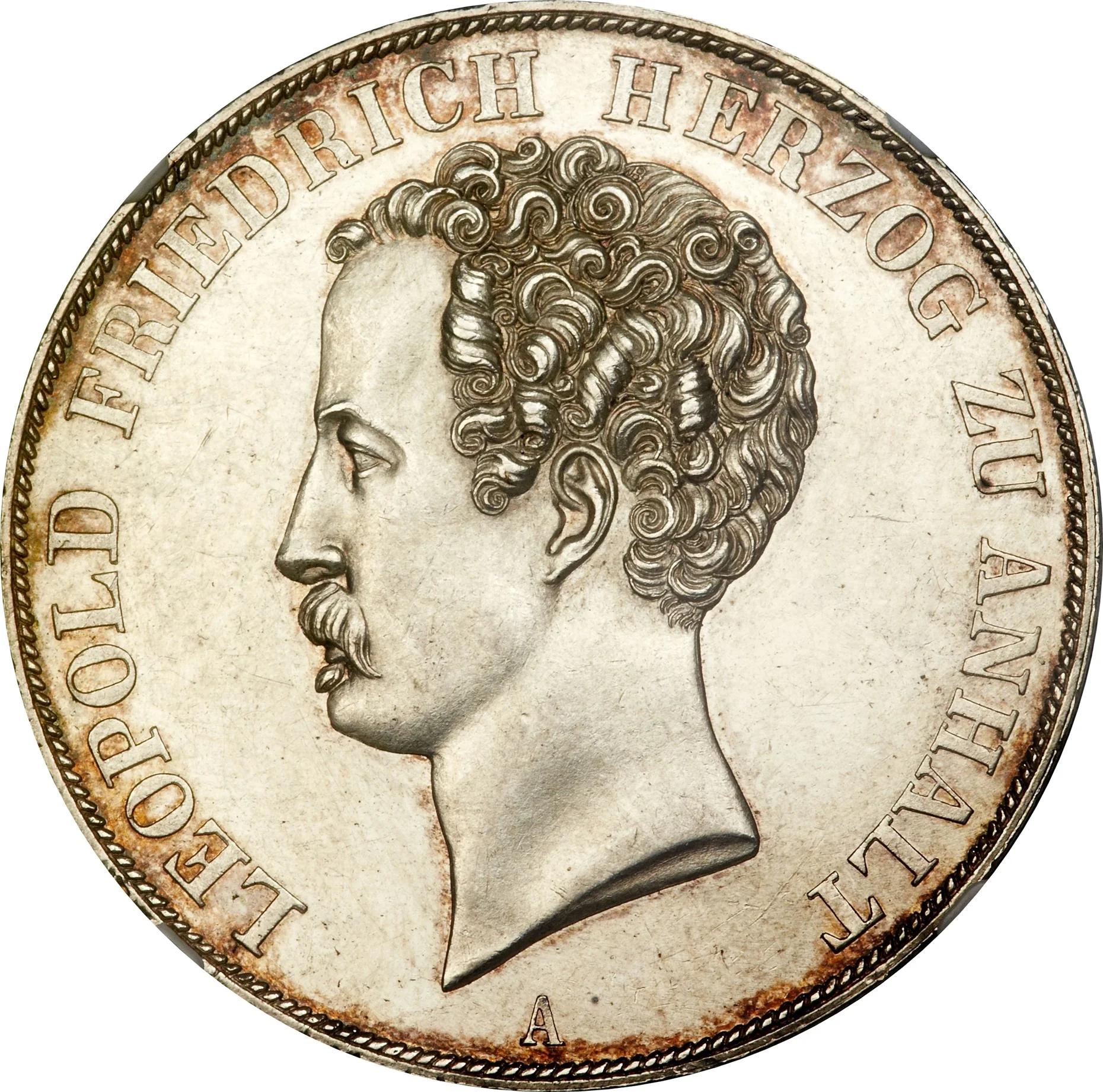
Obverse
Description:
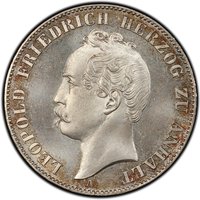
Inscription encircling left-facing portrait of Duke Leopold Friedrich of Anhalt-Dessau; mint mark below.
Inscription:
LEOPOLD FRIEDRICH HERZOG ZU ANHALT
A
A
Translation:
LEOPOLD FRIEDRICH DUKE OF ANHALT
Script: Latin
Language: German
Designer: Henri-François Brandt
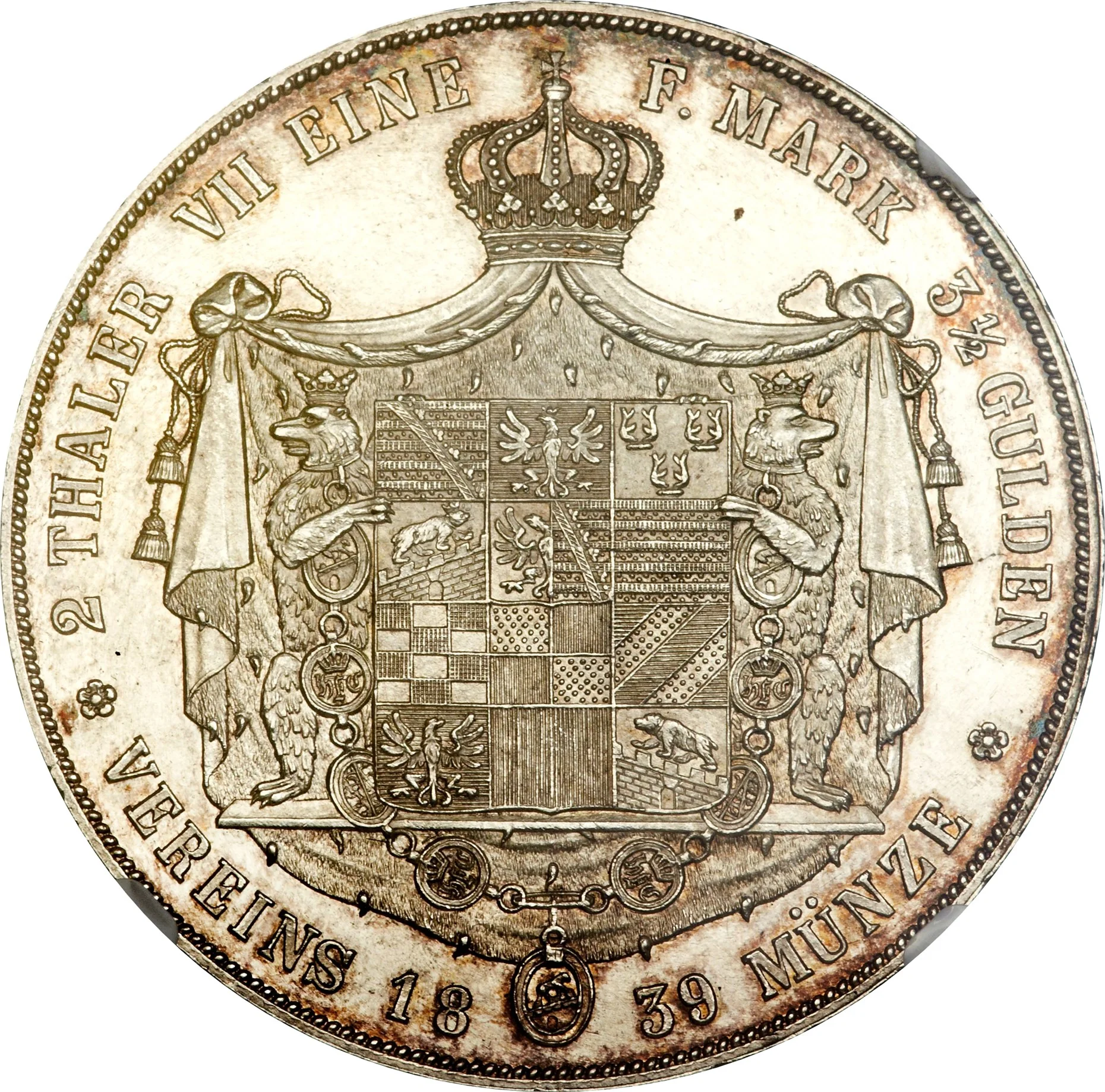
Reverse
Edge
Plain with inscription.
Legend:
GOTT SEGNE ANHALT
Mints
| Name | Mark |
|---|---|
| Berlin | A |
Historical background
In 1839, the currency situation in the Duchy of Anhalt-Dessau was characterized by a complex and fragmented system, typical of the German Confederation prior to unification. The duchy did not have a unique, independent currency but operated within the broader framework of the North German Thaler zones. The primary standard was the Prussian Thaler, divided into 30 Silbergroschen, each of 12 Pfennig. This system, established by the Prussian Coinage Reform of 1821, was widely influential, and Anhalt-Dessau, closely aligned with Prussia both politically and economically, had effectively adopted it for official and large-scale transactions.
However, the monetary landscape was not uniform. In daily commerce, older regional coinage and notes from neighboring states still circulated, leading to occasional confusion and exchange difficulties. Furthermore, the duchy was part of the Dresden Coinage Convention of 1838, a critical agreement among several German states to standardize silver coinage. This convention aimed to create a stable exchange rate (a 14:1 ratio) between the northern Thaler (based on the Cologne mark) and the southern Gulden, facilitating trade across the German customs unions. For Anhalt-Dessau, this meant its Prussian-style Thaler was now legally integrated into a wider, more predictable monetary network.
Thus, by 1839, Anhalt-Dessau was in a transitional phase, moving from a purely Prussian-aligned system toward a more standardized German monetary environment. The currency in use was fundamentally the Prussian Thaler, but its value and legitimacy were increasingly underpinned by the multilateral Dresden Convention. This provided greater economic stability for the duchy's trade, yet the full practical implementation and phasing out of older, heterogeneous coinage remained an ongoing process for merchants and citizens alike.
However, the monetary landscape was not uniform. In daily commerce, older regional coinage and notes from neighboring states still circulated, leading to occasional confusion and exchange difficulties. Furthermore, the duchy was part of the Dresden Coinage Convention of 1838, a critical agreement among several German states to standardize silver coinage. This convention aimed to create a stable exchange rate (a 14:1 ratio) between the northern Thaler (based on the Cologne mark) and the southern Gulden, facilitating trade across the German customs unions. For Anhalt-Dessau, this meant its Prussian-style Thaler was now legally integrated into a wider, more predictable monetary network.
Thus, by 1839, Anhalt-Dessau was in a transitional phase, moving from a purely Prussian-aligned system toward a more standardized German monetary environment. The currency in use was fundamentally the Prussian Thaler, but its value and legitimacy were increasingly underpinned by the multilateral Dresden Convention. This provided greater economic stability for the duchy's trade, yet the full practical implementation and phasing out of older, heterogeneous coinage remained an ongoing process for merchants and citizens alike.
✨ Legendary