

100 Reales – Spain
Spain
Context
Material
References
KM: #Click to copy to clipboard594
Numista: #14828
Value
Bullion value: $1245.48
Obverse
Description:
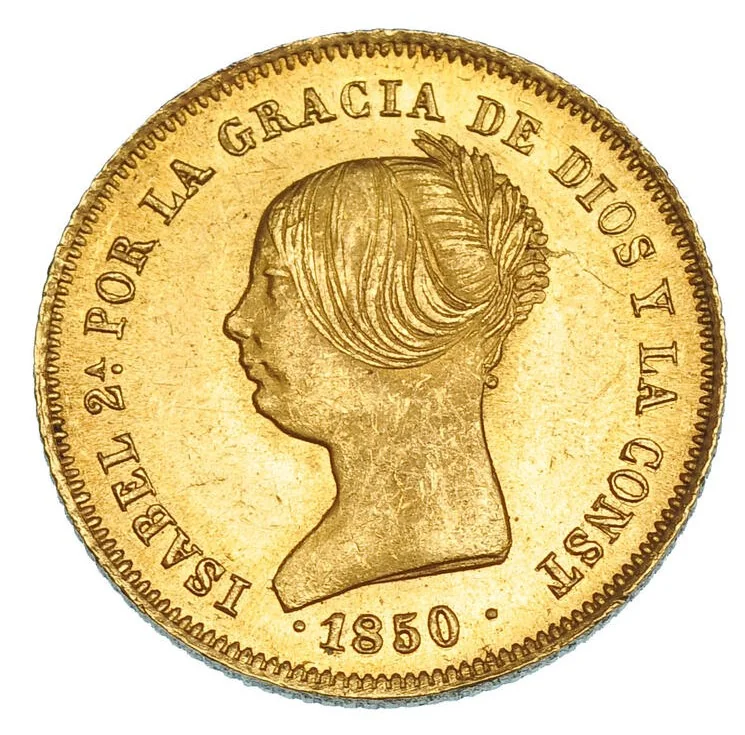
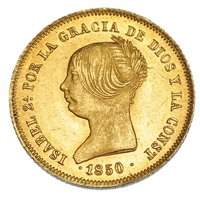
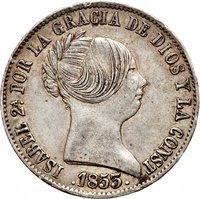
Young Isabella II facing left.
Inscription:
ISABEL 2A. POR LA GRACIA DE DIOS Y LA CONST
· 1850 ·
· 1850 ·
Translation:
Isabel 2nd, by the Grace of God and the Constitution.
Script: Latin
Language: Spanish
Engraver: Remigio Vega
Reverse
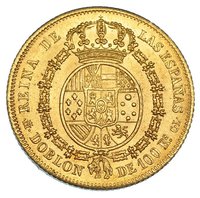
Description:
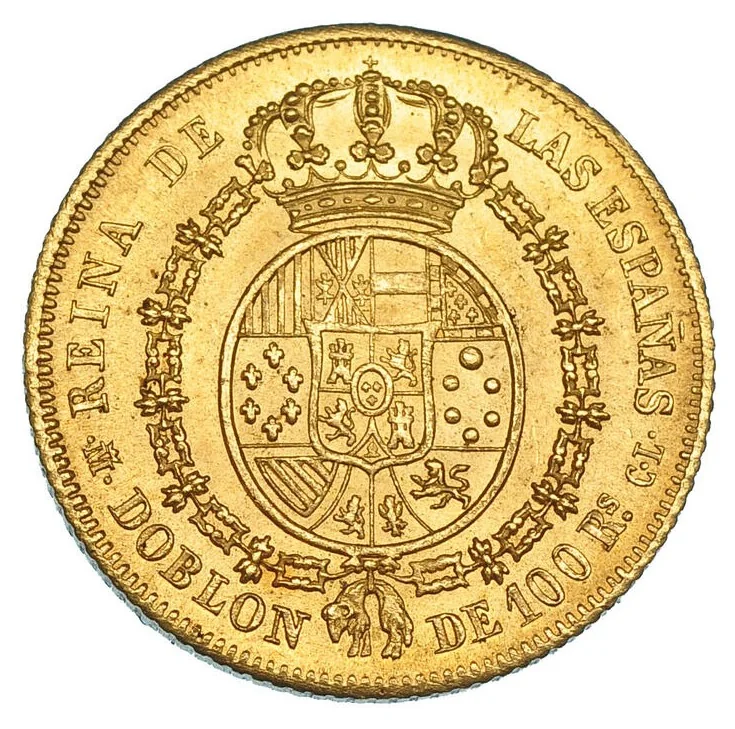
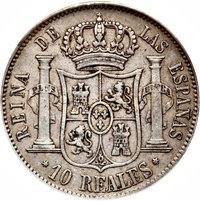
Crowned Spanish coat of arms with the Golden Fleece.
Inscription:
REINA DE LAS ESPAÑAS
·M· DOBLON DE 100 RS. C· L·
·M· DOBLON DE 100 RS. C· L·
Translation:
Queen of the Spains
·M· Doubloon of 100 Reales C· L·
·M· Doubloon of 100 Reales C· L·
Script: Latin
Language: Spanish
Engraver: Remigio Vega
Edge
Categories
| Symbols> Coat of Arms |
Mints
| Name | Mark |
|---|---|
| Barcelona Mint / La Seca | (B) |
| Royal Mint of Madrid | (M) |
| Royal Mint of Seville | (S) |
Mintings
| Year | Mint Mark | Mintage | Quality | Collection |
|---|---|---|---|---|
| 1850 | BSM | — | ||
| 1850 | MCL | — | ||
| 1850 | MDG | — | ||
| 1850 | SRD | — | ||
| 1851 | BSM | — | ||
| 1851 | MCL | — |
Historical background
In 1850, Spain's currency system was a complex and fragmented legacy of its turbulent early 19th century, characterized by political instability, war, and fiscal crisis. The nation operated on a bimetallic standard in theory, but in practice, it suffered from a severe shortage of precious metal coinage. Decades of war, including the Peninsular War and the Carlist conflicts, had drained treasury reserves and led to successive devaluations and the issuance of vast quantities of low-quality, token copper coinage (calderilla). This resulted in a chaotic circulation where the nominal value of coins bore little relation to their intrinsic metal content, undermining public trust and hindering commerce.
The monetary landscape was a confusing patchwork. Alongside the devalued Spanish reales and escudos, foreign coins—particularly French francs and British sovereigns—circulated widely, especially in port cities and for significant transactions, as they were seen as more reliable stores of value. Furthermore, the proliferation of paper money issued by various private banks and financial entities, with varying degrees of solvency, added to the instability. The government lacked central control, and the Banco de España, while established in 1856, did not yet possess a monopoly on note issuance. This lack of a uniform, trusted currency stifled economic development and national market integration.
This untenable situation set the stage for the major monetary reform that would follow in the coming decades. The 1850s marked a period of growing political consensus on the need for modernization. The eventual solution, enacted in 1868 after the Glorious Revolution, was the adoption of the peseta as the sole national currency, moving Spain onto the Latin Monetary Union's gold standard. Thus, the mid-century period represents the final, problematic chapter of the old monetary order, directly precipitating the creation of the modern, unified system that would define Spain's economy until the introduction of the Euro.
The monetary landscape was a confusing patchwork. Alongside the devalued Spanish reales and escudos, foreign coins—particularly French francs and British sovereigns—circulated widely, especially in port cities and for significant transactions, as they were seen as more reliable stores of value. Furthermore, the proliferation of paper money issued by various private banks and financial entities, with varying degrees of solvency, added to the instability. The government lacked central control, and the Banco de España, while established in 1856, did not yet possess a monopoly on note issuance. This lack of a uniform, trusted currency stifled economic development and national market integration.
This untenable situation set the stage for the major monetary reform that would follow in the coming decades. The 1850s marked a period of growing political consensus on the need for modernization. The eventual solution, enacted in 1868 after the Glorious Revolution, was the adoption of the peseta as the sole national currency, moving Spain onto the Latin Monetary Union's gold standard. Thus, the mid-century period represents the final, problematic chapter of the old monetary order, directly precipitating the creation of the modern, unified system that would define Spain's economy until the introduction of the Euro.
💎 Extremely Rare