

1 Dollar (Charlottetown and Quebec Conferences) – Canada
Circulating commemorative coins
Commemoration: 100th Anniversary of Charlottetown & Quebec Conferences
Canada
Context
Material
References
KM: #Click to copy to clipboard58
Numista: #455
Value
Exchange value: 1 CAD = $0.73
Bullion value: $53.04
Inflation-adjusted value: 10.04 CAD
Obverse
Description:
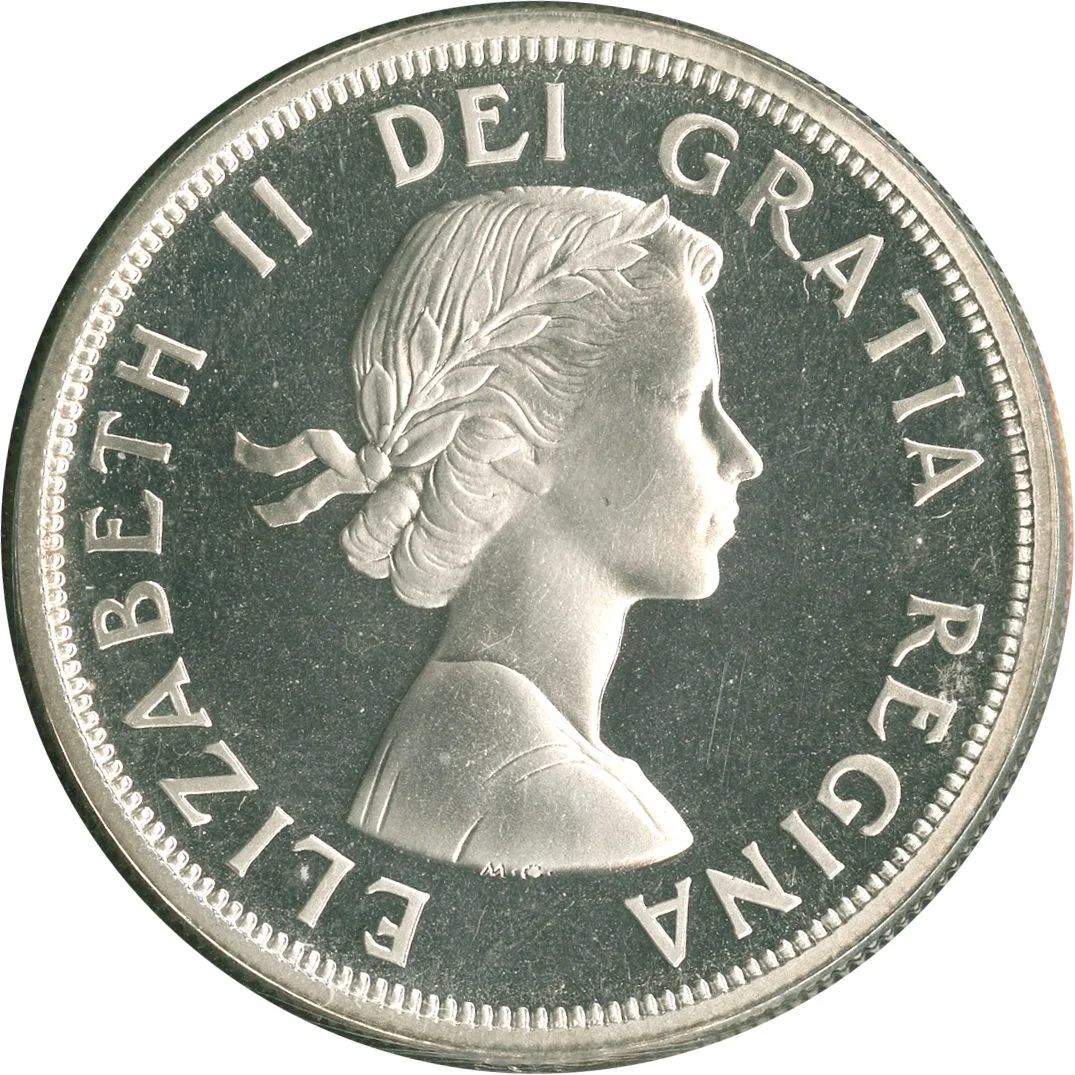
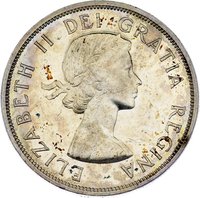
Bust of Queen Elizabeth II at age 27, wearing a wreath and facing right.
Inscription:
ELIZABETH II DEI GRATIA REGINA M.C.
Translation:
Elizabeth II by the Grace of God Queen M.C.
Script: Latin
Language: Latin
Engraver: Myron Cook
Designer: Mary Gillick
Reverse
Description:
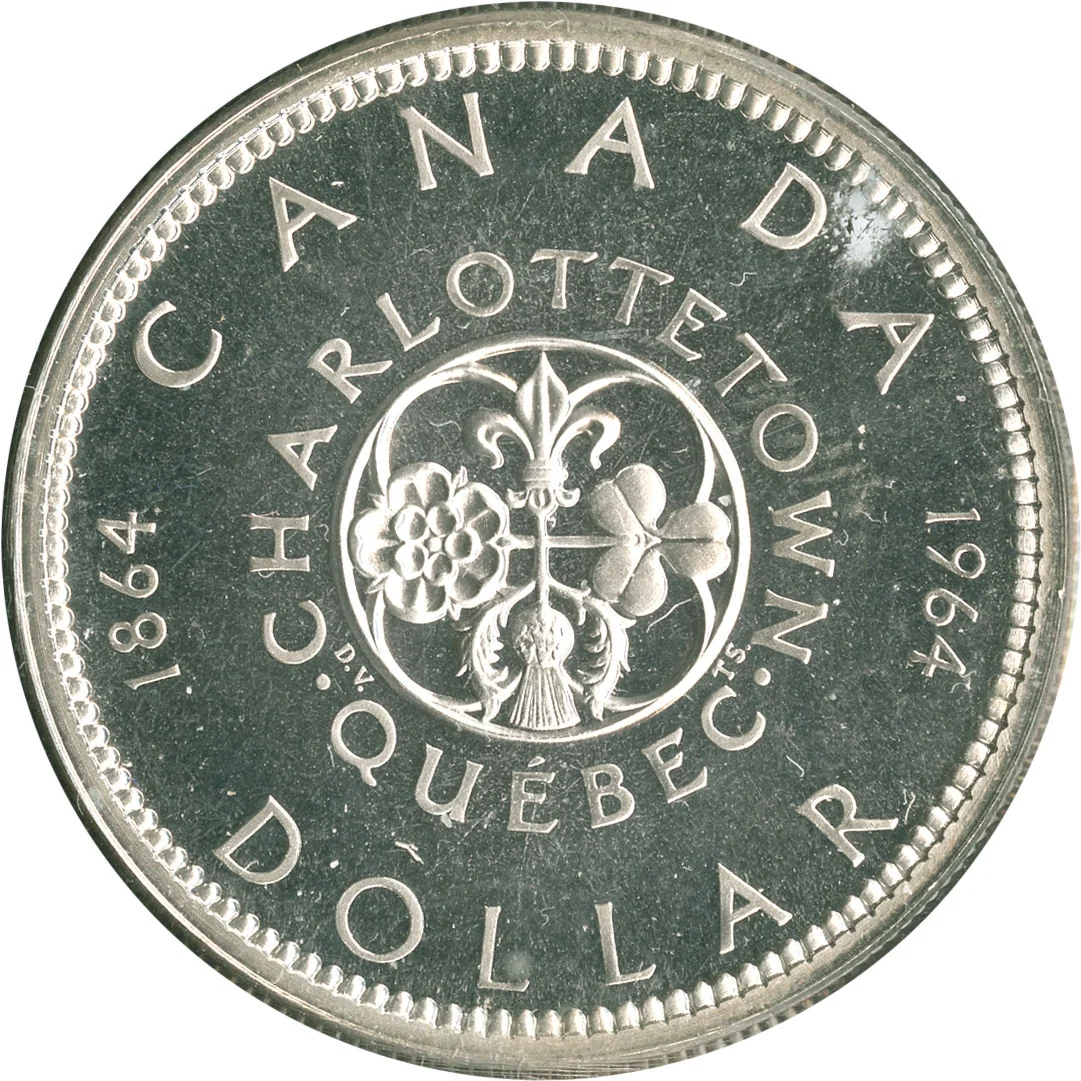
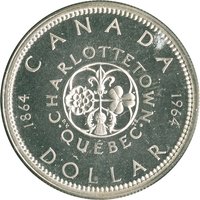
A unique design featuring the fleur-de-lis, shamrock, thistle, and rose, encircled by "CHARLOTTETOWN • QUÉBEC" and the dates 1864–1964. The country name is at the top and the value at the bottom.
Inscription:
1864 C A N A D A 1964
CHARLOTTETOWN
·QUÉBEC·
D O L L A R
D.V. T.S.
CHARLOTTETOWN
·QUÉBEC·
D O L L A R
D.V. T.S.
Translation:
CANADA
CHARLOTTETOWN
QUEBEC
DOLLAR
GOD WILLING [and] TIMING IS EVERYTHING
CHARLOTTETOWN
QUEBEC
DOLLAR
GOD WILLING [and] TIMING IS EVERYTHING
Script: Latin
Engraver: Thomas Shingles
Designer: Dinko Vodanovic
Edge
Milled
Categories
| Symbol> Fleur-de-lis |
Mints
| Name | Mark |
|---|---|
| Royal Canadian Mint of Ottawa | — |
Mintings
| Year | Mint Mark | Mintage | Quality | Collection |
|---|---|---|---|---|
| 1964 | — | 1,209,000 | Prooflike | |
| 1964 | — | 7,296,832 |
Historical background
In 1964, Canada's currency system was in a period of transition, still anchored by the Bank of Canada Act of 1934 which had established a central bank and given it a monopoly on issuing paper money. The nation was on a de facto gold standard through the Bretton Woods system, meaning the Canadian dollar was pegged to the U.S. dollar, which was itself convertible to gold. This provided exchange rate stability but constrained independent monetary policy. Notably, the chartered banks still retained the right to issue their own banknotes, a legacy of the pre-1935 system, though these were being progressively removed from circulation in favour of the now-familiar Bank of Canada notes.
A significant and symbolic change was underway: the retirement of the large-sized banknotes. For decades, Canadian paper money had been a large format (7.375 by 3.625 inches). In 1935, the Bank of Canada had introduced its first series in this size, featuring portraits of members of the royal family. By the late 1950s, a shift to the more practical, smaller "Canadian Landscape" series had begun. By 1964, this process was largely complete, with the new, modern-sized notes fully circulating and depicting iconic Canadian scenes like the Okanagan Valley and the St. Lawrence River, marking a visual step toward a distinct national identity.
Economically, the currency was stable, with the Canadian dollar trading very close to its U.S. counterpart, often at a slight premium. This strength was underpinned by strong post-war economic growth and resource exports. However, the fixed exchange rate regime of Bretton Woods was beginning to show strains internationally, and within a few years, Canada would once again let its dollar float freely (in 1970), as it had from 1950 to 1962. Thus, 1964 represents a calm point within these larger monetary shifts—a year where the currency was stable, its physical form had been modernized, but the foundations of the international system that governed its value were soon to be challenged.
A significant and symbolic change was underway: the retirement of the large-sized banknotes. For decades, Canadian paper money had been a large format (7.375 by 3.625 inches). In 1935, the Bank of Canada had introduced its first series in this size, featuring portraits of members of the royal family. By the late 1950s, a shift to the more practical, smaller "Canadian Landscape" series had begun. By 1964, this process was largely complete, with the new, modern-sized notes fully circulating and depicting iconic Canadian scenes like the Okanagan Valley and the St. Lawrence River, marking a visual step toward a distinct national identity.
Economically, the currency was stable, with the Canadian dollar trading very close to its U.S. counterpart, often at a slight premium. This strength was underpinned by strong post-war economic growth and resource exports. However, the fixed exchange rate regime of Bretton Woods was beginning to show strains internationally, and within a few years, Canada would once again let its dollar float freely (in 1970), as it had from 1950 to 1962. Thus, 1964 represents a calm point within these larger monetary shifts—a year where the currency was stable, its physical form had been modernized, but the foundations of the international system that governed its value were soon to be challenged.
🌱 Very Common