

1 Cent – Canada
Circulating commemorative coins
Commemoration: Canada's Centennial (1867-1967)
Canada
Context

Material
References
KM: #Click to copy to clipboard65
Numista: #430
Value
Exchange value: 0.01 CAD = $0.01
Inflation-adjusted value: 0.09 CAD
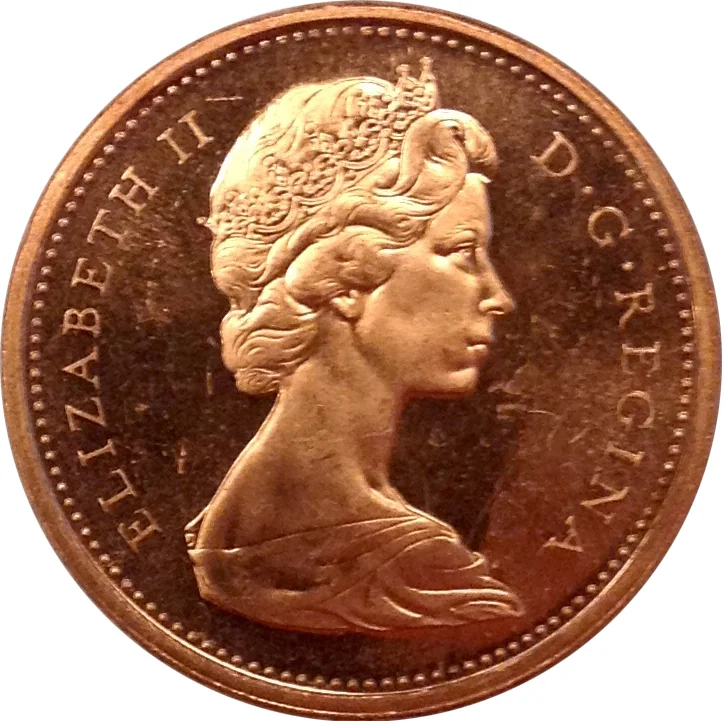
Obverse
Description:
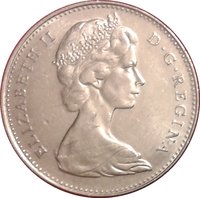
Bust of Queen Elizabeth II at age 37, wearing a tiara and facing right.
Inscription:
ELIZABETH II D·G·REGINA
Translation:
Elizabeth II, by the Grace of God, Queen
Script: Latin
Language: Latin
Engraver: Arnold Machin
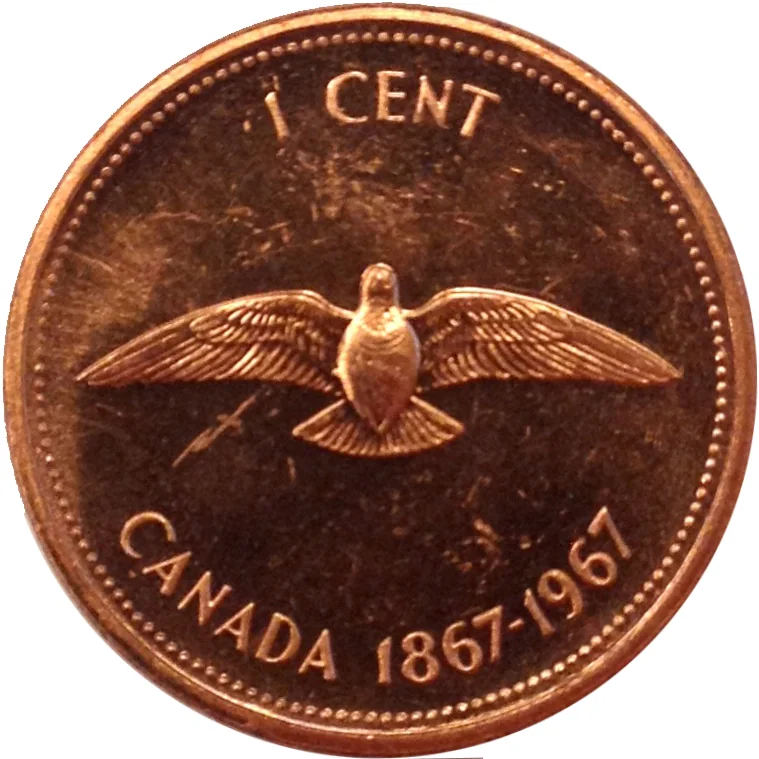
Reverse
Description:
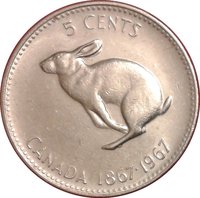
A flying rock dove encircled by the face value and "CANADA 1867-1967".
Inscription:
1 CENT
CANADA 1867-1967
CANADA 1867-1967
Script: Latin
Engraver: Alex Colville
Edge
Plain
Mints
| Name | Mark |
|---|---|
| Royal Canadian Mint of Ottawa | — |
Mintings
| Year | Mint Mark | Mintage | Quality | Collection |
|---|---|---|---|---|
| 1967 | — | 345,140,645 | ||
| 1967 | — | — | Proof |
Historical background
In 1967, Canada's currency system was in a period of significant transition, marked by the centennial of Confederation and a deliberate shift towards a distinct national identity. The most visible change was the introduction of a new series of banknotes, known as the "Scenes of Canada" series, which replaced the earlier "Canadian Landscape" series. These new notes were a symbolic departure from the past, as they phased out the traditional portrait of the British monarch on the $1 bill (replacing it with a youthful Queen Elizabeth II on the higher-denomination $20 bill) and instead featured iconic Canadian scenes, such as the Parliament Buildings and fishing fleets. This redesign was a conscious effort to celebrate Canada's heritage and assert its sovereignty in the lead-up to the Expo 67 world's fair.
Underpinning this visual change was Canada's ongoing commitment to a fixed exchange rate, but within a new framework. Since 1962, the Canadian dollar had been pegged at US$0.925, a rate maintained by the Bank of Canada. This followed a decade of a floating "Floating Canadian dollar" (1950-1962), and the return to a fixed peg was intended to provide stability and curb inflationary pressures. However, the peg was under constant market pressure throughout the mid-1960s, requiring active intervention by the central bank to defend the established rate, as economic conditions and capital flows frequently tested its viability.
Thus, the currency situation in 1967 was one of symbolic modernization layered atop a fragile monetary policy structure. The new banknotes projected a confident, centennial nation, while the fixed exchange rate regime operated under significant strain. This tension would culminate just three years later, in 1970, when Canada abandoned the peg and returned to a floating exchange rate system, allowing the market to determine the value of the Canadian dollar—a system that remains in place today. The year 1967, therefore, stands as a final chapter of the mid-century fixed-rate era, framed by a patriotic redesign that continues to influence the iconography of Canadian money.
Underpinning this visual change was Canada's ongoing commitment to a fixed exchange rate, but within a new framework. Since 1962, the Canadian dollar had been pegged at US$0.925, a rate maintained by the Bank of Canada. This followed a decade of a floating "Floating Canadian dollar" (1950-1962), and the return to a fixed peg was intended to provide stability and curb inflationary pressures. However, the peg was under constant market pressure throughout the mid-1960s, requiring active intervention by the central bank to defend the established rate, as economic conditions and capital flows frequently tested its viability.
Thus, the currency situation in 1967 was one of symbolic modernization layered atop a fragile monetary policy structure. The new banknotes projected a confident, centennial nation, while the fixed exchange rate regime operated under significant strain. This tension would culminate just three years later, in 1970, when Canada abandoned the peg and returned to a floating exchange rate system, allowing the market to determine the value of the Canadian dollar—a system that remains in place today. The year 1967, therefore, stands as a final chapter of the mid-century fixed-rate era, framed by a patriotic redesign that continues to influence the iconography of Canadian money.
🌱 Very Common