

1 Dollar (British Columbia) – Canada
Circulating commemorative coins
Commemoration: 100th Anniversary of British Columbia
Canada
Context
Material
References
KM: #Click to copy to clipboard55
Numista: #454
Value
Exchange value: 1 CAD = $0.73
Bullion value: $54.06
Inflation-adjusted value: 10.94 CAD
Obverse
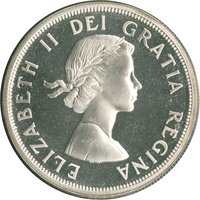
Description:
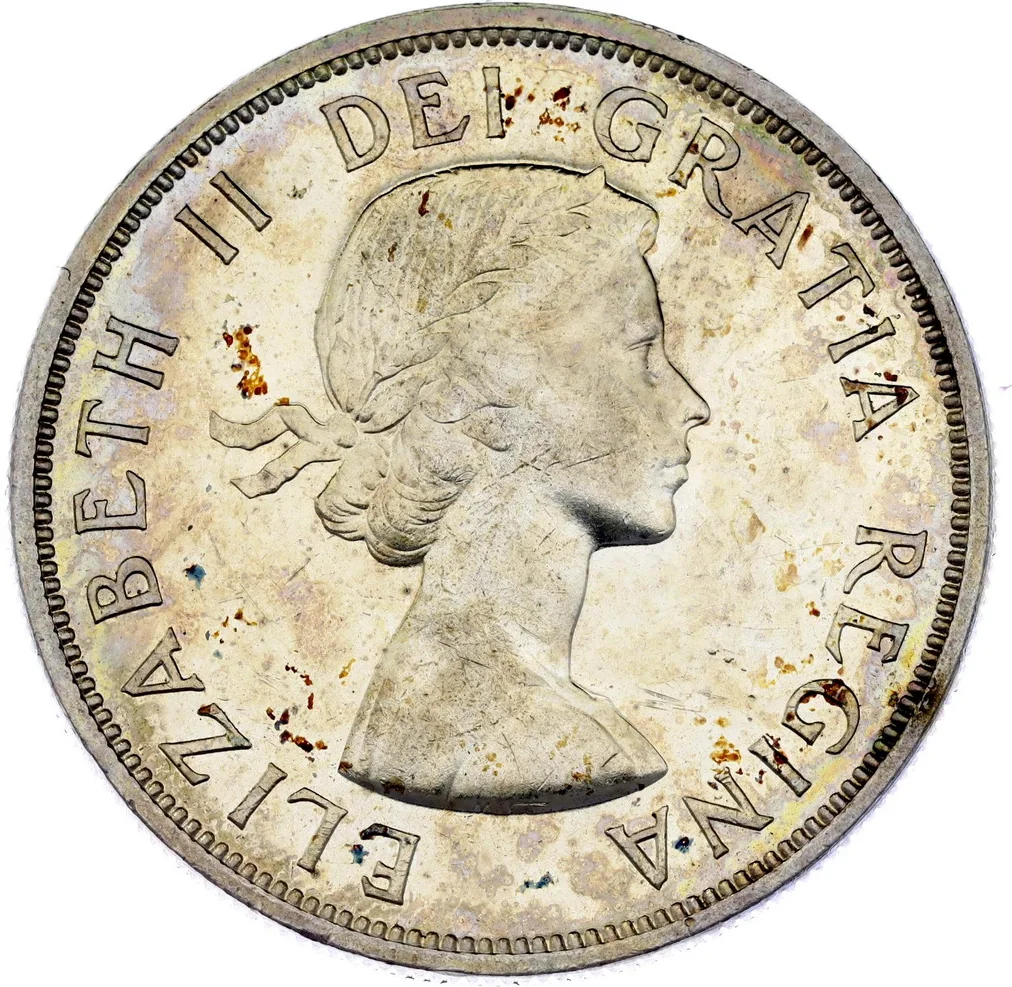
Bust of Queen Elizabeth II at age 27, wearing a wreath and facing right.
Inscription:
ELIZABETH II DEI GRATIA REGINA
MG
MG
Translation:
Elizabeth II by the Grace of God Queen
Script: Latin
Language: Latin
Engraver: Thomas Shingles
Designer: Mary Gillick
Reverse
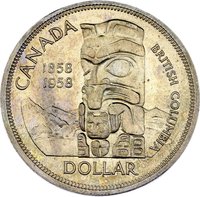
Description:
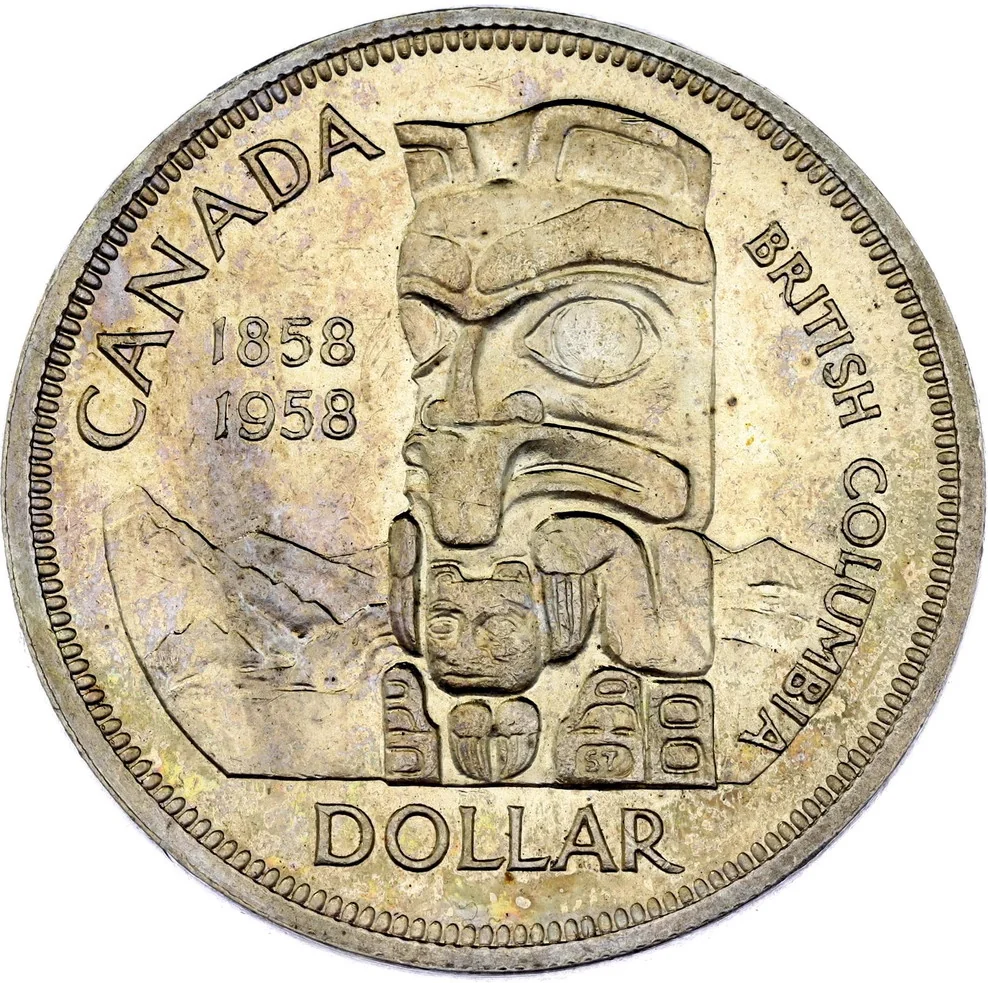
Totem pole before coastal mountains.
Inscription:
CANADA BRITISH COLUMBIA
1858
1958
DOLLAR
1858
1958
DOLLAR
Script: Latin
Engraver: Thomas Shingles
Designer: Stephen Trenka
Edge
Reeded
Mints
| Name | Mark |
|---|---|
| Royal Canadian Mint of Ottawa | — |
Mintings
| Year | Mint Mark | Mintage | Quality | Collection |
|---|---|---|---|---|
| 1958 | — | 3,039,630 |
Historical background
In 1958, Canada's currency situation was defined by its adherence to the Bretton Woods system of fixed exchange rates. The Canadian dollar was pegged to the United States dollar at a rate of approximately CAD $1.00 = USD $1.02, a slight premium that reflected strong international confidence in Canada's resource-driven economy. This fixed parity was maintained by the Bank of Canada, which held substantial reserves of US dollars and gold to intervene in foreign exchange markets, ensuring the currency traded within a narrow band. The system provided stability for trade, which was crucial given that the United States was by far Canada's largest trading partner.
However, this period of stability was a deliberate return to orthodoxy following a significant and controversial experiment. From 1950 to 1962, Canada had uniquely floated its dollar, allowing its value to be set by the market. This float began due to inflationary pressures and massive capital inflows, particularly from American investment. By 1958, the float was still technically in effect, but in practice, the Bank of Canada was heavily managing the rate to keep it virtually fixed against the US dollar, creating a "dirty float." This policy was a compromise, aiming to harness the flexibility of a floating rate while avoiding the political and economic risks of a sharply appreciating currency, which could hurt exports.
The underlying economic context was one of transition. The post-war boom was slowing, and the country entered a mild recession in 1958. Despite this, demand for Canadian staples like wheat, lumber, and minerals remained robust, supporting the currency's strength. The Diefenbaker government, elected in 1957, was navigating these economic crosscurrents while the Bank of Canada, under Governor James Coyne, pursued a notably tight monetary policy to curb inflation and speculative inflows. This tension between government priorities and central bank policy would soon escalate, setting the stage for the dramatic return to a formal fixed peg in 1962 after a speculative crisis against the Canadian dollar.
However, this period of stability was a deliberate return to orthodoxy following a significant and controversial experiment. From 1950 to 1962, Canada had uniquely floated its dollar, allowing its value to be set by the market. This float began due to inflationary pressures and massive capital inflows, particularly from American investment. By 1958, the float was still technically in effect, but in practice, the Bank of Canada was heavily managing the rate to keep it virtually fixed against the US dollar, creating a "dirty float." This policy was a compromise, aiming to harness the flexibility of a floating rate while avoiding the political and economic risks of a sharply appreciating currency, which could hurt exports.
The underlying economic context was one of transition. The post-war boom was slowing, and the country entered a mild recession in 1958. Despite this, demand for Canadian staples like wheat, lumber, and minerals remained robust, supporting the currency's strength. The Diefenbaker government, elected in 1957, was navigating these economic crosscurrents while the Bank of Canada, under Governor James Coyne, pursued a notably tight monetary policy to curb inflation and speculative inflows. This tension between government priorities and central bank policy would soon escalate, setting the stage for the dramatic return to a formal fixed peg in 1962 after a speculative crisis against the Canadian dollar.
🌱 Very Common