

Obverse
Description:
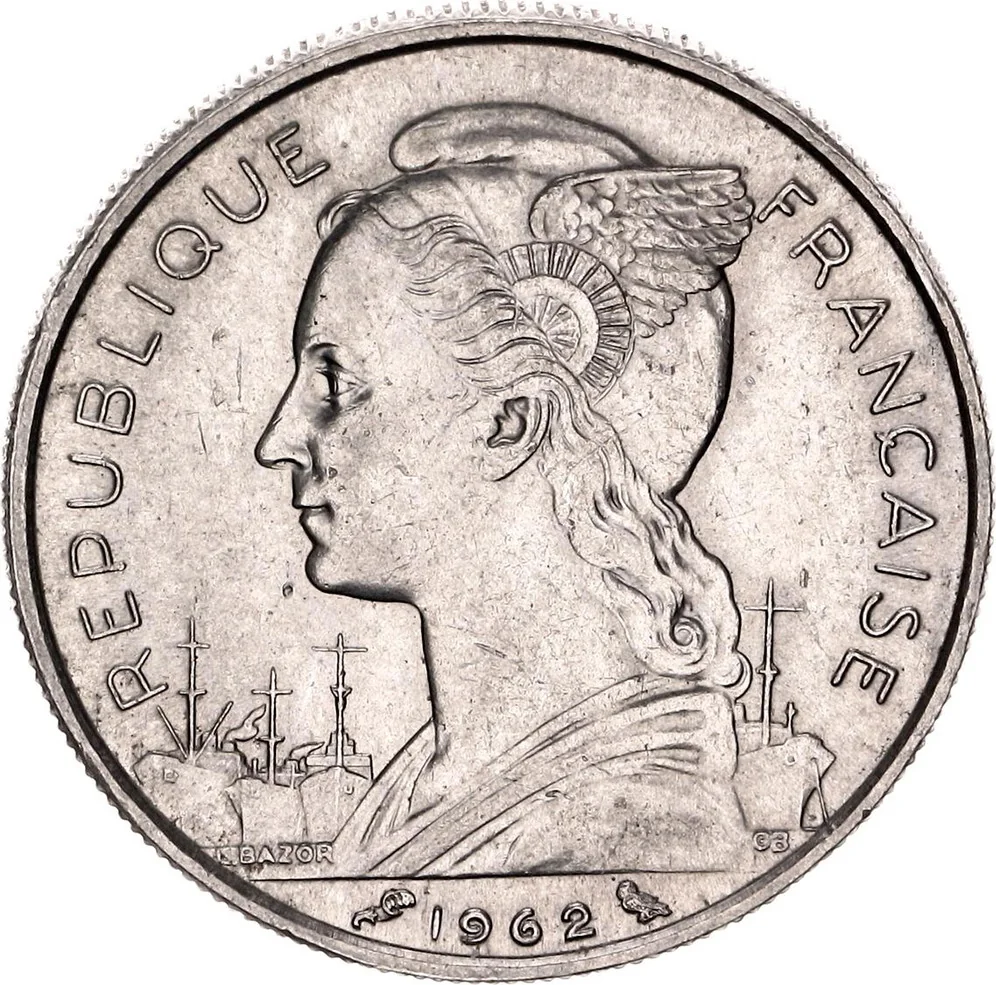
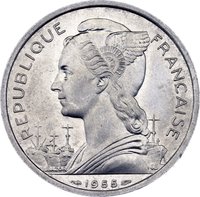
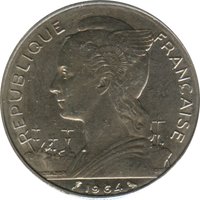
Marianne faces left in a winged Phrygian cap, with four ships behind her and the date below.
Inscription:
REPUBLIQUE FRANÇAISE
L.BAZOR GB
1964
L.BAZOR GB
1964
Translation:
FRENCH REPUBLIC
L.BAZOR GB
1964
L.BAZOR GB
1964
Script: Latin
Language: French
Engraver: Lucien Georges Bazor
Reverse
Description:
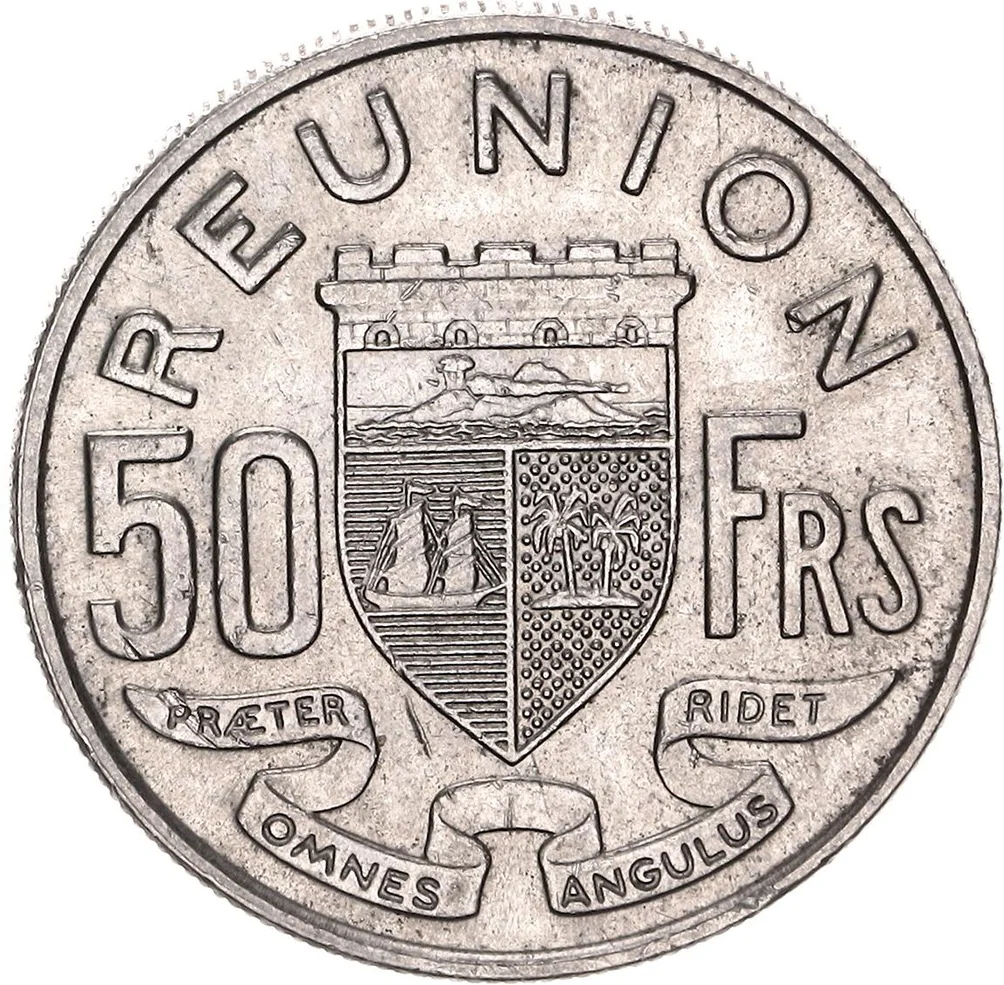
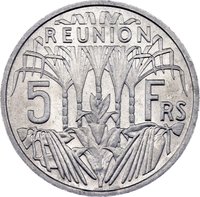
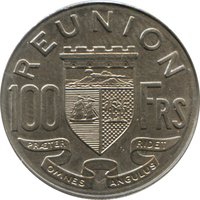
Shield of Saint-Denis divides value, motto "PRAETER OMNES ANGULUS RIDET" on ribbon below.
Inscription:
R E U N I O N
50 FRS
PRAETER OMNES ANGULUS RIDET
50 FRS
PRAETER OMNES ANGULUS RIDET
Script: Latin
Engraver: Lucien Georges Bazor
Edge
Reeded
Categories
| Transportation> Watercraft |
Mints
| Name | Mark |
|---|---|
| Monnaie de Paris | — |
Mintings
| Year | Mint Mark | Mintage | Quality | Collection |
|---|---|---|---|---|
| 1962 | — | 1,000,000 | ||
| 1964 | — | 500,000 | ||
| 1969 | — | 100,000 | ||
| 1970 | — | 100,000 | ||
| 1973 | — | 350,000 |
Historical background
In 1962, Réunion's currency situation was fundamentally defined by its status as an overseas department (département d'outre-mer) of France, a political integration that had been fully enacted in 1946. Consequently, the island's official legal tender was the French franc (FRF), issued and governed by the Banque de France. There was no local or separate Réunionese currency; the monetary system was an integral part of the French metropolitan system, with banknotes and coins circulating from France being used for all transactions.
This integration meant that Réunion had no independent monetary policy. Its money supply, interest rates, and exchange rates were entirely determined by the authorities in Paris. The island's economy, heavily dependent on sugar exports and French subsidies, was therefore directly affected by France's broader economic policies and the stability of the franc. During this period, France was operating under the Bretton Woods system of fixed exchange rates, which pegged the franc to the US dollar, indirectly tying Réunion's currency to international standards through the French link.
The year 1962 fell within a period of relative monetary stability for the French franc, following the 1958 devaluation and the introduction of the "new franc" (nouveau franc) in 1960. In Réunion, this transition to the new franc (where 1 new franc = 100 old francs) would have been fully implemented, simplifying accounting and aligning the island's currency even more closely with the modernized metropolitan system. Thus, the currency situation in Réunion in 1962 was one of complete assimilation, with the island functioning as a user, not a creator, of the French franc, fully embedded within the Franc Zone and subject to its disciplines and benefits.
This integration meant that Réunion had no independent monetary policy. Its money supply, interest rates, and exchange rates were entirely determined by the authorities in Paris. The island's economy, heavily dependent on sugar exports and French subsidies, was therefore directly affected by France's broader economic policies and the stability of the franc. During this period, France was operating under the Bretton Woods system of fixed exchange rates, which pegged the franc to the US dollar, indirectly tying Réunion's currency to international standards through the French link.
The year 1962 fell within a period of relative monetary stability for the French franc, following the 1958 devaluation and the introduction of the "new franc" (nouveau franc) in 1960. In Réunion, this transition to the new franc (where 1 new franc = 100 old francs) would have been fully implemented, simplifying accounting and aligning the island's currency even more closely with the modernized metropolitan system. Thus, the currency situation in Réunion in 1962 was one of complete assimilation, with the island functioning as a user, not a creator, of the French franc, fully embedded within the Franc Zone and subject to its disciplines and benefits.
🌱 Common