

Obverse
Description:
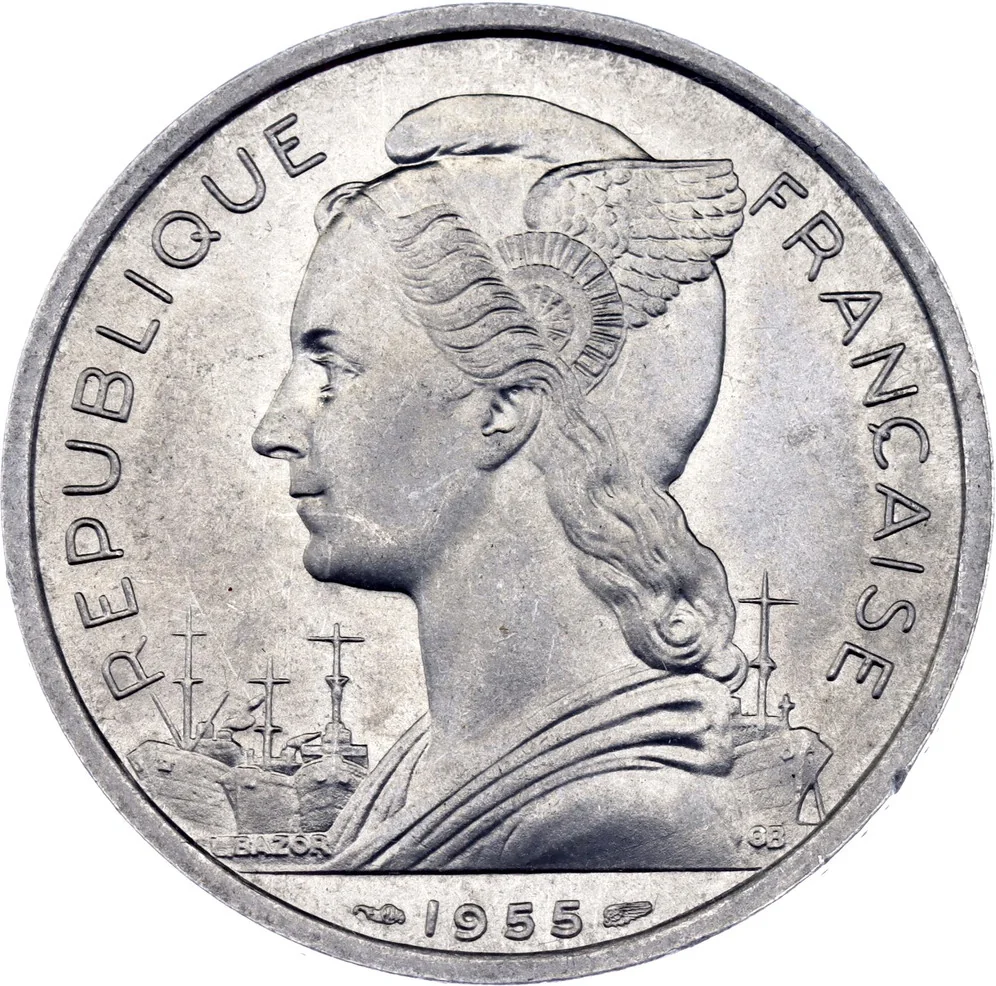
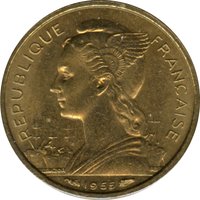
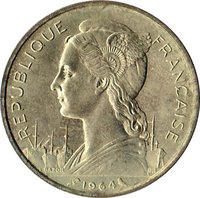
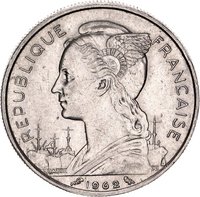
Marianne faces left in a winged Phrygian cap, with four ships behind her and the date below.
Inscription:
RÉPUBLIQUE FRANÇAISE
L.BAZOR GB
1955
L.BAZOR GB
1955
Translation:
FRENCH REPUBLIC
L.BAZOR GB
1955
L.BAZOR GB
1955
Script: Latin
Language: French
Engraver: Lucien Georges Bazor
Reverse
Description:
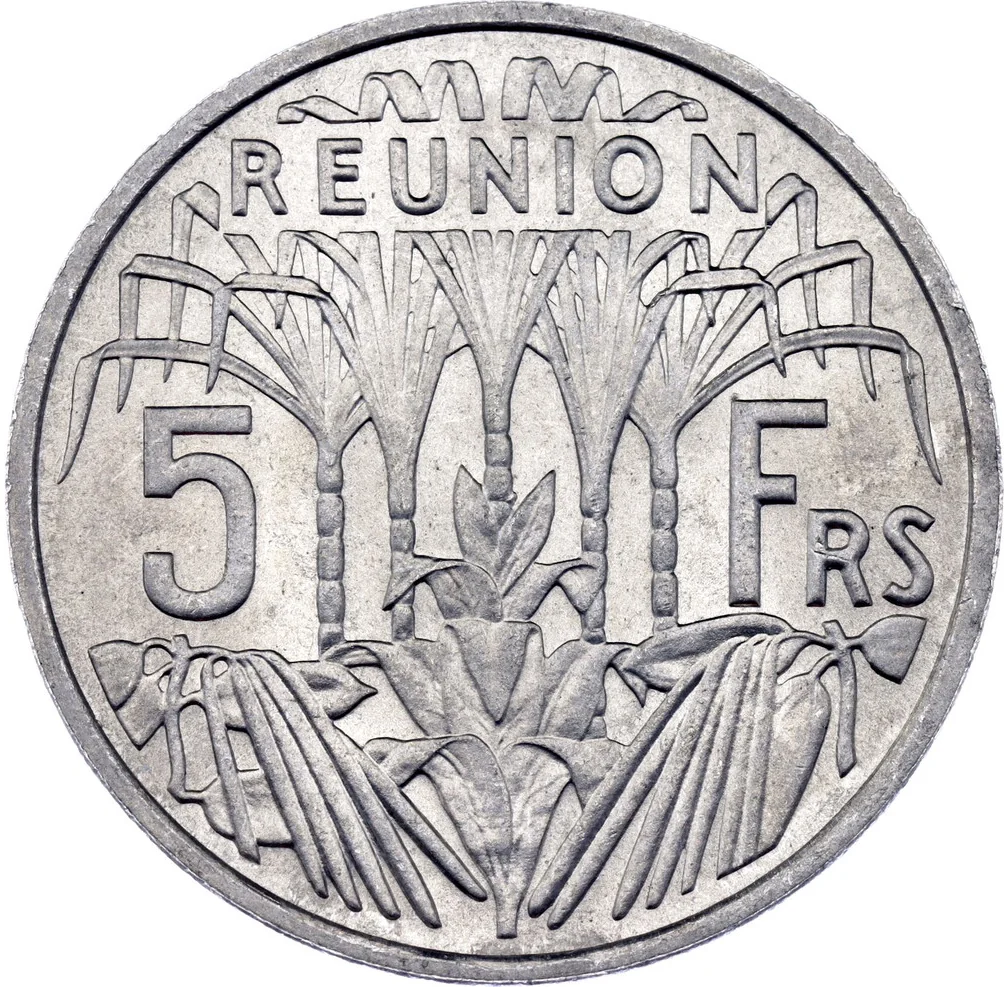
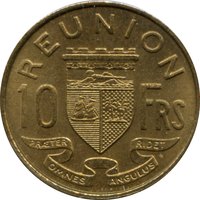
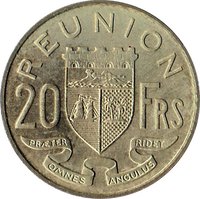
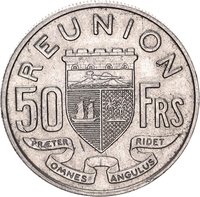
Sugar cane shares value.
Inscription:
RÉUNION
5 FRS
5 FRS
Translation:
RÉUNION
5 Francs
5 Francs
Script: Latin
Language: French
Engraver: Lucien Georges Bazor
Edge
Plain
Mints
| Name | Mark |
|---|---|
| Monnaie de Paris | — |
Mintings
| Year | Mint Mark | Mintage | Quality | Collection |
|---|---|---|---|---|
| 1955 | — | 3,000,000 | ||
| 1969 | — | 100,000 | ||
| 1970 | — | 200,000 | ||
| 1971 | — | 100,000 | ||
| 1972 | — | 300,000 | ||
| 1973 | — | 250,000 |
Historical background
In 1955, Réunion, as an overseas department of France, was fully integrated into the French monetary system. The official currency was the French Franc (FRF), governed by the Banque de France. There was no distinct "Réunion franc" or separate currency; the island used the same banknotes and coins as metropolitan France, reflecting its political status as an integral part of the republic. This monetary integration facilitated trade and administrative cohesion but also tied Réunion's economy directly to the economic policies and inflationary trends of the mainland.
The currency situation was stable but operated within the context of a controlled, post-war economy. France was still recovering from World War II and was part of the Bretton Woods system, which pegged the franc to the US dollar. As a result, Réunion's currency was indirectly linked to gold and the dollar. The island's economy, heavily dependent on sugar cane exports and reliant on imports for most manufactured goods, was therefore subject to exchange rate stability with France's major trading partners, but also vulnerable to shifts in the value of the franc.
Economically, the use of the French franc underscored the island's dependency. While it provided stability, it did not address underlying structural issues like high unemployment and a significant trade deficit. The currency facilitated the flow of subsidies and public investment from Paris, which were crucial for development, but it also meant Réunion had no autonomous monetary policy to address local economic challenges. Thus, in 1955, the currency situation was a symbol of both integration and dependence, functioning smoothly as a medium of exchange but within a framework that highlighted the island's constrained economic agency.
The currency situation was stable but operated within the context of a controlled, post-war economy. France was still recovering from World War II and was part of the Bretton Woods system, which pegged the franc to the US dollar. As a result, Réunion's currency was indirectly linked to gold and the dollar. The island's economy, heavily dependent on sugar cane exports and reliant on imports for most manufactured goods, was therefore subject to exchange rate stability with France's major trading partners, but also vulnerable to shifts in the value of the franc.
Economically, the use of the French franc underscored the island's dependency. While it provided stability, it did not address underlying structural issues like high unemployment and a significant trade deficit. The currency facilitated the flow of subsidies and public investment from Paris, which were crucial for development, but it also meant Réunion had no autonomous monetary policy to address local economic challenges. Thus, in 1955, the currency situation was a symbol of both integration and dependence, functioning smoothly as a medium of exchange but within a framework that highlighted the island's constrained economic agency.
🌱 Common