

25 rupiah – Indonesia
Add to wishlist
Indonesia
Context
Years: 1991–1996
Issuer: Indonesia
Issuing organization: Bank Indonesia
Period:
(since 1950)
Currency:
(since 1965)
Demonetized: Yes
Total mintage: 548,480,000
Material
References
KM: #
Numista: #4525
Value
Exchange value: 25 IDR
Inflation-adjusted value: 342.64 IDR
Obverse
Description:
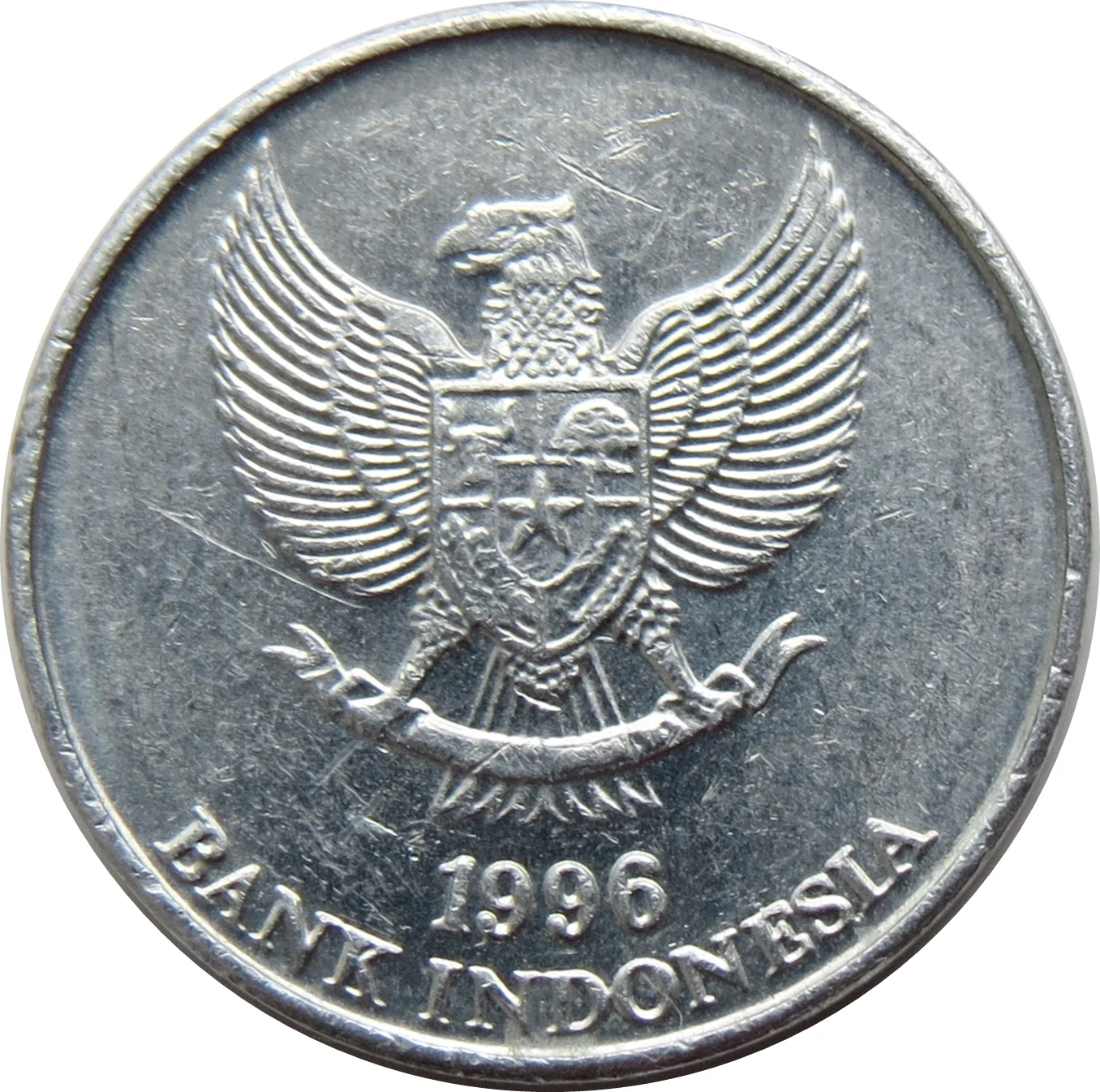
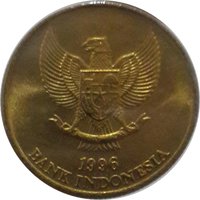
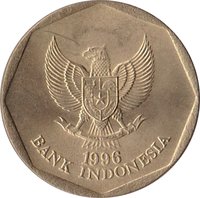
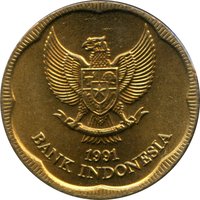
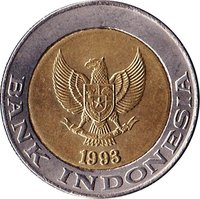
Garuda Pancasila, Indonesia's national emblem.
Inscription:
BHINNEKA TUNGGAL IKA
1996
BANK INDONESIA
1996
BANK INDONESIA
Translation:
Unity in Diversity
1996
Bank Indonesia
1996
Bank Indonesia
Script: Latin
Languages: Indonesian, Javanese
Reverse
Description:
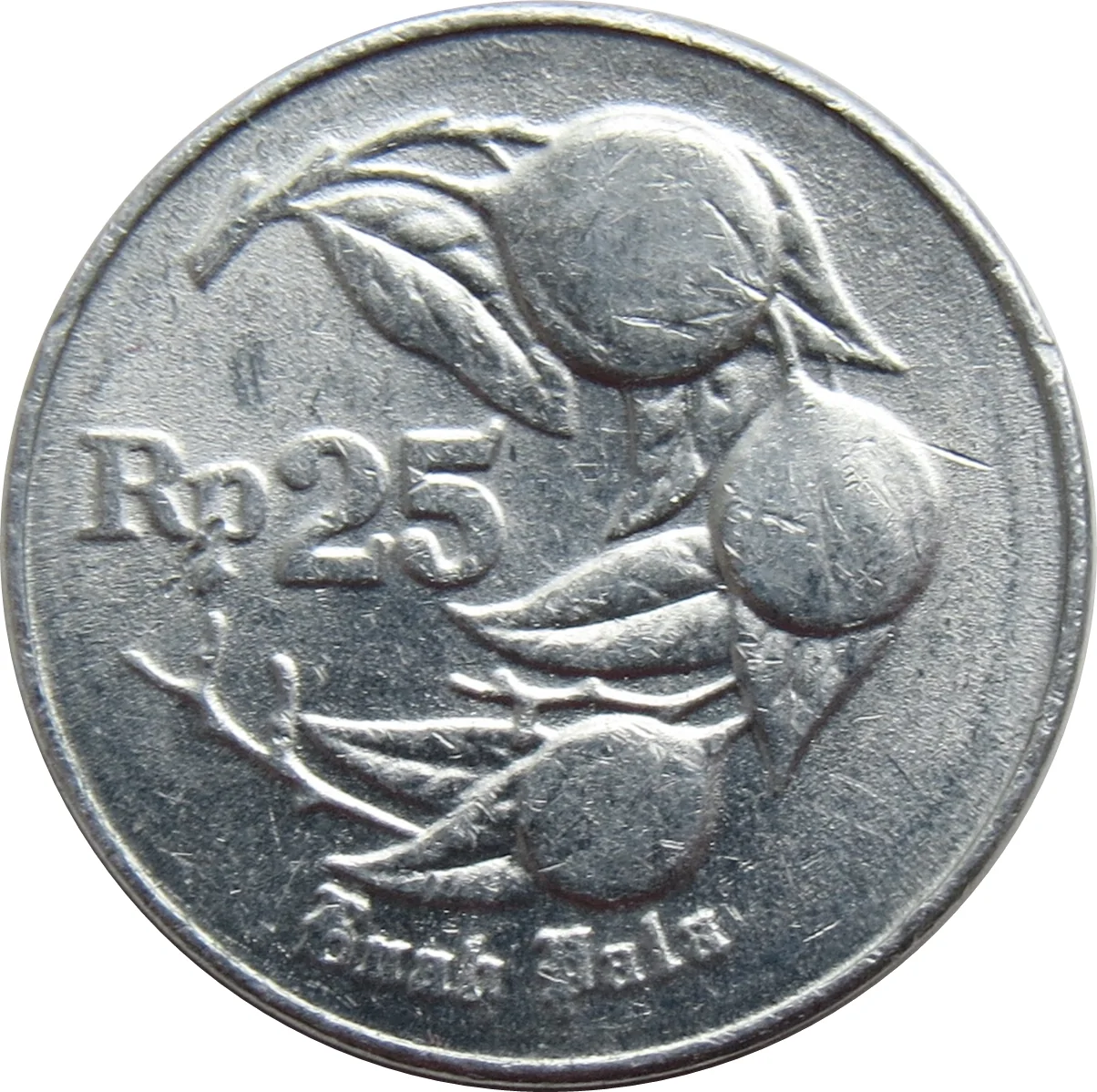
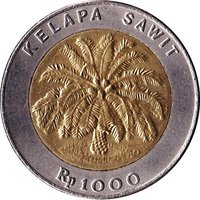
Nutmeg (Myristica fragrans)
Inscription:
Rp 25
Buah Pala
Buah Pala
Translation:
Rp 25
Nutmeg
Nutmeg
Scripts: Latin, Latin (Fraktur blackletter)
Language: Indonesian
Edge
Plain
Categories
| Plant> Fruit |
| Symbols> Coat of Arms |
Mints
| Name | Mark |
|---|---|
| Perum Peruri | — |
Mintings
| Year | Mint Mark | Mintage | Quality | Collection |
|---|---|---|---|---|
| 1991 | — | 30,000,000 | ||
| 1992 | — | 64,000,000 | ||
| 1993 | — | 20,000,000 | ||
| 1994 | — | 250,000,000 | ||
| 1995 | — | 184,480,000 | ||
| 1995 | — | — | Proof | |
| 1996 | — | — |
Historical background
In 1991, Indonesia's currency situation was characterized by a period of relative stability and cautious optimism under the managed floating exchange rate system administered by Bank Indonesia. The rupiah was pegged to a basket of currencies of Indonesia's major trading partners, though the composition was not publicly disclosed. This policy, in place since the 1970s, aimed to maintain export competitiveness by preventing sharp appreciations, while also providing a measure of predictability for businesses and investors. The year saw the rupiah experience only a modest controlled depreciation of approximately 4% against the US dollar, a deliberate move to offset higher domestic inflation and maintain the competitiveness of key exports like oil, gas, and textiles.
This stability was underpinned by several favorable macroeconomic conditions. The economy was growing robustly, fueled by strong foreign investment inflows and high global oil prices, which boosted government revenues. Furthermore, Indonesia was benefiting from a wave of capital inflows into emerging markets in the early 1990s. The country's debt situation had also improved significantly since the reforms of the late 1980s, with prudent fiscal management and a growing non-oil export sector reducing vulnerability to external shocks. Consequently, foreign exchange reserves were adequate, providing Bank Indonesia with the means to effectively manage the exchange rate within its targeted band.
However, this apparent calm masked underlying vulnerabilities that would later contribute to the 1997 Asian Financial Crisis. The banking sector was expanding rapidly with inadequate supervision, leading to a buildup of risky private-sector debt, much of which was denominated in US dollars. The rigidity of the managed exchange rate regime created a perception of implicit government guarantee against currency risk, encouraging further foreign borrowing. While 1991 itself was not a year of crisis, it represented the peak of a stability that was increasingly reliant on sustained investor confidence and continuous capital inflows, setting the stage for future turbulence when those conditions eventually reversed.
This stability was underpinned by several favorable macroeconomic conditions. The economy was growing robustly, fueled by strong foreign investment inflows and high global oil prices, which boosted government revenues. Furthermore, Indonesia was benefiting from a wave of capital inflows into emerging markets in the early 1990s. The country's debt situation had also improved significantly since the reforms of the late 1980s, with prudent fiscal management and a growing non-oil export sector reducing vulnerability to external shocks. Consequently, foreign exchange reserves were adequate, providing Bank Indonesia with the means to effectively manage the exchange rate within its targeted band.
However, this apparent calm masked underlying vulnerabilities that would later contribute to the 1997 Asian Financial Crisis. The banking sector was expanding rapidly with inadequate supervision, leading to a buildup of risky private-sector debt, much of which was denominated in US dollars. The rigidity of the managed exchange rate regime created a perception of implicit government guarantee against currency risk, encouraging further foreign borrowing. While 1991 itself was not a year of crisis, it represented the peak of a stability that was increasingly reliant on sustained investor confidence and continuous capital inflows, setting the stage for future turbulence when those conditions eventually reversed.
Series: 1991 Indonesia circulation coins


🌱 Very Common