

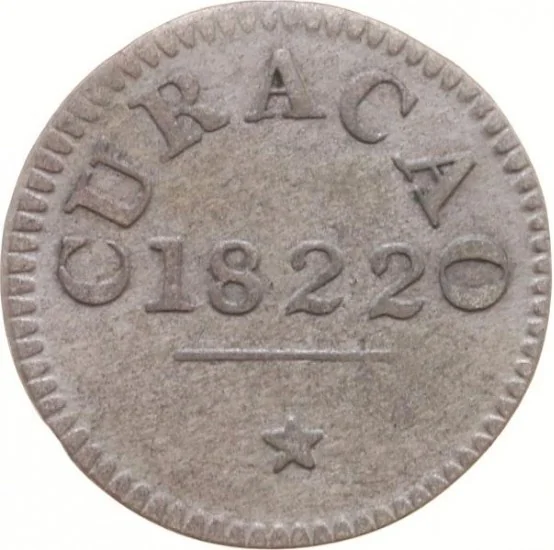
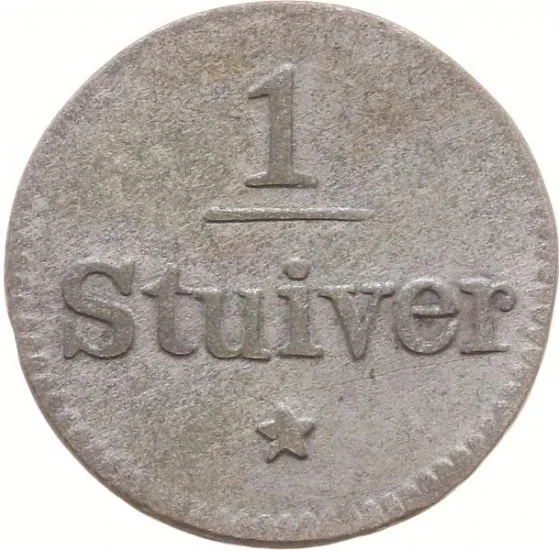
1 stuiver – Curaçao
Add to wishlist
Netherlands
Context
Year: 1822
Country: Netherlands
Issuer: Curaçao
Ruler: William I
Currency:
(1799—1828)
Demonetized: Yes
Total mintage: 360,000
Material
References
KM: #
Numista: #45220
Obverse
Reverse
Edge
Plain
Mints
| Name | Mark |
|---|---|
| Royal Dutch Mint | — |
Mintings
| Year | Mint Mark | Mintage | Quality | Collection |
|---|---|---|---|---|
| 1822 | — | 360,000 |
Historical background
In 1822, Curaçao was a Dutch colony navigating a complex and challenging monetary landscape. The island's economy, heavily reliant on trade and its role as a free port, was plagued by a severe shortage of official coinage. The primary currency in theory was the Dutch guilder, but in practice, a bewildering variety of foreign coins circulated, including Spanish American pesos (pieces of eight), British sovereigns, and coins from other Caribbean and South American territories. This scarcity of standardized money hindered daily commerce and created uncertainty in transactions.
The root of the problem lay in the colonial trade imbalance. Curaçao imported more than it exported, causing official Dutch coins to constantly flow off the island to settle debts. To fill the void, merchants and officials were forced to accept almost any coin with intrinsic silver or gold value, leading to a de facto system of trade by weight and assay rather than by a stable unit of account. The colonial government frequently issued proclamations attempting to set fixed exchange rates for the myriad of foreign coins, but these official valuations often conflicted with their actual market value based on metal content, leading to confusion, arbitrage, and a thriving business for money changers.
This chaotic situation was a persistent feature of Curaçao's 19th-century economy and was not unique to 1822. The year itself did not see a major monetary reform but represented a point within this ongoing struggle. The lack of a uniform, trusted currency reflected the island's position as a commercial crossroads and the broader monetary disarray in the post-Napoleonic War Atlantic world, where the collapse of the Spanish Empire further fragmented regional currency systems. Effective solutions would remain elusive for decades, with the currency chaos only beginning to be resolved after the establishment of the Curaçao Bank in 1828.
The root of the problem lay in the colonial trade imbalance. Curaçao imported more than it exported, causing official Dutch coins to constantly flow off the island to settle debts. To fill the void, merchants and officials were forced to accept almost any coin with intrinsic silver or gold value, leading to a de facto system of trade by weight and assay rather than by a stable unit of account. The colonial government frequently issued proclamations attempting to set fixed exchange rates for the myriad of foreign coins, but these official valuations often conflicted with their actual market value based on metal content, leading to confusion, arbitrage, and a thriving business for money changers.
This chaotic situation was a persistent feature of Curaçao's 19th-century economy and was not unique to 1822. The year itself did not see a major monetary reform but represented a point within this ongoing struggle. The lack of a uniform, trusted currency reflected the island's position as a commercial crossroads and the broader monetary disarray in the post-Napoleonic War Atlantic world, where the collapse of the Spanish Empire further fragmented regional currency systems. Effective solutions would remain elusive for decades, with the currency chaos only beginning to be resolved after the establishment of the Curaçao Bank in 1828.
💎 Extremely Rare