

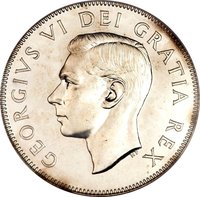
Obverse
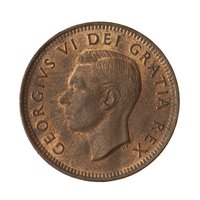
Description:
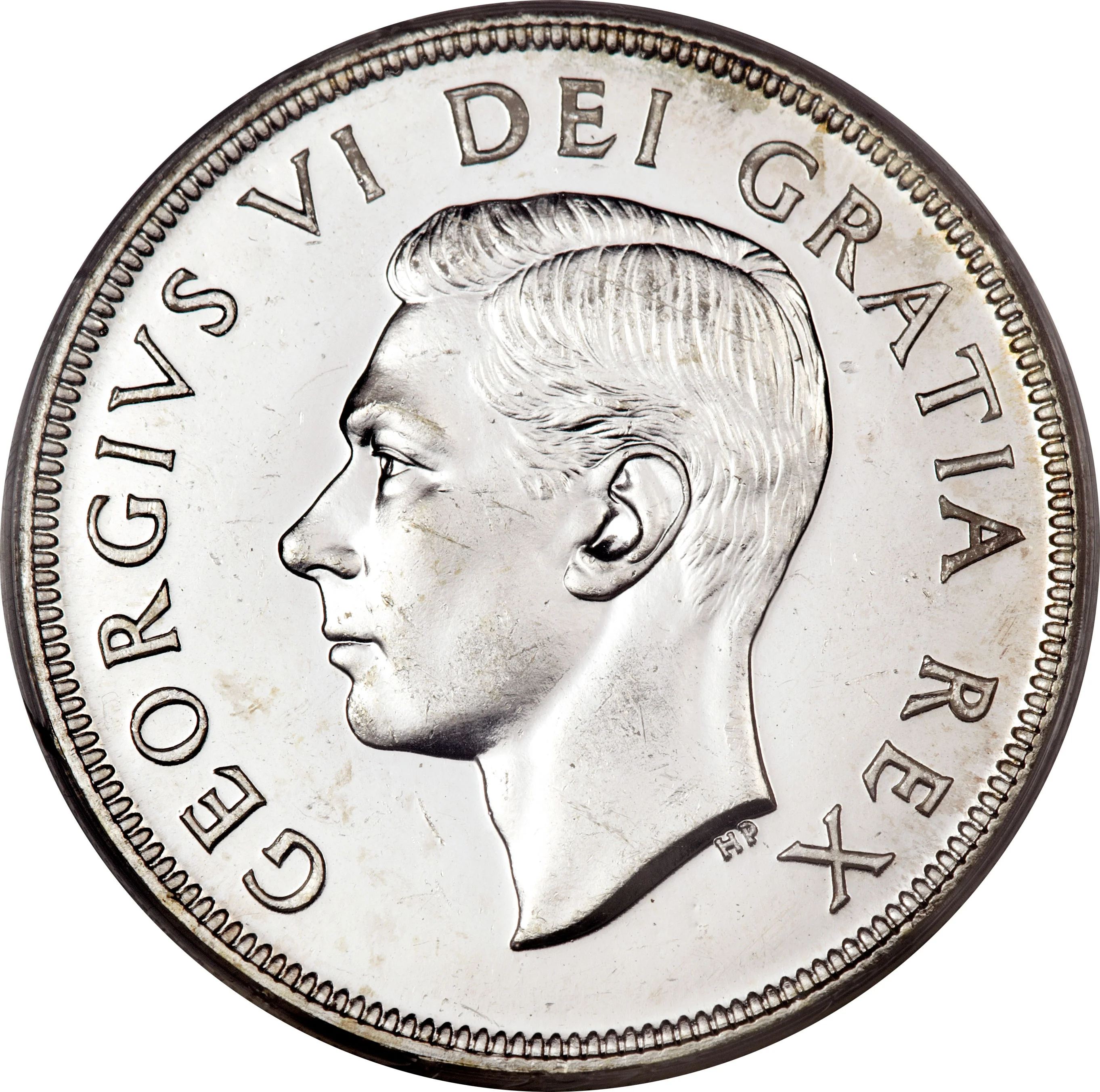
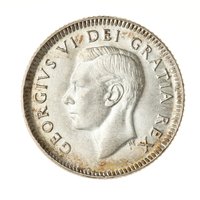
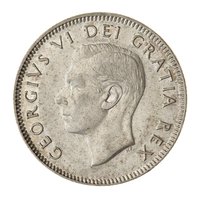
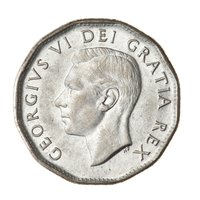
King George VI left-facing portrait.
Inscription:
GEORGIVS VI DEI GRATIA REX
HP
HP
Translation:
George VI by the Grace of God King
Script: Latin
Language: Latin
Engraver: Thomas Humphrey Paget
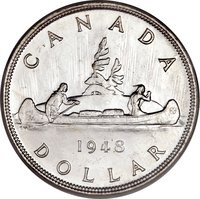
Reverse
Description:
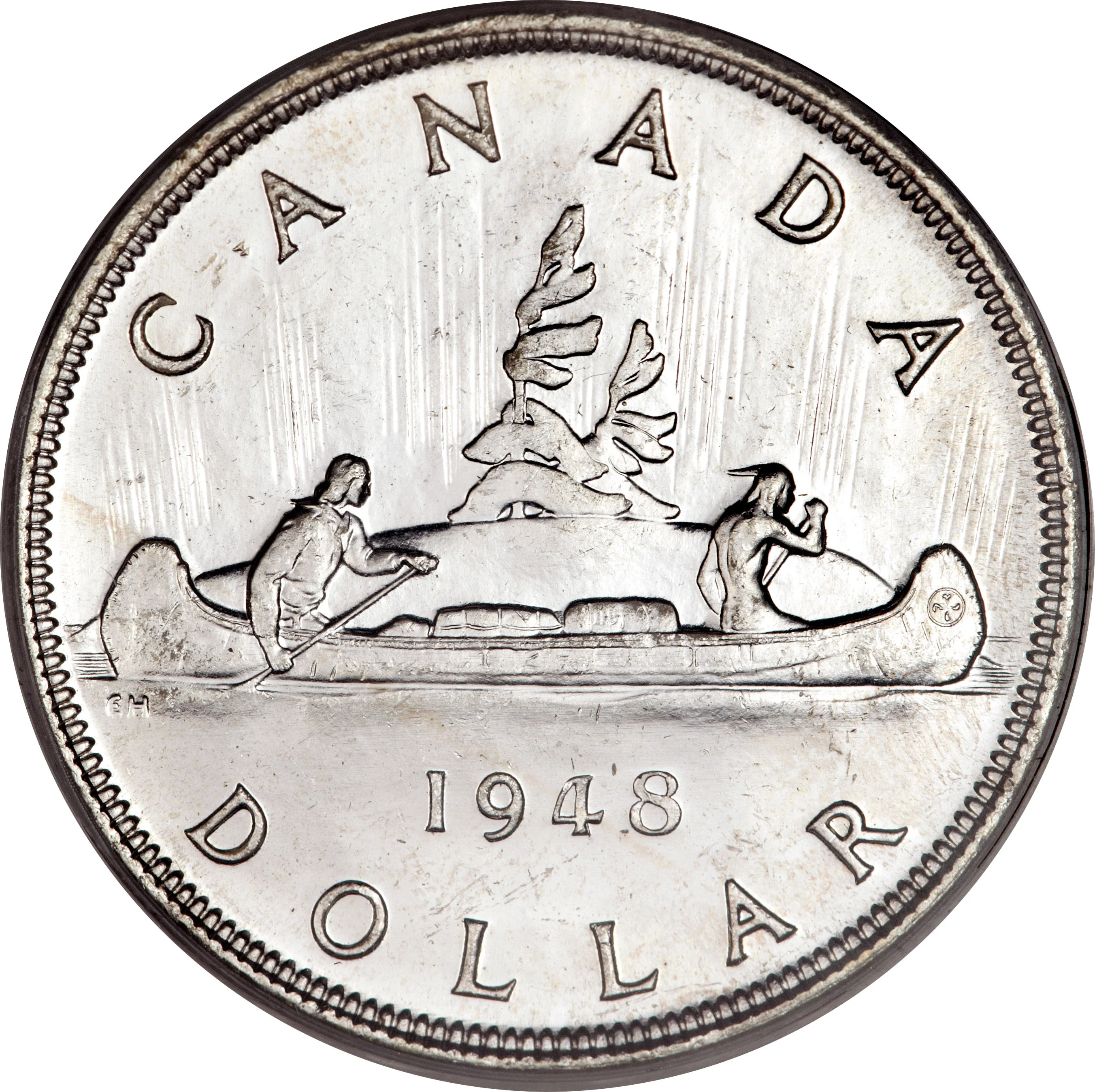
A voyageur and Indigenous guide paddle a canoe with Hudson's Bay Company ("HB") bundles, flanked by the face value and "CANADA."
Inscription:
CANADA
1948
DOLLAR
EH
1948
DOLLAR
EH
Script: Latin
Engraver: Emanuel Otto Hahn
Edge
Milled
Categories
| Transportation> Watercraft |
Mints
| Name | Mark |
|---|---|
| Royal Canadian Mint of Ottawa | — |
Mintings
| Year | Mint Mark | Mintage | Quality | Collection |
|---|---|---|---|---|
| 1948 | — | 18,780 | ||
| 1950 | — | — | Proof | |
| 1950 | — | 261,002 | ||
| 1951 | — | 416,395 | ||
| 1952 | — | 406,148 |
Historical background
In 1948, Canada’s currency situation was defined by its position within the Bretton Woods system, established in 1944. The Canadian dollar was pegged to the United States dollar at a fixed rate of 1.00 CAD = 0.925 USD (or US$1 = $1.10 Canadian), a parity maintained by the Foreign Exchange Control Board. This fixed exchange rate was intended to provide stability for international trade and investment, which was crucial for a resource-exporting nation like Canada. However, this period was one of transition and mild tension, as post-war economic pressures and strong capital inflows from the United States began testing the sustainability of the peg.
Domestically, the currency was backed by a central bank, the Bank of Canada, which had been nationalized in 1938. While the Bretton Woods system officially tied currencies to gold, in practice, the Canadian dollar’s value was managed against the U.S. dollar, which itself was convertible to gold. Canada’s economy was performing robustly, driven by exports and post-war reconstruction, but this success attracted substantial American investment. These capital inflows created upward pressure on the Canadian dollar, making it increasingly difficult and expensive for the authorities to maintain the agreed-upon fixed rate by selling Canadian dollars and buying foreign reserves.
The strains of 1948 would culminate just two years later. In 1950, facing persistent and overwhelming market pressure, Canada made a historic and unconventional decision within the Bretton Woods framework: it floated its dollar. This move to a flexible exchange rate in September 1950 was a direct outcome of the conflicting monetary pressures experienced in the late 1940s, where the fixed parity was seen as incompatible with independent domestic economic management and free capital flows. Thus, 1948 represents the final years of Canada’s initial post-war fixed exchange rate, a period of growing economic confidence that simultaneously exposed the vulnerabilities of its currency peg.
Domestically, the currency was backed by a central bank, the Bank of Canada, which had been nationalized in 1938. While the Bretton Woods system officially tied currencies to gold, in practice, the Canadian dollar’s value was managed against the U.S. dollar, which itself was convertible to gold. Canada’s economy was performing robustly, driven by exports and post-war reconstruction, but this success attracted substantial American investment. These capital inflows created upward pressure on the Canadian dollar, making it increasingly difficult and expensive for the authorities to maintain the agreed-upon fixed rate by selling Canadian dollars and buying foreign reserves.
The strains of 1948 would culminate just two years later. In 1950, facing persistent and overwhelming market pressure, Canada made a historic and unconventional decision within the Bretton Woods framework: it floated its dollar. This move to a flexible exchange rate in September 1950 was a direct outcome of the conflicting monetary pressures experienced in the late 1940s, where the fixed parity was seen as incompatible with independent domestic economic management and free capital flows. Thus, 1948 represents the final years of Canada’s initial post-war fixed exchange rate, a period of growing economic confidence that simultaneously exposed the vulnerabilities of its currency peg.
Series: 1948 Canada circulation coins
🌱 Common