

5 cents – Canada
Add to wishlist
Canada
Context
Material
Diameter: 21.23 mm
Weight: 4.54 g
Thickness: 1.7 mm
Shape: Dodecagonal
Technique: Milled
Alignment: Medal alignment
flip
References
KM: #
Numista: #406
Value
Exchange value: 0.05 CAD
Inflation-adjusted value: 0.65 CAD
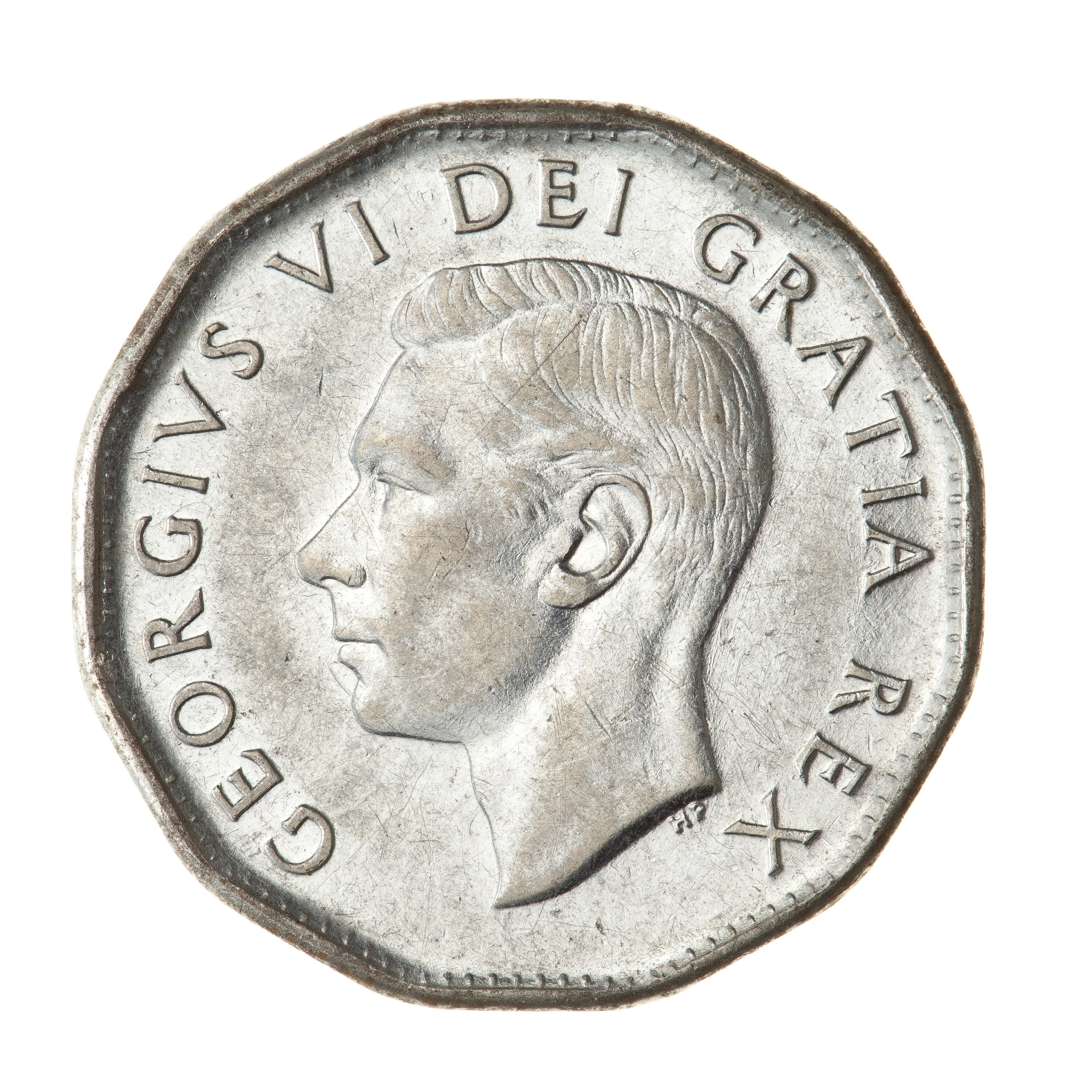
Obverse
Description:
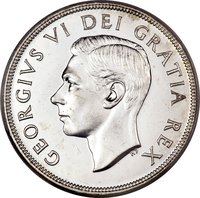
King George VI left-facing portrait.
Inscription:
GEORGIVS VI DEI GRATIA REX
HP
HP
Translation:
George VI by the Grace of God King
Script: Latin
Language: Latin
Engraver: Thomas Shingles
Designer: Thomas Humphrey Paget
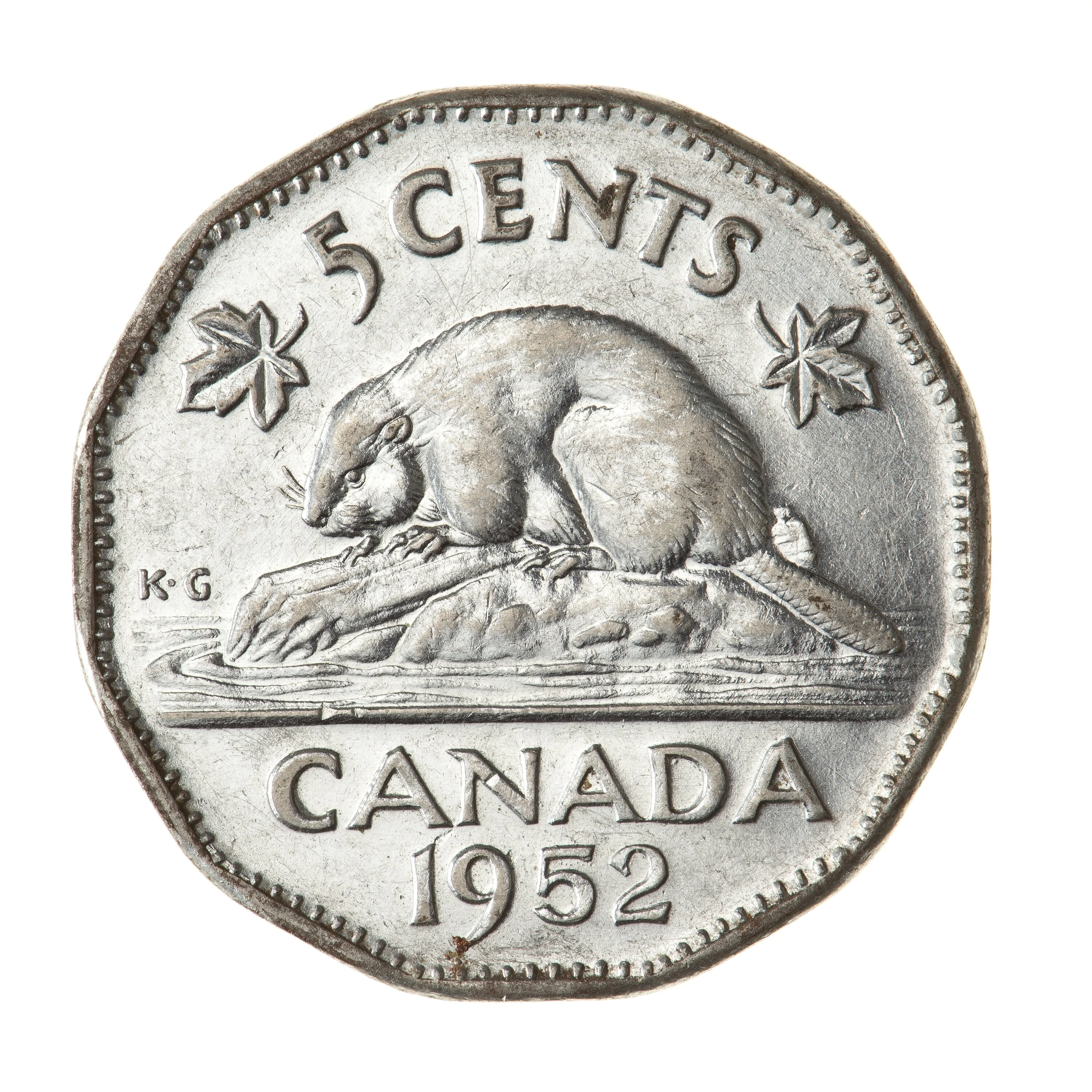
Reverse
Description:
A beaver above "CANADA" is flanked by maple leaves and the face value.
Inscription:
5 CENTS
CANADA
1951
K·G
CANADA
1951
K·G
Script: Latin
Engraver: Thomas Shingles
Designer: George Kruger Gray
Edge
Plain
Mints
| Name | Mark |
|---|---|
| Royal Canadian Mint of Ottawa | — |
Mintings
| Year | Mint Mark | Mintage | Quality | Collection |
|---|---|---|---|---|
| 1951 | — | — | ||
| 1952 | — | 10,891,148 |
Historical background
In 1951, Canada's currency system was firmly anchored in the Bretton Woods international monetary order, established after World War II. The Canadian dollar was pegged to the United States dollar at a fixed rate of approximately 1.00 CAD = 0.925 USD, which itself was convertible to gold at $35 per ounce. This fixed exchange rate provided stability for trade and investment, which was crucial for a nation whose economy was heavily dependent on exports, particularly natural resources and manufactured goods flowing to its southern neighbour and war-ravaged Europe. The Bank of Canada, operating under the 1934 Bank of Canada Act, managed this peg and was responsible for the nation's monetary policy, though its tools were more constrained by the requirements of maintaining the fixed parity.
Domestically, Canada was experiencing a period of robust post-war economic expansion and rising inflation pressures, partly due to the Korean War boom that began in 1950. This created a policy dilemma: the need to control inflation through higher interest rates conflicted with the desire to maintain the fixed exchange rate, as higher rates could attract destabilizing speculative capital inflows. Notably, Canada had already faced this tension and would, just a decade later in 1962, formally return to a fixed peg after a unique experiment with a floating exchange rate from 1950 to 1962. However, in 1951 specifically, the currency remained formally fixed, and the government utilized fiscal measures and direct controls more heavily than later decades to manage the overheated economy without abandoning its Bretton Woods commitment.
The physical currency in circulation reflected Canada's constitutional history and evolving identity. Banknotes, issued by the Bank of Canada, featured the portrait of King George VI, who would pass away the following year. These notes were bilingual, a practice established in 1937, but still carried predominantly British symbolism. Coins, minted by the Royal Canadian Mint, bore the effigy of the monarch and were decimal, with denominations like the silver dollar (containing 80% silver until 1968) and the popular "nickel" five-cent piece. Thus, the 1951 currency situation embodied a nation balancing international obligations, domestic economic pressures, and a cultural identity in transition within the broader Commonwealth framework.
Domestically, Canada was experiencing a period of robust post-war economic expansion and rising inflation pressures, partly due to the Korean War boom that began in 1950. This created a policy dilemma: the need to control inflation through higher interest rates conflicted with the desire to maintain the fixed exchange rate, as higher rates could attract destabilizing speculative capital inflows. Notably, Canada had already faced this tension and would, just a decade later in 1962, formally return to a fixed peg after a unique experiment with a floating exchange rate from 1950 to 1962. However, in 1951 specifically, the currency remained formally fixed, and the government utilized fiscal measures and direct controls more heavily than later decades to manage the overheated economy without abandoning its Bretton Woods commitment.
The physical currency in circulation reflected Canada's constitutional history and evolving identity. Banknotes, issued by the Bank of Canada, featured the portrait of King George VI, who would pass away the following year. These notes were bilingual, a practice established in 1937, but still carried predominantly British symbolism. Coins, minted by the Royal Canadian Mint, bore the effigy of the monarch and were decimal, with denominations like the silver dollar (containing 80% silver until 1968) and the popular "nickel" five-cent piece. Thus, the 1951 currency situation embodied a nation balancing international obligations, domestic economic pressures, and a cultural identity in transition within the broader Commonwealth framework.
🌱 Very Common