

10 kroner (Universal Suffrage) – Norway
Add to wishlist
Circulating commemorative coins
Commemoration: 100th Anniversary of Universal Suffrage
Norway
Context
Material
References
KM: #
Numista: #44927
Value
Exchange value: 10 NOK
Inflation-adjusted value: 14.48 NOK
Obverse
Description:
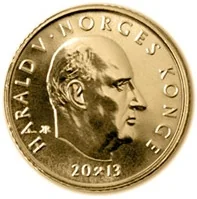
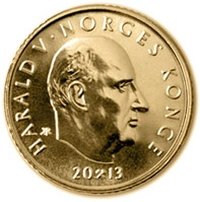
King Harald V bust facing right. Engraver's initials behind bust. Inscription surrounds. Date split by mintmark below. Solid rim ring.
Inscription:
HARALD V · NORGES KONGE
IAR
20 ⚒ 13
IAR
20 ⚒ 13
Translation:
Harald V, Norway's King
20th Anniversary
20 · 13
20th Anniversary
20 · 13
Script: Latin
Engraver: Ingrid Austlid Rise
Reverse
Description:
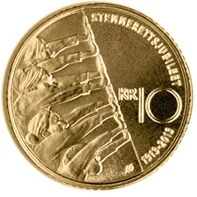
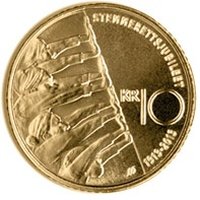
Four women pushing a large object. Inscription, value, and date at right. Designer's initials below. Solid ring on rim.
Inscription:
STEMMERETTSJUBILEET
KR 10
1913-2013
SD
KR 10
1913-2013
SD
Translation:
The Centenary of Women's Suffrage
10 Kroner
1913-2013
Sd
10 Kroner
1913-2013
Sd
Script: Latin
Language: Norwegian
Engraver: Ingrid Austlid Rise
Designer: Siri Dokken
Edge
Segmented reeding.
Categories
| Human rights |
Mints
| Name | Mark |
|---|---|
| Norwegian Mint | — |
Mintings
| Year | Mint Mark | Mintage | Quality | Collection |
|---|---|---|---|---|
| 2013 | — | 2,025,111 | ||
| 2013 | — | 2,894 | Proof |
Historical background
In 2013, Norway's currency situation was dominated by the persistent strength of the Norwegian krone (NOK), a phenomenon often referred to as the "krone paradox." Despite historically low interest rates from Norges Bank, the central bank, the krone remained robust, trading at high levels against major currencies like the euro and the US dollar. This strength was fundamentally driven by Norway's strong economic position, fueled by high oil and gas prices, substantial foreign exchange reserves, and a sovereign wealth fund (the Government Pension Fund Global) that was the largest in the world. The country's AAA credit rating and fiscal stability made the krone a sought-after safe-haven currency.
This strong krone presented a significant challenge for Norway's non-oil export industries, particularly manufacturing, fisheries, and tourism. Companies in these sectors faced intense competitive pressure in international markets, as their goods and services became more expensive for foreign buyers. The situation sparked considerable debate between industry leaders, who called for intervention to weaken the currency, and the central bank, which emphasized its mandate for price stability. Norges Bank's main policy tool was the key policy rate, which it had cut to 1.5% by March 2013 in part to temper krone appreciation, but with limited effect.
Consequently, 2013 was a year of strategic patience and limited tools for Norwegian monetary authorities. Norges Bank explicitly stated it would not engage in direct currency intervention, relying instead on interest rate policy and verbal guidance. The bank's forward guidance in its monetary policy reports consistently signaled that rates would remain low for an extended period, a stance aimed at capping the krone's rise. The year ended with the currency strength largely unabated, underscoring the complex disconnect between domestic interest rate policy and a currency valuation overwhelmingly shaped by global hydrocarbon markets and macroeconomic stability.
This strong krone presented a significant challenge for Norway's non-oil export industries, particularly manufacturing, fisheries, and tourism. Companies in these sectors faced intense competitive pressure in international markets, as their goods and services became more expensive for foreign buyers. The situation sparked considerable debate between industry leaders, who called for intervention to weaken the currency, and the central bank, which emphasized its mandate for price stability. Norges Bank's main policy tool was the key policy rate, which it had cut to 1.5% by March 2013 in part to temper krone appreciation, but with limited effect.
Consequently, 2013 was a year of strategic patience and limited tools for Norwegian monetary authorities. Norges Bank explicitly stated it would not engage in direct currency intervention, relying instead on interest rate policy and verbal guidance. The bank's forward guidance in its monetary policy reports consistently signaled that rates would remain low for an extended period, a stance aimed at capping the krone's rise. The year ended with the currency strength largely unabated, underscoring the complex disconnect between domestic interest rate policy and a currency valuation overwhelmingly shaped by global hydrocarbon markets and macroeconomic stability.
🌱 Common