

10 Pesos (War of Independence) – Mexico
Circulating commemorative coins
Commemoration: 150th Anniversary of the War of Independence
Mexico
Obverse
Description:
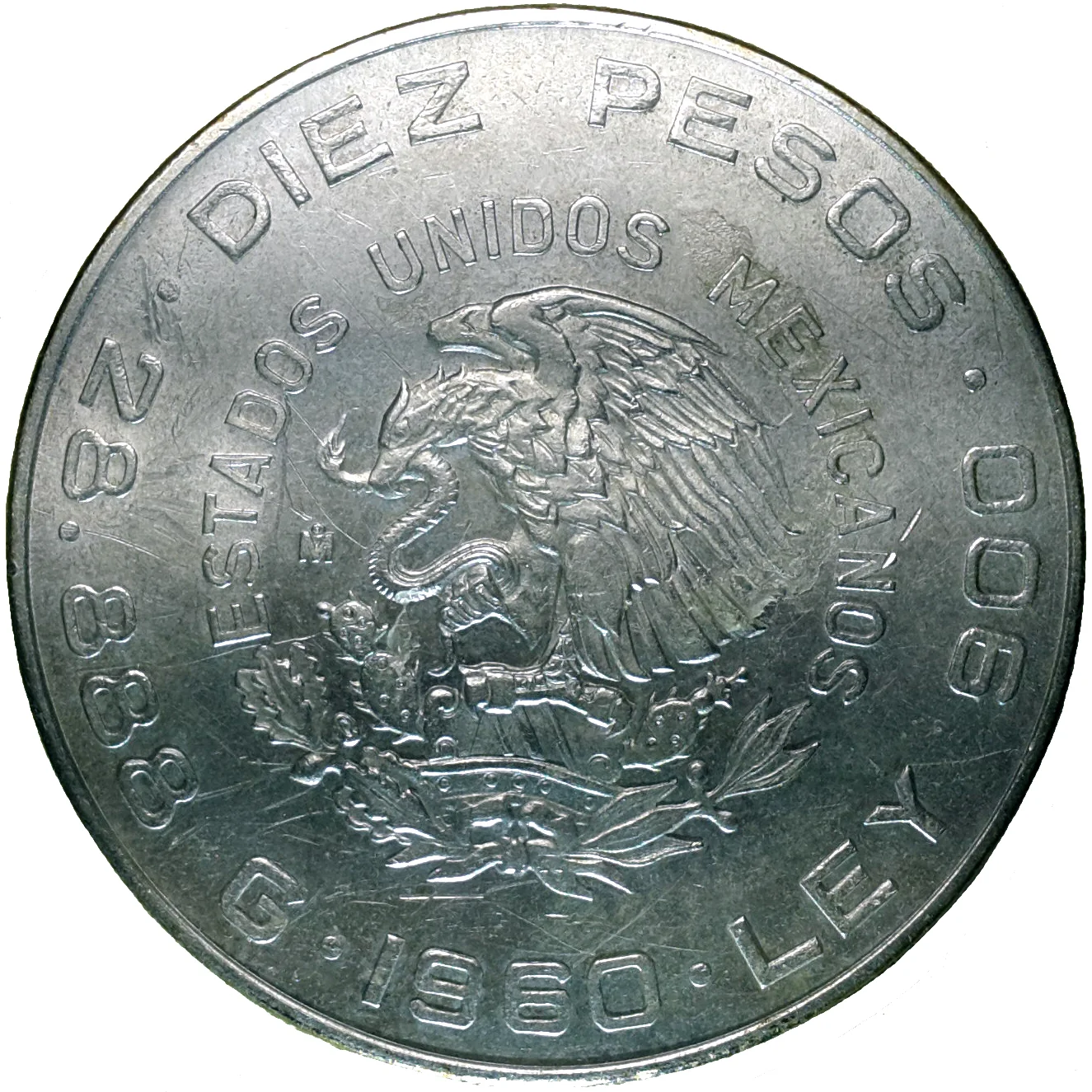
The Mexican coat of arms—an eagle on a cactus devouring a snake, flanked by oak and laurel branches—is encircled by "Estados Unidos Mexicanos" and surrounded by the coin's date, weight, purity, and denomination.
Inscription:
DIEZ PESOS
28.888 G · 1960 · LEY 900
ESTADOS UNIDOS MEXICANOS
Mo
28.888 G · 1960 · LEY 900
ESTADOS UNIDOS MEXICANOS
Mo
Translation:
TEN PESOS
28.888 G · 1960 · .900 FINE
UNITED MEXICAN STATES
28.888 G · 1960 · .900 FINE
UNITED MEXICAN STATES
Script: Latin
Language: Spanish
Reverse
Description:
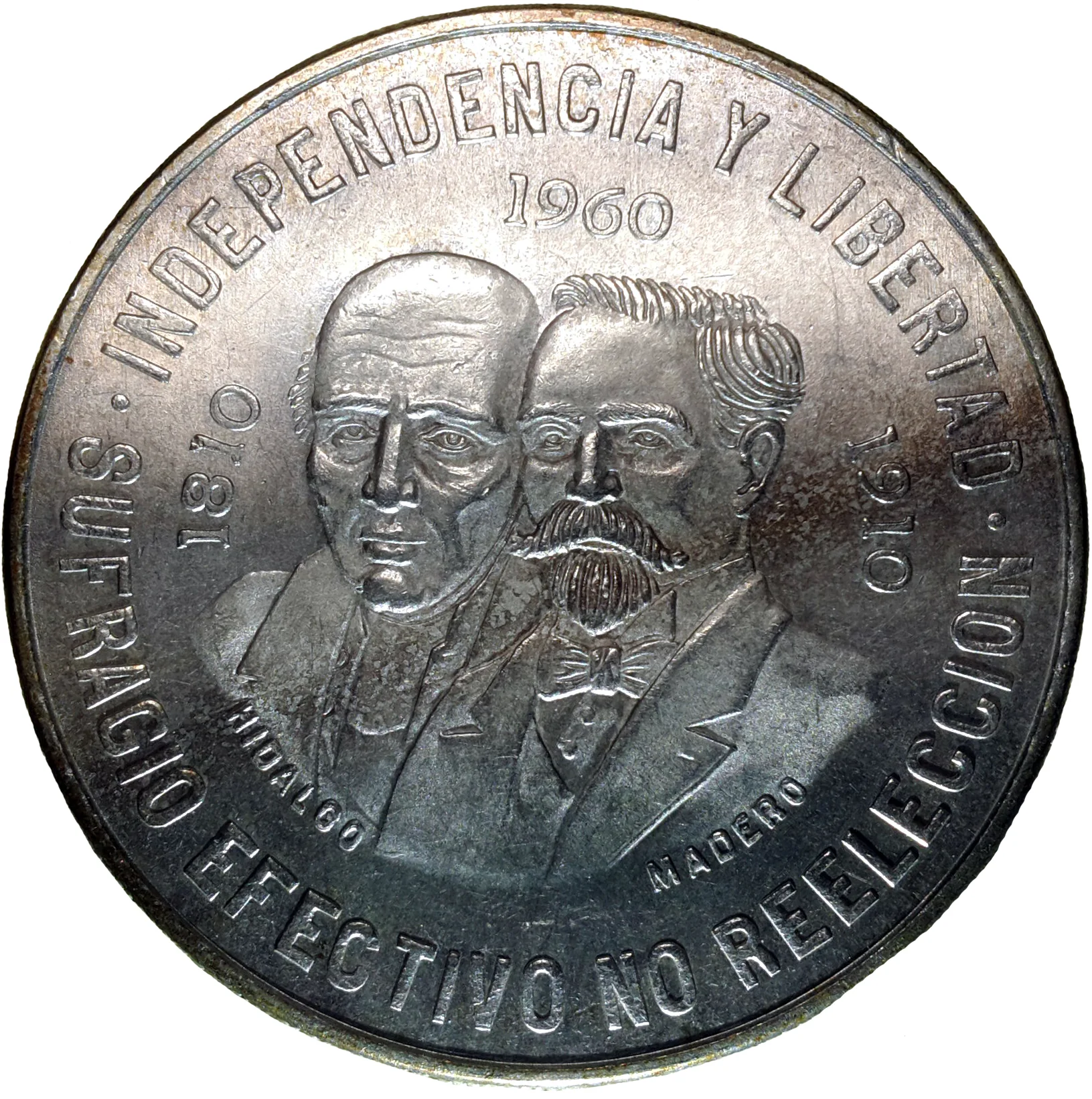
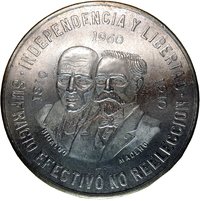
Busts of Hidalgo and Madero facing forward, labeled with their last names, surrounded by dates and text.
Inscription:
INDEPENDENCIA Y LIBERTAD
1810 1960 1910
HIDALGO MADERO
SUFRAGIO EFECTIVO NO REELECCION
1810 1960 1910
HIDALGO MADERO
SUFRAGIO EFECTIVO NO REELECCION
Translation:
INDEPENDENCE AND LIBERTY
1810 1960 1910
HIDALGO MADERO
EFFECTIVE SUFFRAGE, NO RE-ELECTION
1810 1960 1910
HIDALGO MADERO
EFFECTIVE SUFFRAGE, NO RE-ELECTION
Script: Latin
Language: Spanish
Edge
Reeded
Categories
| History> War |
| Person> Politician |
| Person> Military leader |
Mints
| Name | Mark |
|---|---|
| Mexican Mint | (Mo) |
Mintings
| Year | Mint Mark | Mintage | Quality | Collection |
|---|---|---|---|---|
| 1960 | Mo | 1,000,000 |
Historical background
In 1960, Mexico's currency, the peso, operated under a fixed exchange rate regime, pegged to the U.S. dollar at a parity of 12.50 pesos per dollar. This stability was a cornerstone of the country's "Desarrollo Estabilizador" (Stabilizing Development) economic model, a period from the mid-1950s to the early 1970s characterized by sustained growth, low inflation, and fiscal discipline. The fixed rate provided predictability for trade and investment, fostering industrialization and the expansion of domestic industry behind protective tariffs. The Banco de México maintained this peg through conservative monetary policy and the management of the country's foreign exchange reserves, which were bolstered by strong export earnings, particularly from agriculture and a growing manufacturing sector.
However, this apparent stability masked underlying structural pressures. The import-substitution industrialization (ISI) model, while successful in building domestic industry, often led to inefficiencies and a growing reliance on imported capital goods and intermediate products. This contributed to a persistent trade deficit that was offset by foreign borrowing and tourism revenues. Furthermore, the government's commitment to the fixed exchange rate sometimes conflicted with other policy goals, such as public spending for social programs and infrastructure. Maintaining the peg required strict discipline, limiting the government's ability to use monetary policy to stimulate the economy during downturns.
Consequently, while 1960 itself represented a calm point within the long Desarrollo Estabilizador period, the currency regime was increasingly vulnerable. The pressures of financing industrialization, a growing public sector, and the rigidity of the fixed rate would eventually become unsustainable. These accumulating imbalances would later culminate in the devaluations of the 1970s and the eventual abandonment of the fixed exchange rate, but in 1960, the peso's peg to the dollar remained a symbol of Mexico's economic confidence and a key instrument in its state-led development strategy.
However, this apparent stability masked underlying structural pressures. The import-substitution industrialization (ISI) model, while successful in building domestic industry, often led to inefficiencies and a growing reliance on imported capital goods and intermediate products. This contributed to a persistent trade deficit that was offset by foreign borrowing and tourism revenues. Furthermore, the government's commitment to the fixed exchange rate sometimes conflicted with other policy goals, such as public spending for social programs and infrastructure. Maintaining the peg required strict discipline, limiting the government's ability to use monetary policy to stimulate the economy during downturns.
Consequently, while 1960 itself represented a calm point within the long Desarrollo Estabilizador period, the currency regime was increasingly vulnerable. The pressures of financing industrialization, a growing public sector, and the rigidity of the fixed rate would eventually become unsustainable. These accumulating imbalances would later culminate in the devaluations of the 1970s and the eventual abandonment of the fixed exchange rate, but in 1960, the peso's peg to the dollar remained a symbol of Mexico's economic confidence and a key instrument in its state-led development strategy.
🌱 Common