

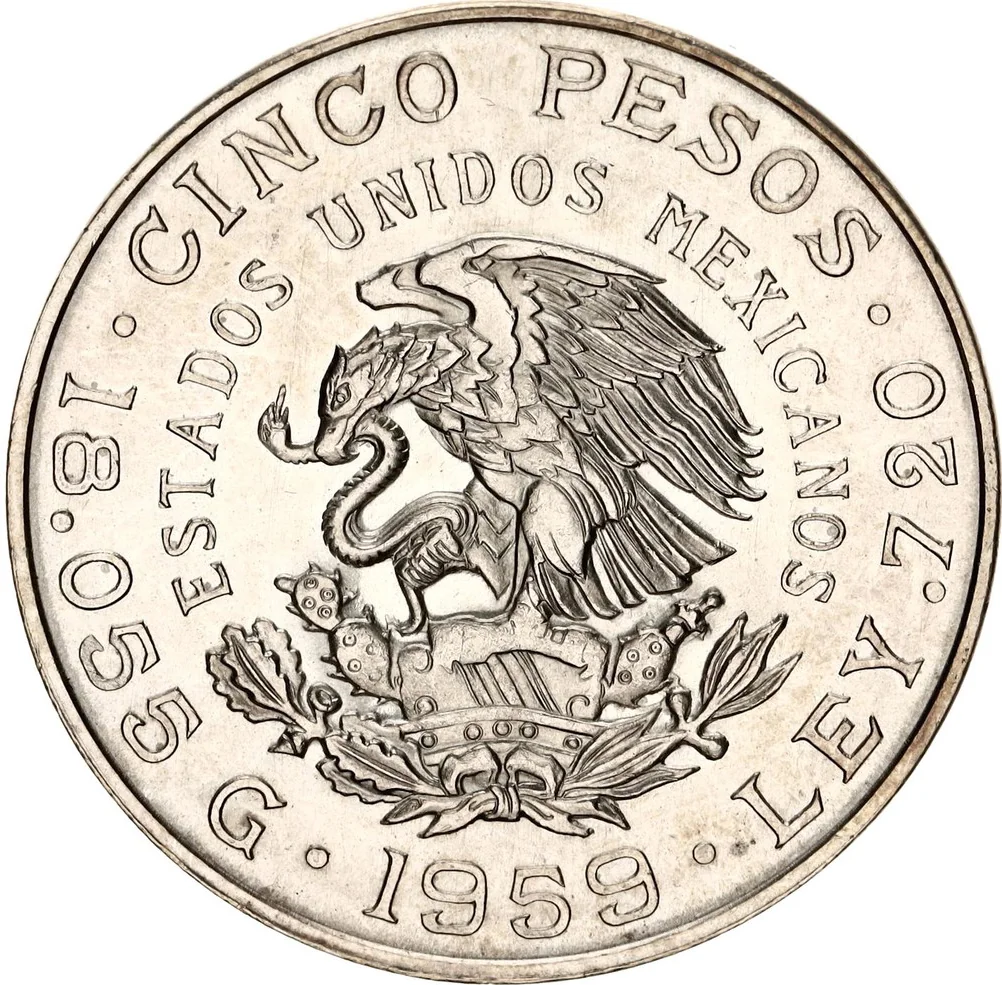
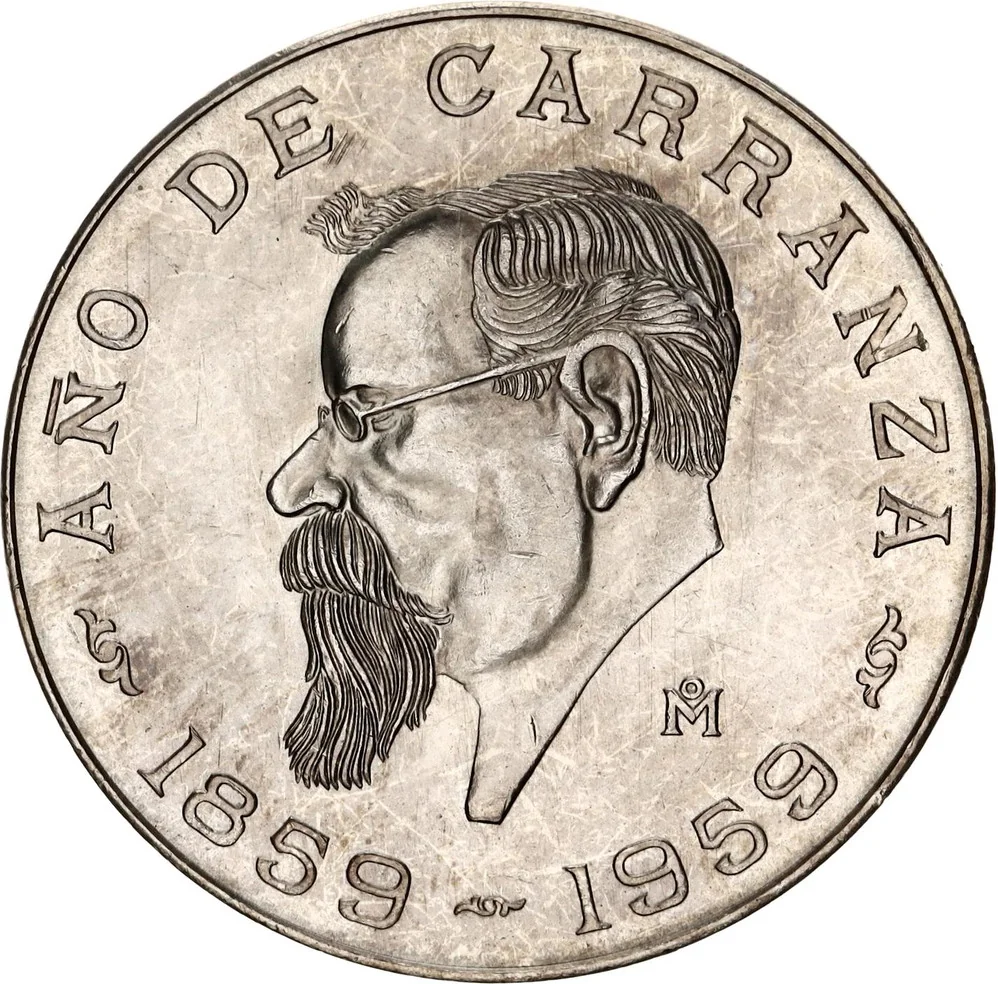
5 Pesos – Mexico
Circulating commemorative coins
Commemoration: Centennial of Carranza's Birth
Mexico
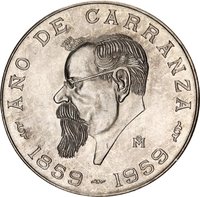
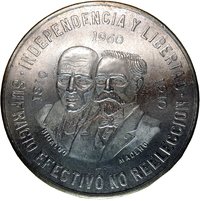
Obverse
Reverse
Edge
Plain
Categories
| Event> Birth anniversary |
| Person> Politician |
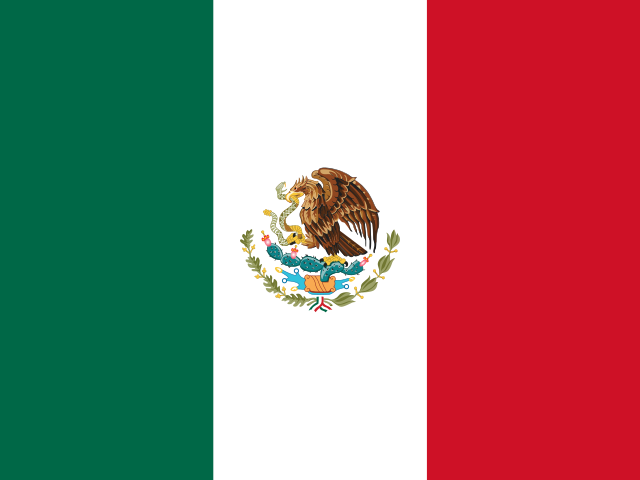
| Symbols> Coat of Arms |
Mints
| Name | Mark |
|---|---|
| Mexican Mint | (Mo) |
Mintings
| Year | Mint Mark | Mintage | Quality | Collection |
|---|---|---|---|---|
| 1959 | Mo | 1,000,000 |
Historical background
In 1959, Mexico's currency situation was characterized by a period of relative stability under the Bretton Woods system, but with underlying pressures that hinted at future economic challenges. The Mexican peso was pegged to the United States dollar at a fixed rate of 12.50 pesos per dollar, a parity established in 1954 after a significant devaluation. This fixed exchange rate, maintained by the Banco de México, provided a predictable environment for trade and investment, supporting the nation's period of sustained industrial growth known as the "Mexican Miracle." The government's conservative fiscal and monetary policies, along with growing foreign investment, helped maintain international confidence in the peso during this year.
However, this stability was not without its costs and vulnerabilities. The fixed peg required the central bank to hold substantial dollar reserves to defend the currency, which limited its ability to use monetary policy for domestic needs. Furthermore, the strategy of promoting industrialization through import substitution began to show strains, as protecting domestic industries led to inefficiencies and a growing reliance on imported capital goods. This contributed to a persistent trade deficit, which was initially offset by tourism revenues and agricultural exports but pointed to a structural imbalance in the economy.
Looking ahead, the pressures of 1959 would eventually culminate in the difficulties of the following decades. While the year itself saw no currency crisis, the model of a fixed peso, coupled with rising public spending and increasing external debt, was building vulnerabilities. These would later challenge the parity, leading to the devaluations and economic turmoil of the 1970s and 1980s. Thus, 1959 represents the calm before the storm, a point where Mexico's post-war economic model appeared stable on the surface but was accumulating the imbalances that would later require drastic adjustment.
However, this stability was not without its costs and vulnerabilities. The fixed peg required the central bank to hold substantial dollar reserves to defend the currency, which limited its ability to use monetary policy for domestic needs. Furthermore, the strategy of promoting industrialization through import substitution began to show strains, as protecting domestic industries led to inefficiencies and a growing reliance on imported capital goods. This contributed to a persistent trade deficit, which was initially offset by tourism revenues and agricultural exports but pointed to a structural imbalance in the economy.
Looking ahead, the pressures of 1959 would eventually culminate in the difficulties of the following decades. While the year itself saw no currency crisis, the model of a fixed peso, coupled with rising public spending and increasing external debt, was building vulnerabilities. These would later challenge the parity, leading to the devaluations and economic turmoil of the 1970s and 1980s. Thus, 1959 represents the calm before the storm, a point where Mexico's post-war economic model appeared stable on the surface but was accumulating the imbalances that would later require drastic adjustment.
🌱 Common