

25 pesos – Mexico
Add to wishlist
Circulating commemorative coins
Commemoration: 19th Summer Olympics - Mexico 1968
Mexico
Obverse
Description:
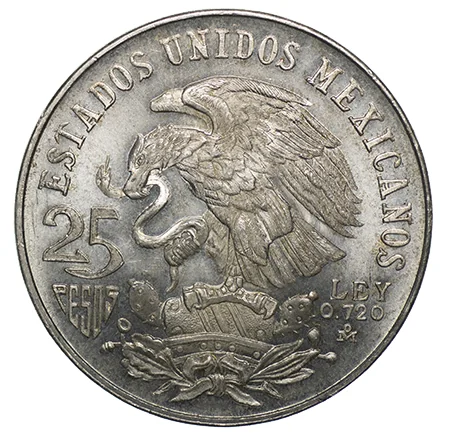
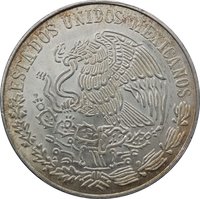
Mexican coat of arms (left-facing eagle) with legend above, value left, purity and mintmark right.
Inscription:
ESTADOS UNIDOS MEXICANOS
25 PESOS
LEY
0.720
Mo
25 PESOS
LEY
0.720
Mo
Translation:
UNITED MEXICAN STATES
25 PESOS
LAW
0.720
25 PESOS
LAW
0.720
Script: Latin
Language: Spanish
Designer and engraver: Ricardo Luna Y Vasco
Reverse
Description:
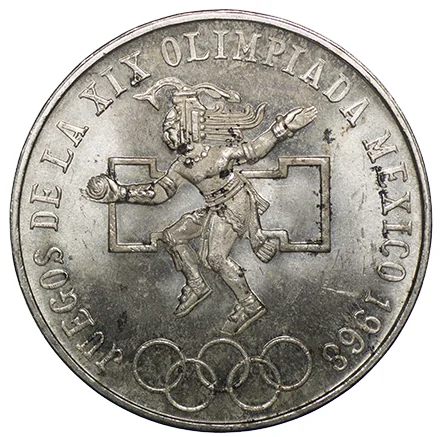
An Aztec ball player faces left inside the Olympic rings, surrounded by a legend.
Inscription:
JUEGOS DE LA XIX OLIMPIADA MEXICO 1968
Translation:
Games of the XIX Olympiad Mexico 1968
Script: Latin
Language: Spanish
Designer and engraver: Lorenzo Rafael
Edge
Smooth with incused lettering
Legend:
INDEPENDENCIA Y LIBERTAD
Translation:
Independence and Liberty
Language: Spanish
Categories
| Sport> Summer Olympic Games |
Mints
| Name | Mark |
|---|---|
| Mexican Mint | Mo |
Mintings
| Year | Mint Mark | Mintage | Quality | Collection |
|---|---|---|---|---|
| 1968 | Mo | 27,182,000 |
Historical background
In 1968, Mexico's currency, the peso, operated under a fixed exchange rate regime, pegged to the U.S. dollar at 12.50 pesos per dollar—a parity that had been maintained since 1954. This stability was a cornerstone of the nation's "Mexican Miracle," a period of sustained industrial growth and low inflation. The fixed rate provided predictability for foreign investment and trade, underpinning the government's ambitious spending on infrastructure in preparation for the 1968 Olympic Games, which were intended to showcase Mexico's modernity and economic progress on the world stage.
However, this apparent stability masked underlying economic strains. The government's heavy expenditure on the Olympics and social programs, combined with a growing trade deficit and rising public debt, began to put pressure on the peso. While the fixed rate remained officially unchanged, there were growing concerns among economists and international observers about the sustainability of the peg. Inflation was slowly creeping upward, and the country's foreign reserves were being drawn upon to maintain the currency's value, creating a vulnerability that would become a critical issue in the following years.
Thus, 1968 represents the final year of unquestioned confidence in the old peso before the looming crises of the 1970s. The currency situation was a paradox: outwardly solid and symbolic of national prestige during the Olympics, yet internally weakened by fiscal imbalances. The social and political turmoil of the 1968 student movement, culminating in the Tlatelolco massacre, occurred against this backdrop of economic tension, where the government was financially committed to projecting an image of prosperity and stability that was increasingly difficult to maintain.
However, this apparent stability masked underlying economic strains. The government's heavy expenditure on the Olympics and social programs, combined with a growing trade deficit and rising public debt, began to put pressure on the peso. While the fixed rate remained officially unchanged, there were growing concerns among economists and international observers about the sustainability of the peg. Inflation was slowly creeping upward, and the country's foreign reserves were being drawn upon to maintain the currency's value, creating a vulnerability that would become a critical issue in the following years.
Thus, 1968 represents the final year of unquestioned confidence in the old peso before the looming crises of the 1970s. The currency situation was a paradox: outwardly solid and symbolic of national prestige during the Olympics, yet internally weakened by fiscal imbalances. The social and political turmoil of the 1968 student movement, culminating in the Tlatelolco massacre, occurred against this backdrop of economic tension, where the government was financially committed to projecting an image of prosperity and stability that was increasingly difficult to maintain.
🌱 Very Common