

20 crowns – Austrian Empire
Add to wishlist
Austria
Context
Years: 1892–1905
Country: Austria
Issuer: Austrian Empire
Ruler: Francis Joseph I
Currency:
(1892—1918)
Demonetized: Yes
Total mintage: 32,956,441
Material
References
KM: #
Numista: #14747
Value
Bullion value: $941.25
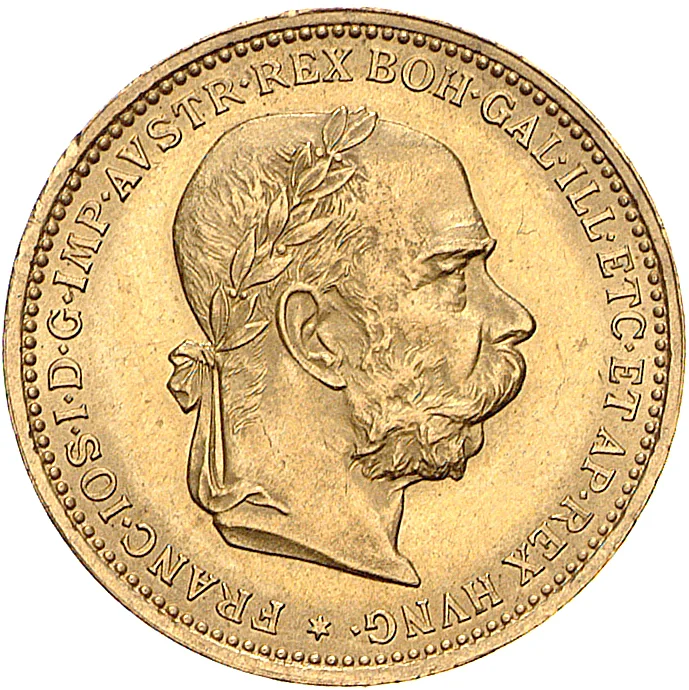
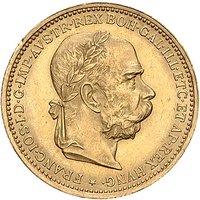
Obverse
Description:
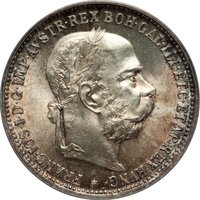
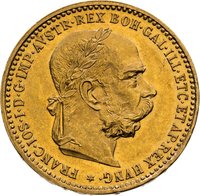
Elderly laureate right, star below.
Inscription:
FRANC·IOS·I·D·G·IMP·AVSTR·REX BOH·GAL·ILL·ETC·ET AP·REX HVNG·
Translation:
FRANCIS I, BY THE GRACE OF GOD, EMPEROR OF AUSTRIA, KING OF BOHEMIA, GALICIA, LODOMERIA, ETC., AND APOSTOLIC KING OF HUNGARY.
Script: Latin
Language: Latin
Engraver: Anton Scharff
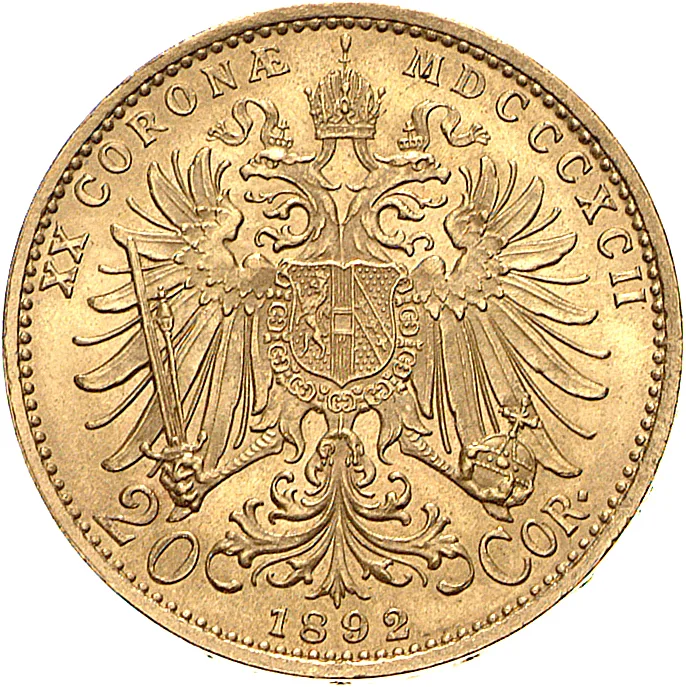
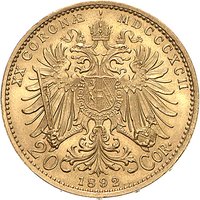
Reverse
Description:
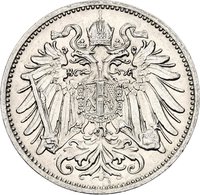
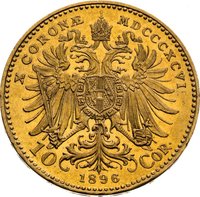
Imperial eagle with Habsburg-Lorraine arms; Latin and numeric dates and values above and below.
Inscription:
XX CORONÆ MDCCCXCIII
20 1893 COR.
20 1893 COR.
Translation:
TWENTY CORONAE 1893 COR.
Script: Latin
Language: Latin
Engraver: Andreas Neudeck
Edge
Categories
| Symbol> Double-headed eagle |
Mints
| Name | Mark |
|---|---|
| Münze Österreich | — |
Mintings
| Year | Mint Mark | Mintage | Quality | Collection |
|---|---|---|---|---|
| 1892 | — | 652,909 | ||
| 1893 | — | 7,872,023 | ||
| 1894 | — | 6,713,890 | ||
| 1895 | — | 2,265,926 | ||
| 1896 | — | 6,867,570 | ||
| 1897 | — | 5,132,829 | ||
| 1898 | — | 1,873,789 | ||
| 1899 | — | 98,408 | ||
| 1900 | — | 26,537 | ||
| 1901 | — | 48,677 | ||
| 1902 | — | 440,751 | ||
| 1903 | — | 322,679 | ||
| 1904 | — | 494,356 | ||
| 1905 | — | 146,097 |
Historical background
In 1892, the Austrian Empire stood at a pivotal monetary crossroads, burdened by a complex and unstable dual-currency system. Since the mid-19th century, the empire operated with two parallel legal tenders: the silver-based Gulden (or Florin) and the paper Austro-Hungarian Gulden, which was not convertible to specie. This system, formalized after the 1867 Austro-Hungarian Compromise, was cumbersome for commerce and international trade. The chronic state budget deficits were financed by the central bank, leading to frequent fluctuations in the value of the paper currency against the silver standard, creating uncertainty and hindering economic modernization.
The decisive push for reform came from the need for economic integration with the German Empire, a key trading and political partner, which had adopted the gold standard with the mark in 1871. To facilitate capital flows, attract foreign investment, and stabilize the economy, the Austro-Hungarian government, led by Minister President Count Eduard Taaffe, passed the Currency Act of 1892. This law laid the groundwork for a profound transition by introducing a new gold-based currency unit, the Krone (crown), divided into 100 Heller. It was established at a fixed rate of 1 gold Krone = 0.5 Gulden, effectively moving the empire onto a gold standard.
The year 1892 itself was one of legislative foundation and preparation, not immediate implementation. The old Gulden remained in circulation as the Krone system was phased in gradually over the following decade. The reform required massive state loans to build the necessary gold reserves and retire the unstable paper currency. This successful monetary transformation, fully realized by 1900, provided the Dual Monarchy with a modern, stable, and unified currency, finally aligning its financial system with the major European powers and supporting the vibrant economic growth of the fin de siècle period until the empire's collapse in 1918.
The decisive push for reform came from the need for economic integration with the German Empire, a key trading and political partner, which had adopted the gold standard with the mark in 1871. To facilitate capital flows, attract foreign investment, and stabilize the economy, the Austro-Hungarian government, led by Minister President Count Eduard Taaffe, passed the Currency Act of 1892. This law laid the groundwork for a profound transition by introducing a new gold-based currency unit, the Krone (crown), divided into 100 Heller. It was established at a fixed rate of 1 gold Krone = 0.5 Gulden, effectively moving the empire onto a gold standard.
The year 1892 itself was one of legislative foundation and preparation, not immediate implementation. The old Gulden remained in circulation as the Krone system was phased in gradually over the following decade. The reform required massive state loans to build the necessary gold reserves and retire the unstable paper currency. This successful monetary transformation, fully realized by 1900, provided the Dual Monarchy with a modern, stable, and unified currency, finally aligning its financial system with the major European powers and supporting the vibrant economic growth of the fin de siècle period until the empire's collapse in 1918.
🌟 Uncommon