

10 crowns – Austrian Empire
Add to wishlist
Austria
Context
Years: 1896–1906
Country: Austria
Issuer: Austrian Empire
Ruler: Francis Joseph I
Currency:
(1892—1918)
Demonetized: Yes
Total mintage: 5,028,395
Material
References
KM: #
Numista: #33244
Value
Bullion value: $470.63
Obverse
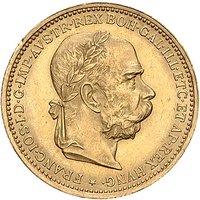
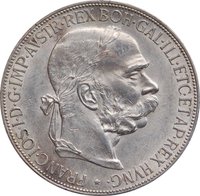
Description:
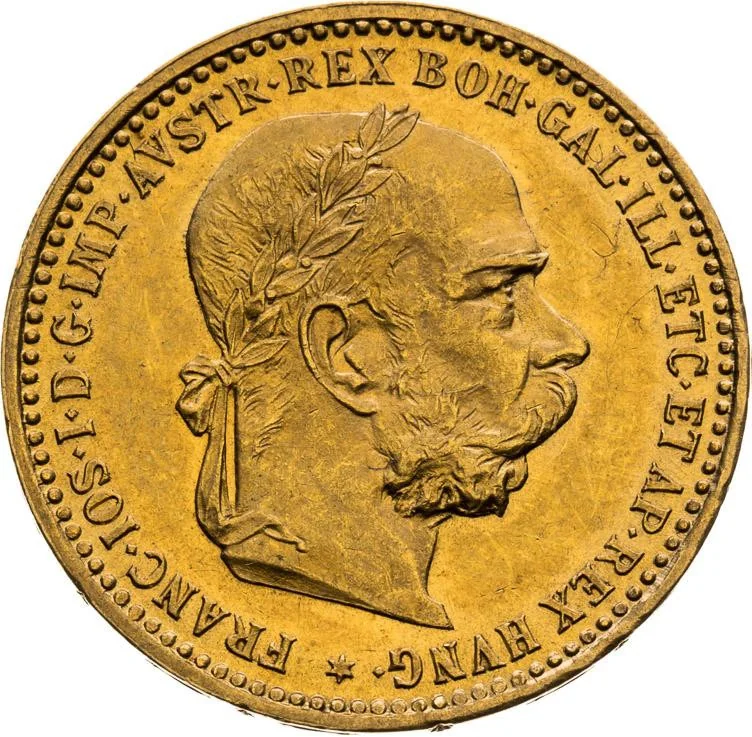
Laureate portrait facing right.
Inscription:
FRANC·IOS·I·D·G·IMP·AVSTR·REX·BOH·GAL·ILL·ETC·ET·AP·REX·HVNG
Translation:
FRANCIS I, BY THE GRACE OF GOD, EMPEROR OF AUSTRIA, KING OF BOHEMIA, GALICIA, ILLYRIA, ETC., AND APOSTOLIC KING OF HUNGARY
Script: Latin
Language: Latin
Engraver: Anton Scharff
Reverse
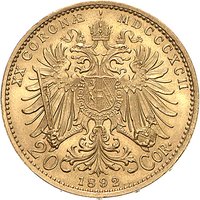
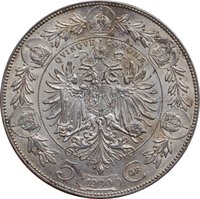
Description:
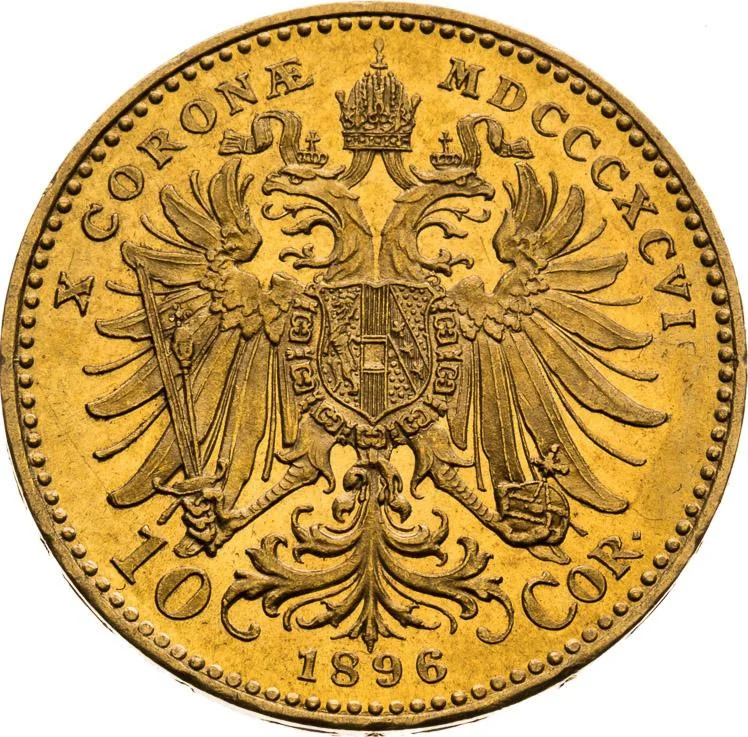
Imperial eagle with Habsburg-Lorraine arms; Latin and numeric dates and values above and below.
Inscription:
X CORONAE MDCCCXCVI
10 1896 COR.
10 1896 COR.
Script: Latin
Engraver: Rudolf Neuberger
Edge
Mints
| Name | Mark |
|---|---|
| Münze Österreich | — |
Mintings
| Year | Mint Mark | Mintage | Quality | Collection |
|---|---|---|---|---|
| 1896 | — | 210,734 | ||
| 1897 | — | 1,803,270 | ||
| 1905 | — | 1,933,230 | ||
| 1906 | — | 1,081,161 |
Historical background
By 1896, the Austro-Hungarian Empire operated under a complex dual monetary system, a reflection of the broader Compromise of 1867. The official currency was the gold standard Gulden (or Florin), divided into 100 Kreuzer. However, alongside this, the silver Gulden also remained legal tender, creating a bimetallic foundation that was increasingly anachronistic in a world moving decisively toward the gold standard. This system, established in the mid-19th century, was stable but cumbersome, and the empire's finances were still shadowed by the state bankruptcy (Staatsbankrott) of 1811 and the currency devaluation that had followed.
Economically, pressure for modernization was mounting. The empire's major trading partners and financial competitors, like Germany, had already adopted a pure gold standard, which facilitated smoother international trade and investment. Within Austria-Hungary, industrialists, bankers, and commercial interests strongly advocated for a currency reform to simplify transactions, attract foreign capital, and align with global financial practices. The concurrent circulation of gold and silver coins, along with a vast array of paper banknotes issued by the Austro-Hungarian Bank, created occasional arbitrage opportunities and inefficiencies.
Consequently, 1896 was a year of anticipation and final preparation for a major change. After years of political negotiation between the Austrian and Hungarian governments, a plan for full conversion to a new gold-based currency, the Krone (or Korona), was firmly in motion. The Krone Law had already been passed in 1892, initiating a transitional period. By 1896, the new gold coins were being minted and the Austro-Hungarian Bank was managing the complex process of withdrawing the old Gulden from circulation. Thus, the currency situation in 1896 was one of a managed transition, marking the final years of the historic Gulden before the official introduction of the Krone, which was set for 1900.
Economically, pressure for modernization was mounting. The empire's major trading partners and financial competitors, like Germany, had already adopted a pure gold standard, which facilitated smoother international trade and investment. Within Austria-Hungary, industrialists, bankers, and commercial interests strongly advocated for a currency reform to simplify transactions, attract foreign capital, and align with global financial practices. The concurrent circulation of gold and silver coins, along with a vast array of paper banknotes issued by the Austro-Hungarian Bank, created occasional arbitrage opportunities and inefficiencies.
Consequently, 1896 was a year of anticipation and final preparation for a major change. After years of political negotiation between the Austrian and Hungarian governments, a plan for full conversion to a new gold-based currency, the Krone (or Korona), was firmly in motion. The Krone Law had already been passed in 1892, initiating a transitional period. By 1896, the new gold coins were being minted and the Austro-Hungarian Bank was managing the complex process of withdrawing the old Gulden from circulation. Thus, the currency situation in 1896 was one of a managed transition, marking the final years of the historic Gulden before the official introduction of the Krone, which was set for 1900.
🌟 Uncommon