

Obverse
Description:
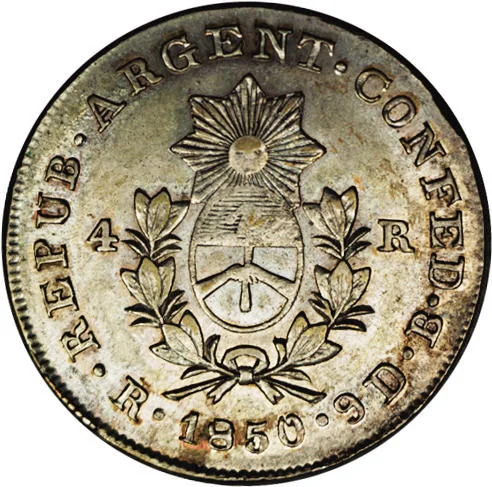
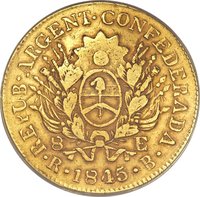
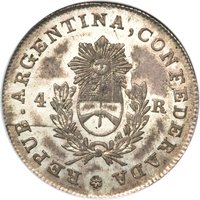
Arms in wreath, radiant sun above. Value and date.
Inscription:
REPUB • ARGENT • CONFED
4 R
• R • 1850 • 9D • B •
4 R
• R • 1850 • 9D • B •
Script: Latin
Reverse
Description:
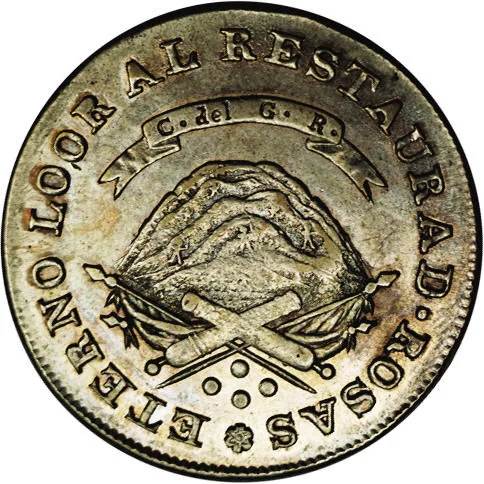
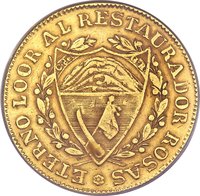
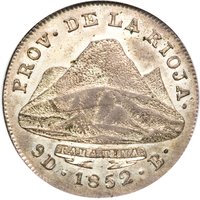
Ribbon over mountains, flags and cannons beneath, encircled by legend.
Inscription:
ETERNO LOOR AL RESTAURAD • ROSAS
C • del G • R •
C • del G • R •
Script: Latin
Edge
Slanted Reeds
Categories
| Symbol> Flag |
| Symbol> Hand |
| Geography> Mountain |
| Symbols> Coat of Arms |
| Symbol> Phrygian cap |
| Symbol> Sun |
| Symbol> Wreath |
| Object> Firearms |
Mintings
| Year | Mint Mark | Mintage | Quality | Collection |
|---|---|---|---|---|
| 1846 | RV | — | ||
| 1849 | RV | — | ||
| 1849 | RB | — | ||
| 1850 | RB | — |
Historical background
In 1846, the Argentine province of La Rioja was embroiled in the broader Argentine Civil Wars, a period defined by a struggle between Federalist and Unitarian forces and the absence of a strong central authority. This political fragmentation led directly to a severe monetary crisis. The national government in Buenos Aires, struggling with its own debts and lack of resources, had ceased providing subsidies to the provincial governments. Facing empty coffers and the costs of maintaining militias, Governor Juan Antonio Brizuela y Doria resorted to a desperate fiscal measure: the issuance of provincial paper currency.
This currency, known as "billetes de ley" or "papel moneda de La Rioja," was not backed by gold or silver but by the promise of future provincial tax revenues. It was a forced loan on the local economy, mandated for all public and private transactions within the province. The immediate result was rapid devaluation and widespread rejection. Merchants and the public, recognizing the notes as a symbol of insolvency, hoarded precious metal coins (metálico), leading to a classic case of Gresham's Law where "bad money drives out good." The economy contracted into barter, and the currency became a source of social unrest and economic paralysis.
The situation in La Rioja was a microcosm of a national problem, as several other provinces issued similar devalued paper during this era. The currency crisis severely weakened Governor Brizuela's position, undermining his ability to pay troops and administer the province effectively. This financial instability contributed to the political and military vulnerability that would soon lead to his overthrow in 1847 by forces loyal to the powerful Federalist caudillo Juan Manuel de Rosas, who sought to impose greater fiscal and monetary control from Buenos Aires. Thus, the paper money of 1846 stands as a stark symbol of the profound economic disarray caused by internecine war and provincial isolation.
This currency, known as "billetes de ley" or "papel moneda de La Rioja," was not backed by gold or silver but by the promise of future provincial tax revenues. It was a forced loan on the local economy, mandated for all public and private transactions within the province. The immediate result was rapid devaluation and widespread rejection. Merchants and the public, recognizing the notes as a symbol of insolvency, hoarded precious metal coins (metálico), leading to a classic case of Gresham's Law where "bad money drives out good." The economy contracted into barter, and the currency became a source of social unrest and economic paralysis.
The situation in La Rioja was a microcosm of a national problem, as several other provinces issued similar devalued paper during this era. The currency crisis severely weakened Governor Brizuela's position, undermining his ability to pay troops and administer the province effectively. This financial instability contributed to the political and military vulnerability that would soon lead to his overthrow in 1847 by forces loyal to the powerful Federalist caudillo Juan Manuel de Rosas, who sought to impose greater fiscal and monetary control from Buenos Aires. Thus, the paper money of 1846 stands as a stark symbol of the profound economic disarray caused by internecine war and provincial isolation.
💎 Very Rare