

50 sen – Cambodia
Add to wishlist
Cambodia
Context
Year: 1959
Issuer: Cambodia
Ruler: Norodom Suramarit
Currency:
(1953—1975)
Demonetized: Yes
Total mintage: 3,399,000
Material
References
KM: #
Numista: #4474
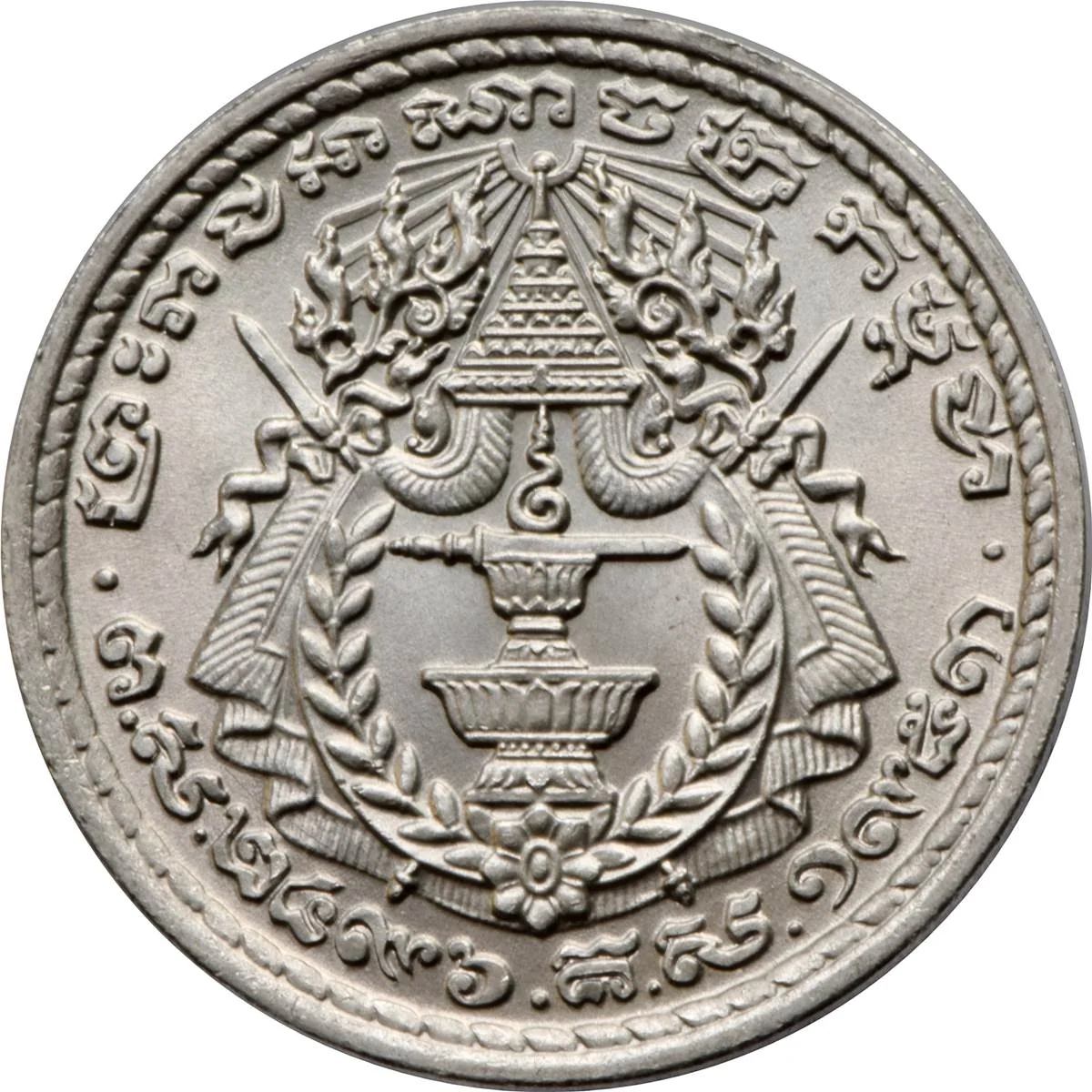
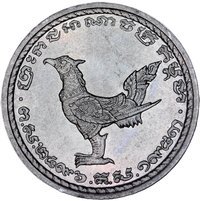
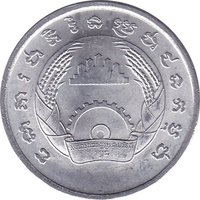
Obverse
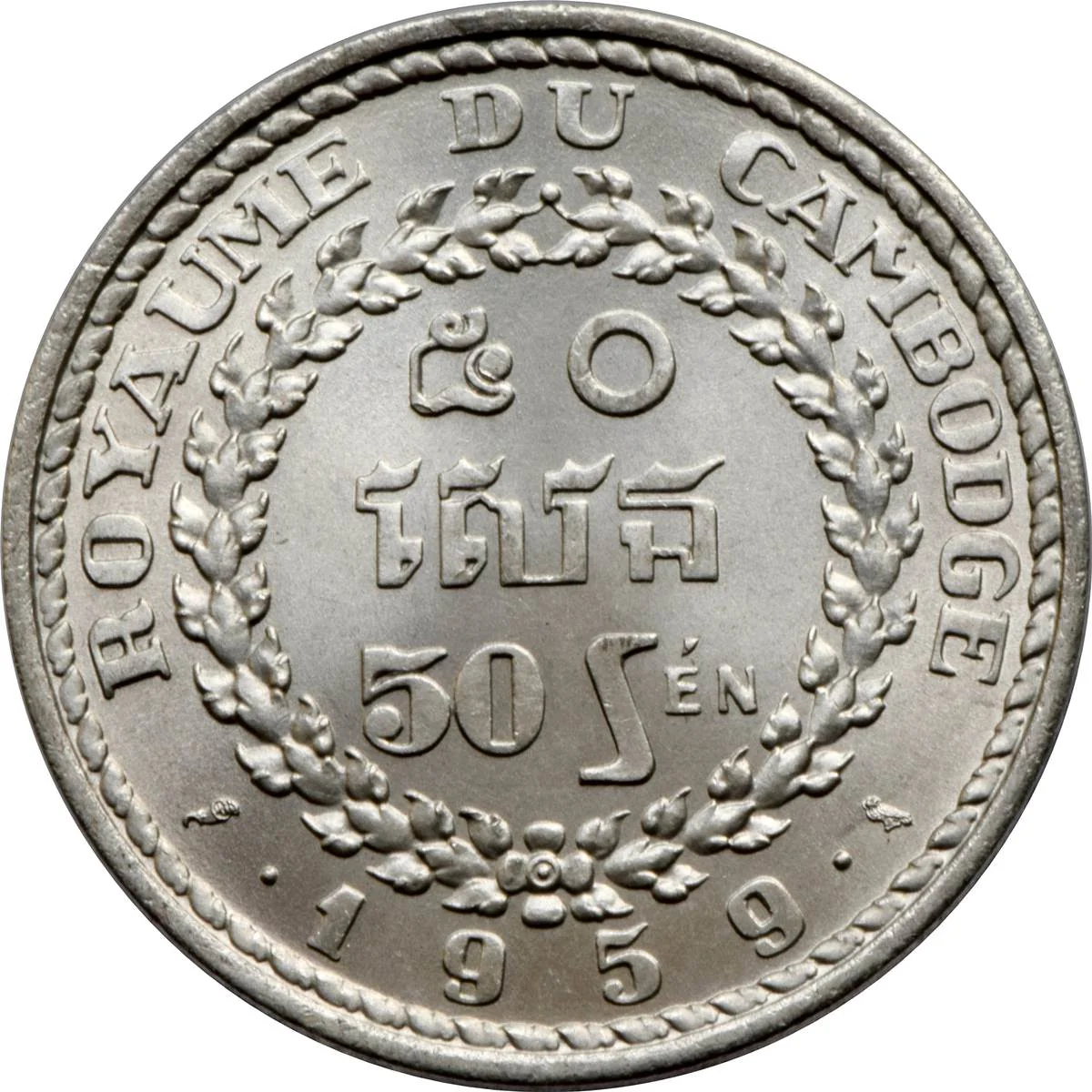
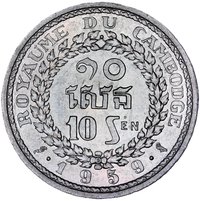
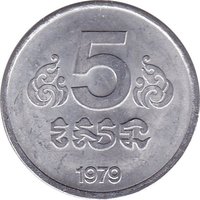
Reverse
Description:
Bilingual Khmer/French text and date encircled by wreath.
Inscription:
ROYAUME DU CAMBODGE
50 SEN
1959
50 SEN
1959
Translation:
Kingdom of Cambodia
50 Sen
1959
50 Sen
1959
Language: French
Engraver: Lucien Georges Bazor
Edge
Plain
Categories
| Symbols> Coat of Arms |
Mints
| Name | Mark |
|---|---|
| Monnaie de Paris | — |
Mintings
| Year | Mint Mark | Mintage | Quality | Collection |
|---|---|---|---|---|
| 1959 | — | 3,399,000 |
Historical background
In 1959, Cambodia's currency situation was defined by the riel, which had been introduced in 1955 to replace the French Indochinese piastre. The newly independent Kingdom of Cambodia, under Prince Norodom Sihanouk's Sangkum regime, was pursuing a policy of economic nationalism and neutrality. The riel was pegged to the US dollar at a fixed rate of 35 riels to 1 dollar, a stability intended to foster confidence and attract foreign investment as the nation developed its post-colonial economy. This peg was managed by the National Bank of Cambodia, established in 1955, which held reserves primarily in gold and foreign currencies to back the riel's value.
However, the monetary system was not fully dominant. A significant characteristic of the era was the continued widespread circulation of foreign currencies, particularly the US dollar and the French (and later, South Vietnamese) piastre in border regions. This was due to historical trade patterns, a still-underdeveloped domestic banking system, and larger regional economic forces. Furthermore, the economy remained heavily reliant on agriculture, with rice and rubber as the primary exports, making the currency's stability vulnerable to fluctuations in global commodity prices.
Overall, the currency situation in 1959 reflected a young nation asserting its economic sovereignty while still grappling with practical realities. The riel's formal stability was a point of pride and a tool for planned development, yet its actual circulation co-existed with stronger foreign currencies. This period laid the groundwork for the monetary challenges Cambodia would face in the following decades, as the geopolitical turmoil of the Vietnam War and subsequent civil conflict would eventually severely destabilize the riel.
However, the monetary system was not fully dominant. A significant characteristic of the era was the continued widespread circulation of foreign currencies, particularly the US dollar and the French (and later, South Vietnamese) piastre in border regions. This was due to historical trade patterns, a still-underdeveloped domestic banking system, and larger regional economic forces. Furthermore, the economy remained heavily reliant on agriculture, with rice and rubber as the primary exports, making the currency's stability vulnerable to fluctuations in global commodity prices.
Overall, the currency situation in 1959 reflected a young nation asserting its economic sovereignty while still grappling with practical realities. The riel's formal stability was a point of pride and a tool for planned development, yet its actual circulation co-existed with stronger foreign currencies. This period laid the groundwork for the monetary challenges Cambodia would face in the following decades, as the geopolitical turmoil of the Vietnam War and subsequent civil conflict would eventually severely destabilize the riel.
🌱 Common