

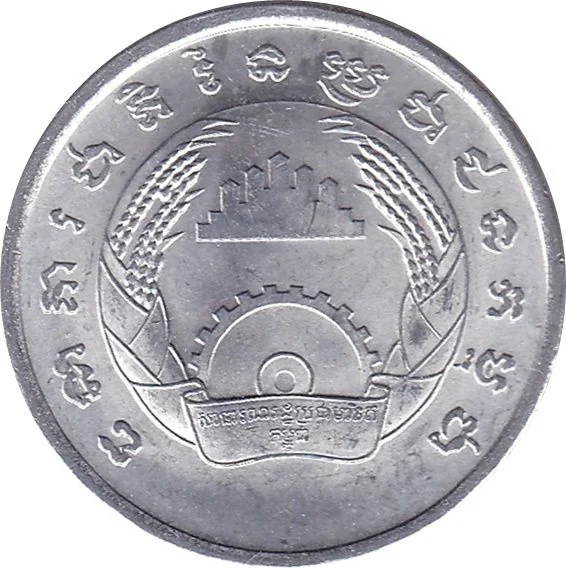
Obverse
Description:
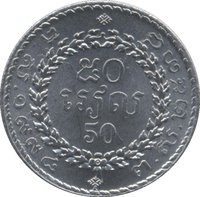
Coat of arms of the People's Republic of Kampuchea (1979–1989).
Inscription:
ធនាគារ ជាតិ នៃ ប្រជាជន កម្ពុជា
Translation:
National Bank of the People of Cambodia
Script: Khmer
Language: Central Khmer
Reverse
Edge
Plain
Mints
| Name | Mark |
|---|---|
| Saint Petersburg | — |
Mintings
| Year | Mint Mark | Mintage | Quality | Collection |
|---|---|---|---|---|
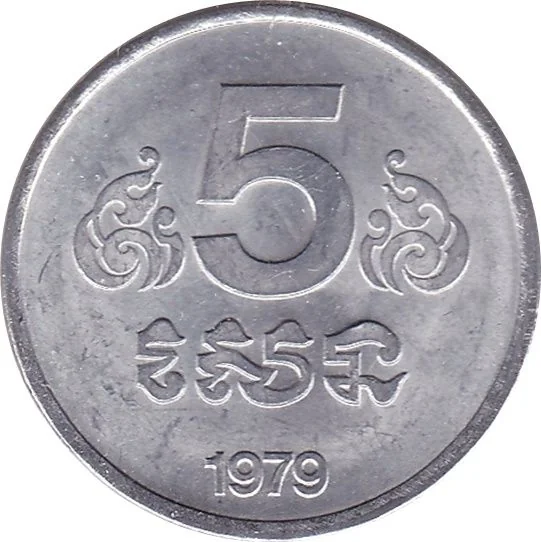
| 1979 | — | 120,000,000 |
Historical background
Following the collapse of the Khmer Rouge regime in January 1979, Cambodia faced a near-total economic vacuum, with its currency system effectively destroyed. The Khmer Rouge had abolished money entirely, leaving the new People’s Republic of Kampuchea (PRK) government with no functioning monetary system, no central bank, and virtually no physical currency in circulation. The economy had reverted to barter, with rice, gold, and jewelry becoming the primary mediums of exchange for survival and basic trade.
In this context, the new government, with essential support from Vietnam and the Soviet bloc, undertook an urgent monetary revival. In March 1980, the PRK reintroduced the Riel as the national currency, initially issuing notes in denominations of 0.1, 0.5, 1, 5, 10, 20, and 50 riels. However, this new riel was not a product of a robust domestic economy; it was a "currency without a country" in many respects, printed in the Soviet Union and lacking substantial foreign reserves or domestic production to back its value. Its legitimacy and utility were severely limited.
Consequently, a multi-currency system emerged spontaneously and persisted. The Vietnamese đồng circulated widely due to the substantial military and administrative presence from Vietnam, while the US dollar and gold remained, as they had for decades, trusted stores of value and mediums for larger transactions. Thus, the 1979-1980 period established a fractured monetary reality: an official but weak and distrusted riel existed alongside more robust foreign currencies, a pattern that would define Cambodia's financial landscape for decades to come.
In this context, the new government, with essential support from Vietnam and the Soviet bloc, undertook an urgent monetary revival. In March 1980, the PRK reintroduced the Riel as the national currency, initially issuing notes in denominations of 0.1, 0.5, 1, 5, 10, 20, and 50 riels. However, this new riel was not a product of a robust domestic economy; it was a "currency without a country" in many respects, printed in the Soviet Union and lacking substantial foreign reserves or domestic production to back its value. Its legitimacy and utility were severely limited.
Consequently, a multi-currency system emerged spontaneously and persisted. The Vietnamese đồng circulated widely due to the substantial military and administrative presence from Vietnam, while the US dollar and gold remained, as they had for decades, trusted stores of value and mediums for larger transactions. Thus, the 1979-1980 period established a fractured monetary reality: an official but weak and distrusted riel existed alongside more robust foreign currencies, a pattern that would define Cambodia's financial landscape for decades to come.
🌱 Common