

Obverse
Description:
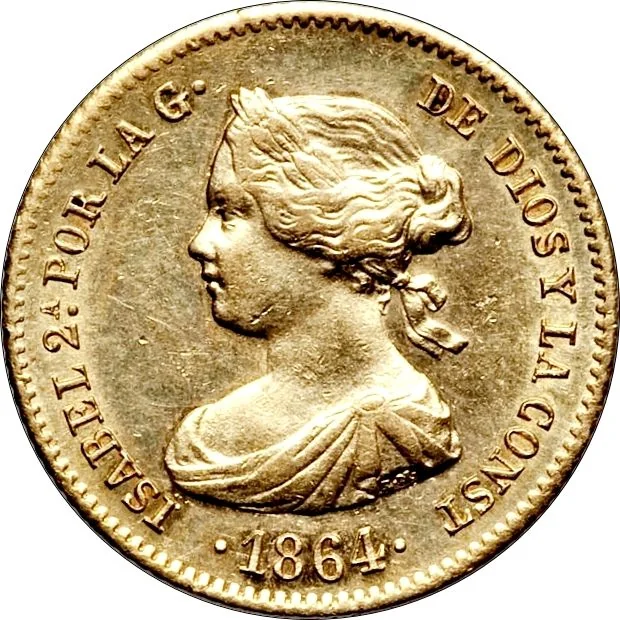
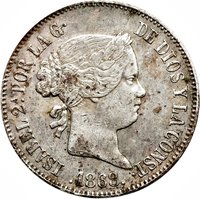
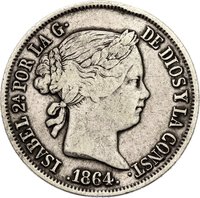
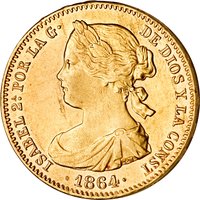
Laureate bust of Isabella II left.
Inscription:
ISABEL 2A. POR LA G· DE DIOS Y LA CONST
·1864·
·1864·
Translation:
Isabel 2nd. By the Grace of God and the Constitution
·1864·
·1864·
Script: Latin
Language: Spanish
Engraver: Luis Marchionni y Hombrón
Reverse
Description:
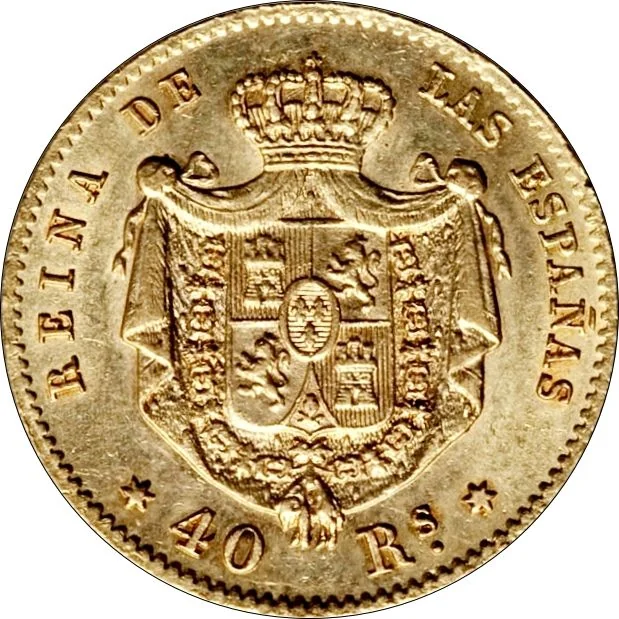
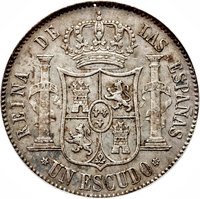
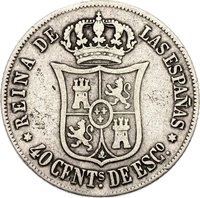
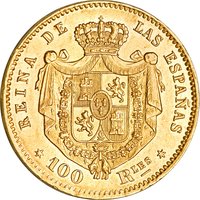
Crowned Spanish coat of arms with the Golden Fleece.
Inscription:
REINA DE LAS ESPAÑAS
* 40 RS. *
* 40 RS. *
Translation:
Queen of the Spains
* 40 Reales *
* 40 Reales *
Script: Latin
Language: Spanish
Engraver: Luis Marchionni y Hombrón
Edge
Categories
| Symbols> Coat of Arms |
Mints
| Name | Mark |
|---|---|
| Royal Mint of Madrid | — |
| Royal Mint of Seville | — |
Mintings
| Year | Mint Mark | Mintage | Quality | Collection |
|---|---|---|---|---|
| 1864 | — | — |
Historical background
In 1864, Spain's currency situation was characterized by instability and complexity, rooted in the political and economic turmoil of the mid-19th century. The nation operated on a bimetallic system, theoretically based on both silver and gold, but it was plagued by a chronic shortage of precious metals and a proliferation of diverse coinage. Much of the circulating medium consisted of worn reales and escudos from earlier centuries, alongside a confusing array of banknotes issued by private banks with questionable convertibility. This monetary fragmentation hindered commerce and reflected the weak central authority of the state, which struggled to impose a uniform national currency.
The government of Queen Isabella II, under Finance Minister Juan Bravo Murillo, had attempted a major reform in 1854 by introducing the decimal escudo, but it failed to gain public trust and circulate widely. By 1864, the most common unit for large transactions remained the silver peseta (worth 4 reales), which was not yet the sole official currency but was growing in practical importance. The real financial pressure, however, came from massive public debt incurred from colonial expenses, civil wars (the Carlist conflicts), and infrastructural projects. This led to repeated devaluations and the issuance of token coinage, eroding public confidence in the value of money.
Consequently, 1864 fell within a period of transition and uncertainty, immediately preceding a decisive monetary reform. Just four years later, in 1868, the Provisional Government after the Glorious Revolution would formally adopt the peseta as Spain's sole monetary unit, creating a new decimal and unified system. Therefore, the currency situation in 1864 is best understood as the fraught end-stage of an outdated order, marked by circulatory chaos and inflationary pressures, setting the stage for the sweeping changes that would define the modern Spanish monetary landscape.
The government of Queen Isabella II, under Finance Minister Juan Bravo Murillo, had attempted a major reform in 1854 by introducing the decimal escudo, but it failed to gain public trust and circulate widely. By 1864, the most common unit for large transactions remained the silver peseta (worth 4 reales), which was not yet the sole official currency but was growing in practical importance. The real financial pressure, however, came from massive public debt incurred from colonial expenses, civil wars (the Carlist conflicts), and infrastructural projects. This led to repeated devaluations and the issuance of token coinage, eroding public confidence in the value of money.
Consequently, 1864 fell within a period of transition and uncertainty, immediately preceding a decisive monetary reform. Just four years later, in 1868, the Provisional Government after the Glorious Revolution would formally adopt the peseta as Spain's sole monetary unit, creating a new decimal and unified system. Therefore, the currency situation in 1864 is best understood as the fraught end-stage of an outdated order, marked by circulatory chaos and inflationary pressures, setting the stage for the sweeping changes that would define the modern Spanish monetary landscape.
💎 Extremely Rare