

100 reales – Spain
Add to wishlist
Spain
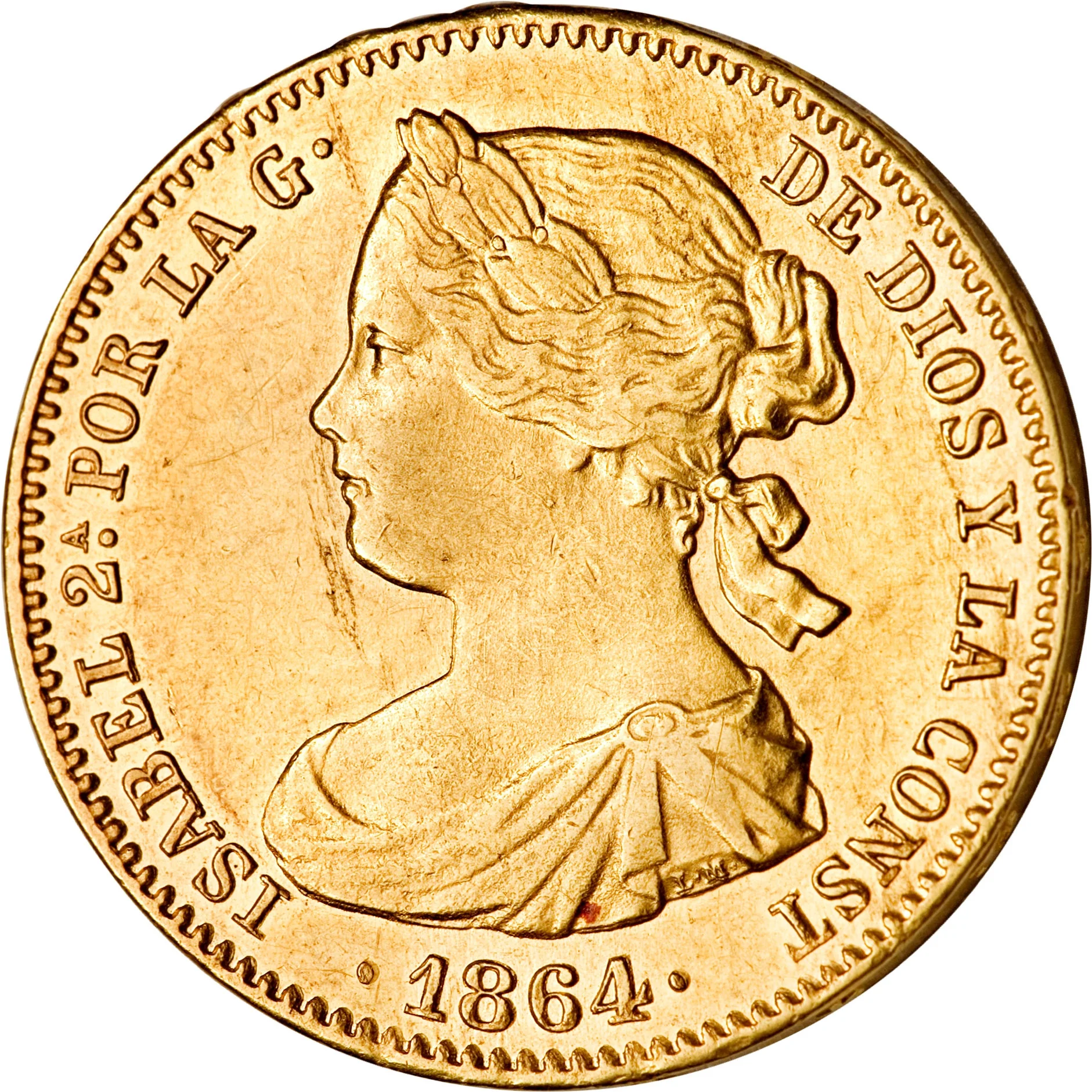
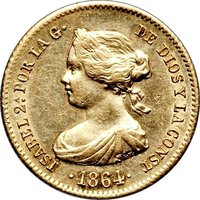
Obverse
Description:
Laureate bust of Isabella II left.
Inscription:
ISABEL 2A. POR LA G· DE DIOS Y LA CONST
· 1864 ·
· 1864 ·
Translation:
ISABELLA 2ND. BY THE GRACE OF GOD AND THE CONST[ITUTION]
· 1864 ·
· 1864 ·
Script: Latin
Language: Spanish
Engraver: Luis Marchionni y Hombrón
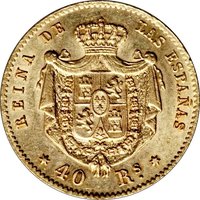
Reverse
Description:
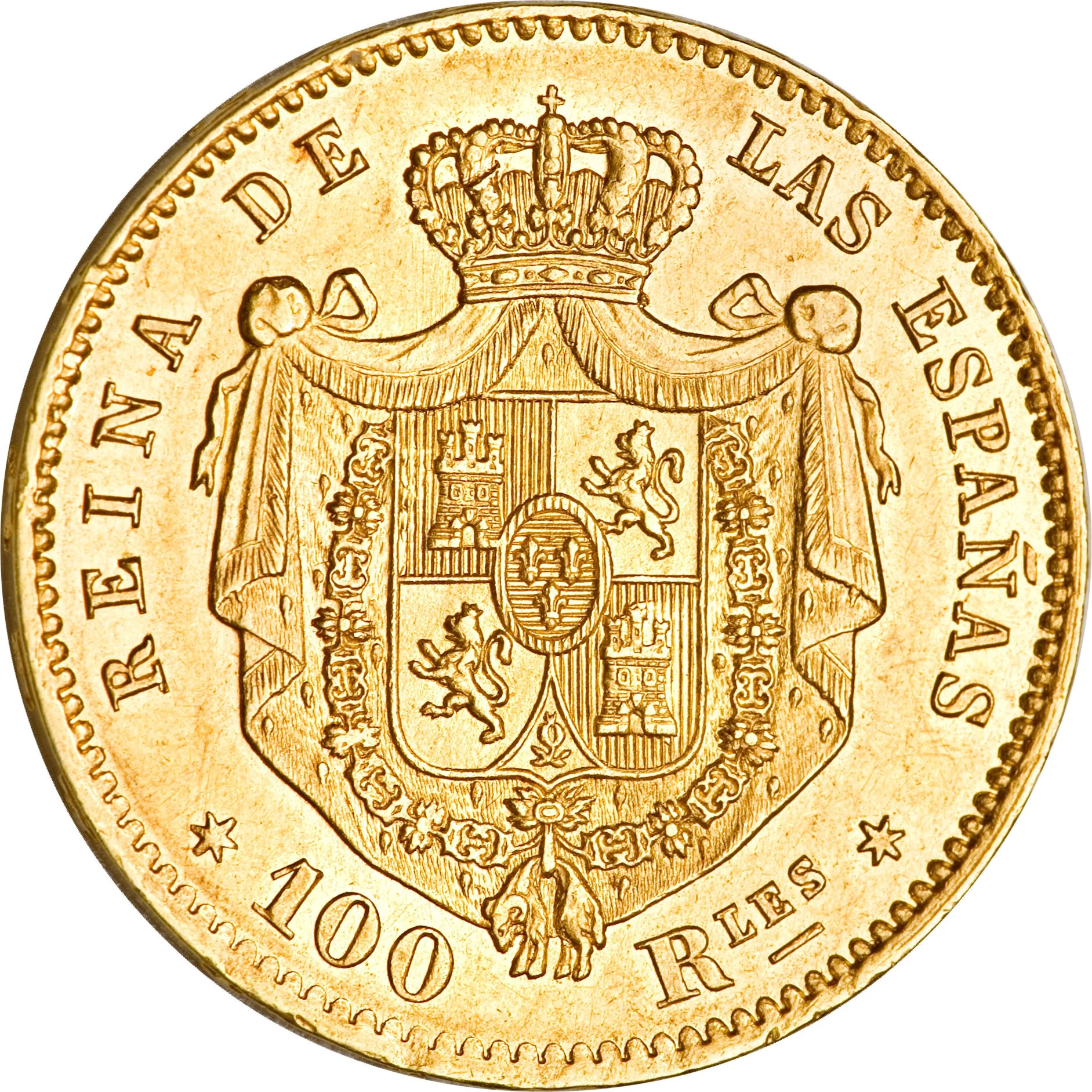
Draped and crowned Spanish coat of arms with the Golden Fleece.
Inscription:
REINA DE LAS ESPAÑAS
🟌 100 R_LES 🟌
🟌 100 R_LES 🟌
Translation:
Queen of the Spains
🟌 100 Reales 🟌
🟌 100 Reales 🟌
Script: Latin
Language: Spanish
Engraver: Luis Marchionni y Hombrón
Edge
Categories
| Symbols> Coat of Arms |
Mints
| Name | Mark |
|---|---|
| Royal Mint of Seville | — |
| Royal Mint of Madrid | (🟌) |
Mintings
| Year | Mint Mark | Mintage | Quality | Collection |
|---|---|---|---|---|
| 1863 | — | — | ||
| 1863 | 🟌 | — | ||
| 1864 | — | — | ||
| 1864 | 🟌 | — |
Historical background
In 1863, Spain's currency system was in a state of transition and complexity, rooted in the historical division between the real and the escudo. The primary unit was the peseta, introduced in 1808 during the Napoleonic occupation but not yet the sole legal tender. The country operated on a bimetallic standard (gold and silver), with the escudo (worth 10 reales) as the main gold coin and the real as the ubiquitous silver and fractional coinage. However, chronic state deficits, political instability, and the costs of colonial wars led to frequent debasements and the issuance of low-quality fractional coinage, creating public distrust and a chaotic circulation of diverse coins from different reigns.
This monetary fragmentation was exacerbated by the parallel circulation of paper money. The Banco de España, having gained the sole right to issue banknotes in 1856, saw its notes circulate alongside those from older, now-defunct banks. While convenient for large transactions, this paper currency was not yet fully trusted by the general populace and was not legal tender for all payments, especially outside major cities. The government itself heavily relied on borrowing from the bank, monetizing its debt and creating inflationary pressures that further complicated the currency's stability.
The year 1863 fell within the period of the "Glorious Revolution" (1868), which would soon bring decisive monetary reform. The existing system was widely seen as antiquated and inefficient, hindering commerce and modernization. Consequently, the groundwork was being laid for the sweeping change that would come in 1868, when the peseta was formally established as Spain's sole monetary unit within a new decimal system, finally unifying the nation's currency and phasing out the centuries-old real and escudo.
This monetary fragmentation was exacerbated by the parallel circulation of paper money. The Banco de España, having gained the sole right to issue banknotes in 1856, saw its notes circulate alongside those from older, now-defunct banks. While convenient for large transactions, this paper currency was not yet fully trusted by the general populace and was not legal tender for all payments, especially outside major cities. The government itself heavily relied on borrowing from the bank, monetizing its debt and creating inflationary pressures that further complicated the currency's stability.
The year 1863 fell within the period of the "Glorious Revolution" (1868), which would soon bring decisive monetary reform. The existing system was widely seen as antiquated and inefficient, hindering commerce and modernization. Consequently, the groundwork was being laid for the sweeping change that would come in 1868, when the peseta was formally established as Spain's sole monetary unit within a new decimal system, finally unifying the nation's currency and phasing out the centuries-old real and escudo.
💎 Very Rare