

10 pesos uruguayos (Artigas' death) – Uruguay
Add to wishlist
Circulating commemorative coins
Commemoration: 150th. anniversary of Artigas' death.
Uruguay
Context
Material
References
KM: #
Numista: #4468
Value
Exchange value: 10 UYU
Obverse
Description:
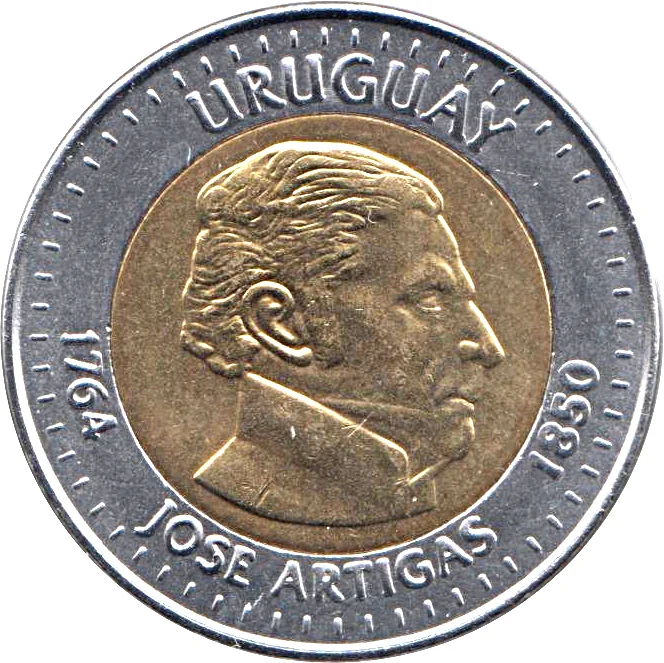
Portrait of José Gervasio Artigas facing right; "URUGUAY" above, with his birth and death dates.
Inscription:
URUGUAY
1764 JOSE ARTIGAS 1850
1764 JOSE ARTIGAS 1850
Translation:
Uruguay
1764 Jose Artigas 1850
1764 Jose Artigas 1850
Script: Latin
Language: Spanish
Engraver: Jorge Nicastro
Reverse
Description:
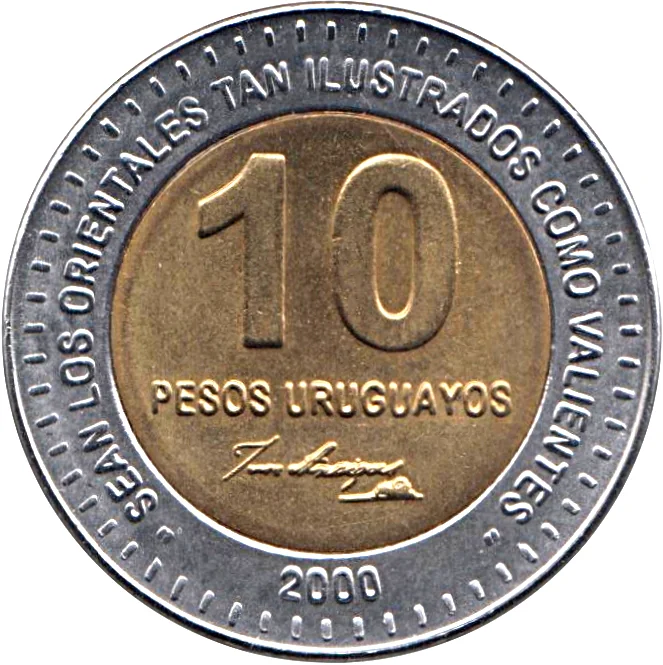
Center: Denomination, encircled by Artigas's phrase "SEAN LOS ORIENTALES TAN ILUSTRADOS COMO VALIENTES." Exergue: Signature and date.
Inscription:
"SEAN LOS ORIENTALES TAN ILUSTRADOS COMO VALIENTES"
10
PESOS URUGUAYOS
José Artigas
2000
10
PESOS URUGUAYOS
José Artigas
2000
Translation:
Let the Orientals be as enlightened as they are brave.
10
Uruguayan Pesos
José Artigas
2000
10
Uruguayan Pesos
José Artigas
2000
Script: Latin
Language: Spanish
Engraver: Jorge Nicastro
Edge
Plain
Categories
| Person> Military leader |
| Person> Politician |
Mints
| Name | Mark |
|---|---|
| Buenos Aires | — |
| Royal Canadian Mint of Winnipeg | — |
Mintings
| Year | Mint Mark | Mintage | Quality | Collection |
|---|---|---|---|---|
| 2000 | — | 10,000,000 | BU | |
| 2000 | — | 40,000,000 |
Historical background
In the year 2000, Uruguay's currency situation was defined by a deeply entrenched process of "dolarización financiera" or financial dollarization, a legacy of past hyperinflation and economic instability. While the official currency remained the Uruguayan peso, the economy operated with a dual monetary system. A significant portion of bank deposits (over 80%), loans, and major business contracts were denominated in US dollars, reflecting a profound lack of public confidence in the peso as a store of value. This dollarization was largely passive, driven by the private sector's preference for stability, rather than an official government policy.
The system functioned under a managed float exchange rate regime, but the Central Bank of Uruguay (BCU) maintained a "banda cambiaria" (exchange rate band) to limit excessive volatility. The primary monetary policy challenge was to manage the peso's value without triggering capital flight or a banking crisis, as the financial system's solvency was heavily dependent on the stability of the dollar-peso exchange rate. Interest rates for peso-denominated instruments were typically much higher than dollar rates to compensate for devaluation risk, creating a persistent incentive for further dollarization.
This fragile equilibrium was being tested by external shocks. The Argentine economic crisis, which culminated in late 2001, had already begun to exert severe pressure on Uruguay by 2000. As a regional financial hub with deep ties to Argentina, Uruguay faced declining exports, reduced tourism, and, most critically, a loss of confidence that would lead to a gradual withdrawal of dollar deposits. While the full-blown crisis erupted in 2002, the currency vulnerabilities of 2000—the high level of dollar-denominated liabilities and dependence on foreign capital—set the stage for the severe banking and balance-of-payments crisis that would soon force a peso devaluation and a temporary suspension of banking operations.
The system functioned under a managed float exchange rate regime, but the Central Bank of Uruguay (BCU) maintained a "banda cambiaria" (exchange rate band) to limit excessive volatility. The primary monetary policy challenge was to manage the peso's value without triggering capital flight or a banking crisis, as the financial system's solvency was heavily dependent on the stability of the dollar-peso exchange rate. Interest rates for peso-denominated instruments were typically much higher than dollar rates to compensate for devaluation risk, creating a persistent incentive for further dollarization.
This fragile equilibrium was being tested by external shocks. The Argentine economic crisis, which culminated in late 2001, had already begun to exert severe pressure on Uruguay by 2000. As a regional financial hub with deep ties to Argentina, Uruguay faced declining exports, reduced tourism, and, most critically, a loss of confidence that would lead to a gradual withdrawal of dollar deposits. While the full-blown crisis erupted in 2002, the currency vulnerabilities of 2000—the high level of dollar-denominated liabilities and dependence on foreign capital—set the stage for the severe banking and balance-of-payments crisis that would soon force a peso devaluation and a temporary suspension of banking operations.
🌱 Very Common