

20000 nuevos pesos (Gold Coinage and Inter-American Development Bank Governors Meeting) – Uruguay
Add to wishlist
Circulating commemorative coins
Commemoration: 130th Anniversary of Gold Coinage and 25th Meeting of Inter-American Development Bank Governors
Uruguay
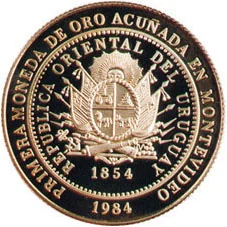
Obverse
Description:
1854 gold coin obverse: radiant sun over crossed arms, encircled by a wreath of flags.
Inscription:
PRIMERA MONEDA DE ORO ACUÑADA EN MONTEVIDEO
REPÚBLICA ORIENTAL DEL URUGUAY
1854
1984
REPÚBLICA ORIENTAL DEL URUGUAY
1854
1984
Translation:
FIRST GOLD COIN MINTED IN MONTEVIDEO
ORIENTAL REPUBLIC OF URUGUAY
1854
1984
ORIENTAL REPUBLIC OF URUGUAY
1854
1984
Script: Latin
Language: Spanish
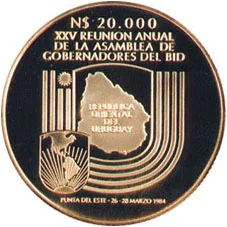
Reverse
Description:
Uruguay map in U-shaped seating design with stylized flag, inscription above, value at sides, and Americas map at lower left.
Inscription:
XXV
REUNION ANUAL
DE LA ASAMBLEA DE
GOBERNADORES DEL BID
N$ 20.000 N$ 20.000
REPUBLICA
ORIENTAL
DEL
URUGUAY
PUNTA DEL ESTE 26-28 MARZO 1984
REUNION ANUAL
DE LA ASAMBLEA DE
GOBERNADORES DEL BID
N$ 20.000 N$ 20.000
REPUBLICA
ORIENTAL
DEL
URUGUAY
PUNTA DEL ESTE 26-28 MARZO 1984
Translation:
TWENTY-FIFTH
ANNUAL MEETING
OF THE BOARD OF GOVERNORS OF THE IDB
N$ 20,000 N$ 20,000
ORIENTAL
REPUBLIC
OF
URUGUAY
PUNTA DEL ESTE MARCH 26-28 1984
ANNUAL MEETING
OF THE BOARD OF GOVERNORS OF THE IDB
N$ 20,000 N$ 20,000
ORIENTAL
REPUBLIC
OF
URUGUAY
PUNTA DEL ESTE MARCH 26-28 1984
Script: Latin
Language: Spanish
Edge
Reeded
Categories
| Currency> Coin depiction |
| Map |
| Symbols> Coat of Arms |
Mints
| Name | Mark |
|---|---|
| Vereinigte Deutsche Nickelwerke | — |
Mintings
| Year | Mint Mark | Mintage | Quality | Collection |
|---|---|---|---|---|
| 1984 | — | 1,500 | Proof |
Historical background
By 1984, Uruguay was emerging from over a decade of brutal military dictatorship (1973-1985), and its currency situation was characterized by profound instability and a legacy of economic mismanagement. The period was marked by the coexistence of multiple exchange rates—an official, heavily overvalued peso used for essential imports and debt servicing, and a parallel black market where the peso traded at a fraction of its official value. This dual system created severe distortions, encouraged capital flight, and reflected a lack of confidence in both the currency and the regime's economic policies. High inflation, though lower than in some neighboring countries, remained a persistent problem, eroding purchasing power and savings.
The economic backdrop was one of deep crisis, with the country grappling with the effects of the Latin American debt crisis that had erupted in 1982. Uruguay's foreign debt was unsustainably high, and a series of devaluations had failed to correct fundamental imbalances. The overvalued official peso crippled the export sector, while the Central Bank's reserves were perilously low. The financial system was fragile, with many institutions technically insolvent. This currency instability was both a cause and a symptom of a broader economic contraction, with stagnant growth and high unemployment plaguing the nation.
The currency turmoil of 1984 was intrinsically linked to the political transition. As the military government began negotiated steps toward democracy, it lacked the political legitimacy to implement the harsh austerity and unified devaluation measures required for stabilization. Consequently, managing the chaotic currency system fell to the incoming civilian administration, which would take office in 1985. The situation thus set the stage for one of the first major challenges for Uruguay's restored democracy: implementing a coherent exchange rate and stabilization policy to rebuild confidence and lay the foundation for future economic recovery.
The economic backdrop was one of deep crisis, with the country grappling with the effects of the Latin American debt crisis that had erupted in 1982. Uruguay's foreign debt was unsustainably high, and a series of devaluations had failed to correct fundamental imbalances. The overvalued official peso crippled the export sector, while the Central Bank's reserves were perilously low. The financial system was fragile, with many institutions technically insolvent. This currency instability was both a cause and a symptom of a broader economic contraction, with stagnant growth and high unemployment plaguing the nation.
The currency turmoil of 1984 was intrinsically linked to the political transition. As the military government began negotiated steps toward democracy, it lacked the political legitimacy to implement the harsh austerity and unified devaluation measures required for stabilization. Consequently, managing the chaotic currency system fell to the incoming civilian administration, which would take office in 1985. The situation thus set the stage for one of the first major challenges for Uruguay's restored democracy: implementing a coherent exchange rate and stabilization policy to rebuild confidence and lay the foundation for future economic recovery.
✨ Legendary