

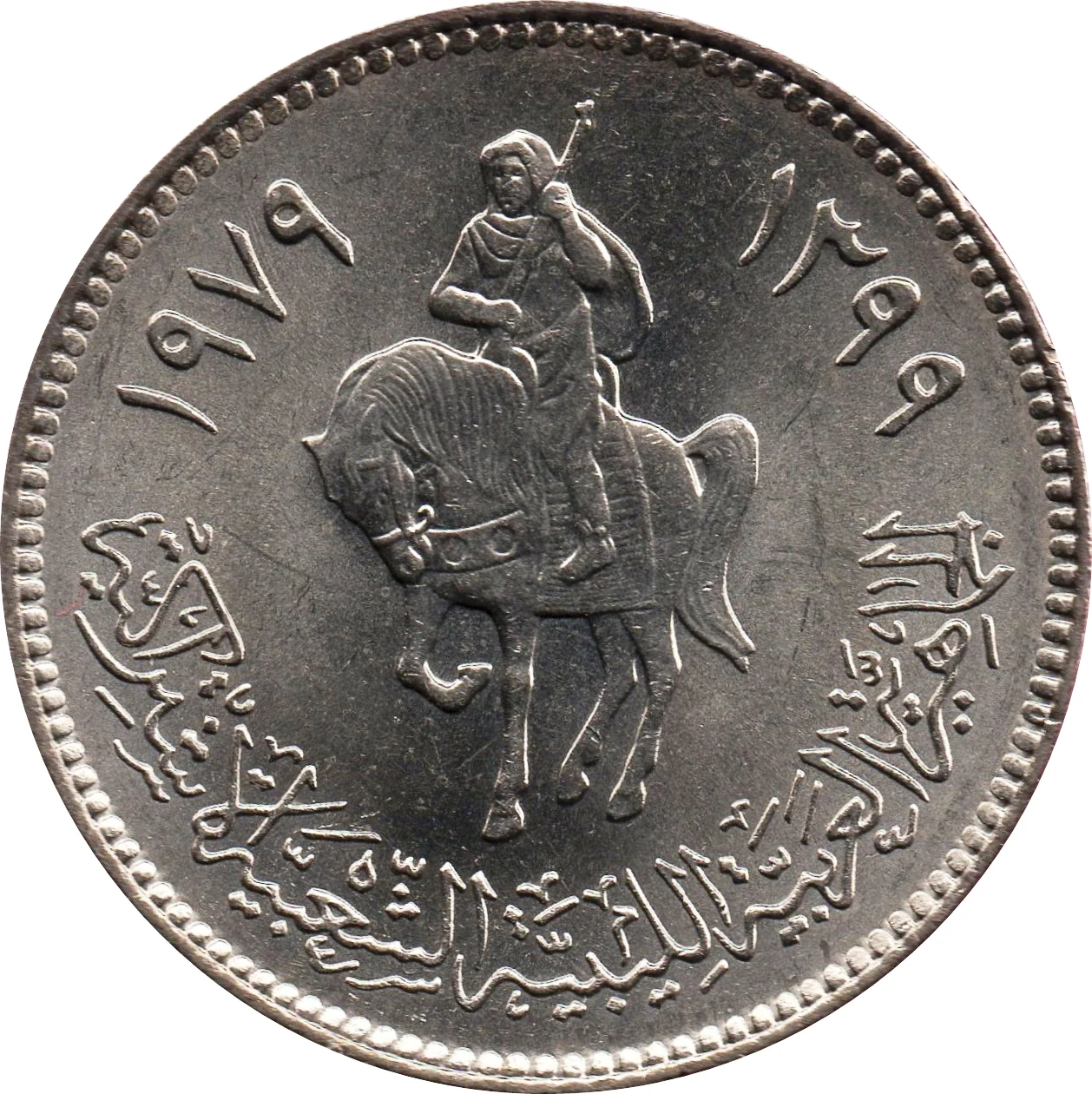
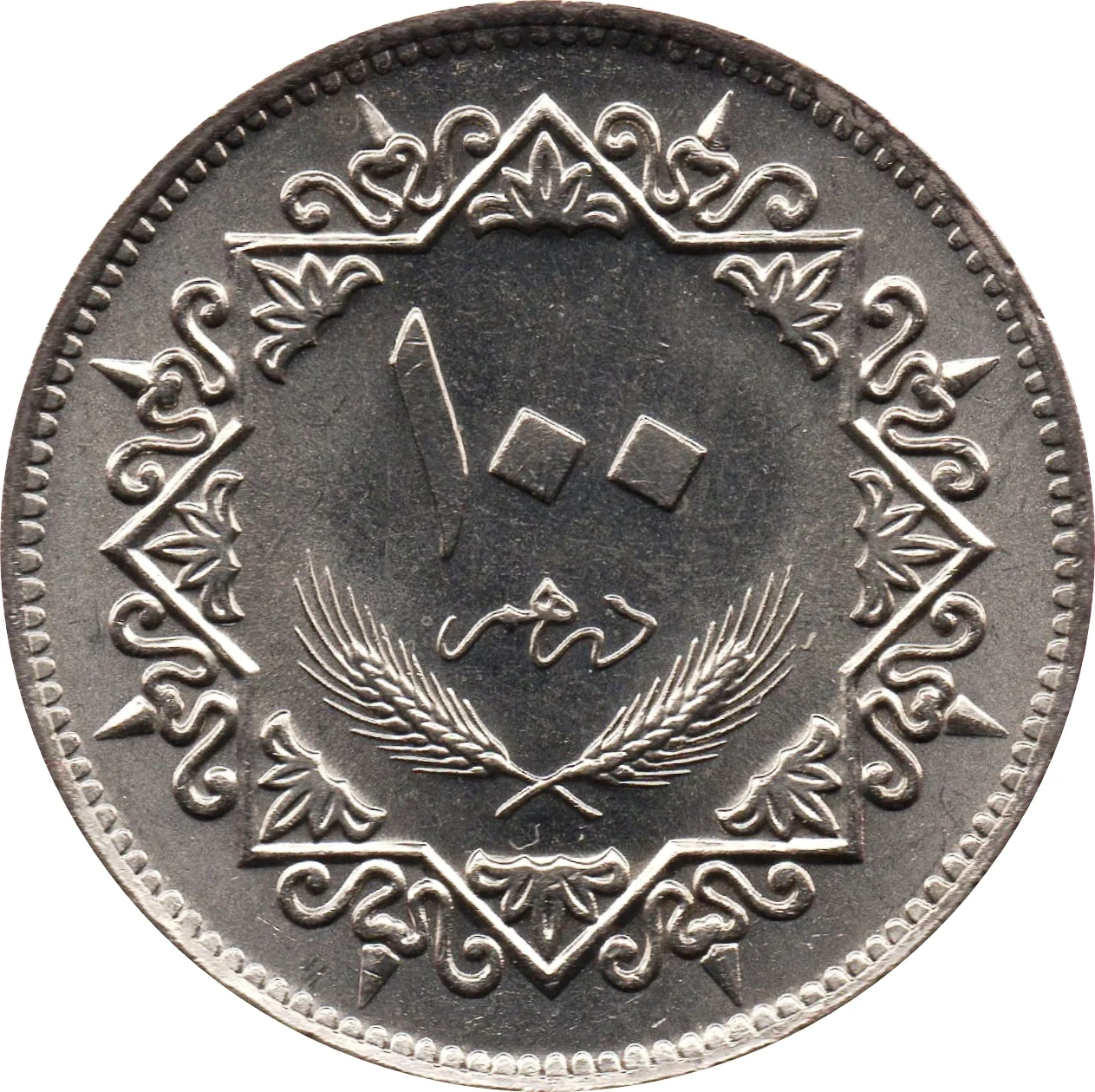
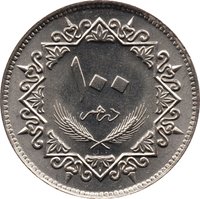
100 Dirhams – Libya
Libya
Context
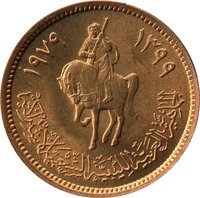
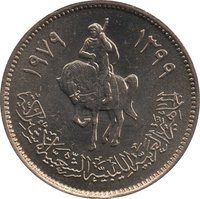
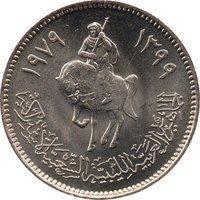
Year: 1979
Islamic (Hijri) Year: 1399
Issuer: Libya 
Period: 
(1977—2011)
Currency:
(since 1971)
Demonetized: Yes
Total mintage: 15,000,000
Material
Diameter: 27 mm
Weight: 8 g
Thickness: 1.58 mm
Shape: Round
Composition: Copper-nickel
Technique: Milled
Alignment: Medal alignment
flip
References
KM: #Click to copy to clipboard23
Numista: #4460
Value
Exchange value: 0.100 LYD
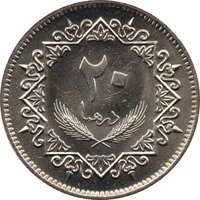
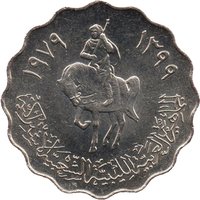
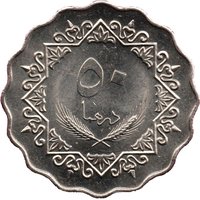
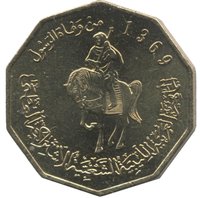
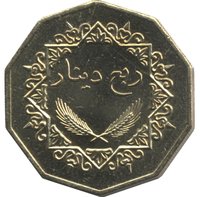
Obverse
Reverse
Edge
Reeded
Mints
| Name | Mark |
|---|---|
| Royal Mint | — |
Mintings
| Year | Mint Mark | Mintage | Quality | Collection |
|---|---|---|---|---|
| 1979 | — | 15,000,000 |
Historical background
In 1979, Libya's currency situation was fundamentally shaped by the revolutionary government of Colonel Muammar Gaddafi, who had been in power for a decade. The official currency, the Libyan dinar (LYD), was a strong, oil-backed unit, pegged to the Special Drawing Rights (SDR) basket of the International Monetary Fund. This peg, along with substantial foreign exchange reserves accumulated from booming oil exports, provided formal stability and high purchasing power internationally. However, this official system existed alongside a strictly controlled and centralized economic model, with the state dictating exchange rates and heavily restricting access to foreign currency for citizens and businesses.
Beneath this surface stability, significant distortions were emerging. Gaddafi's push for a "stateless society" outlined in his Green Book, including the abolition of private trade, created economic inefficiencies. Strict currency controls and the criminalization of holding foreign exchange led to the growth of a active black market. Here, the dinar traded at a significant discount compared to the official rate, reflecting the pent-up demand for hard currencies like the US dollar and the realities of an economy struggling with shortages and bureaucratic hurdles for legitimate imports.
Furthermore, 1979 fell within a period of increasing international tension following Libya's alignment with the Soviet Union and its support for militant groups, which would soon lead to US economic sanctions in the 1980s. While not yet in full force, these geopolitical pressures began to cast a shadow over Libya's financial integration. Thus, the currency landscape was a paradox: a robust, oil-funded official dinar coexisting with a thriving parallel market and an increasingly isolated economic policy, setting the stage for future instability.
Beneath this surface stability, significant distortions were emerging. Gaddafi's push for a "stateless society" outlined in his Green Book, including the abolition of private trade, created economic inefficiencies. Strict currency controls and the criminalization of holding foreign exchange led to the growth of a active black market. Here, the dinar traded at a significant discount compared to the official rate, reflecting the pent-up demand for hard currencies like the US dollar and the realities of an economy struggling with shortages and bureaucratic hurdles for legitimate imports.
Furthermore, 1979 fell within a period of increasing international tension following Libya's alignment with the Soviet Union and its support for militant groups, which would soon lead to US economic sanctions in the 1980s. While not yet in full force, these geopolitical pressures began to cast a shadow over Libya's financial integration. Thus, the currency landscape was a paradox: a robust, oil-funded official dinar coexisting with a thriving parallel market and an increasingly isolated economic policy, setting the stage for future instability.
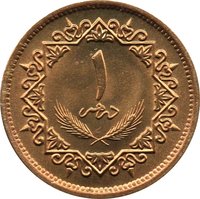
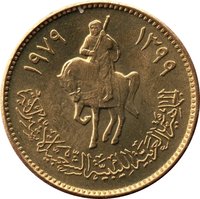
Series: 1979 Libya circulation coins
🌱 Very Common