

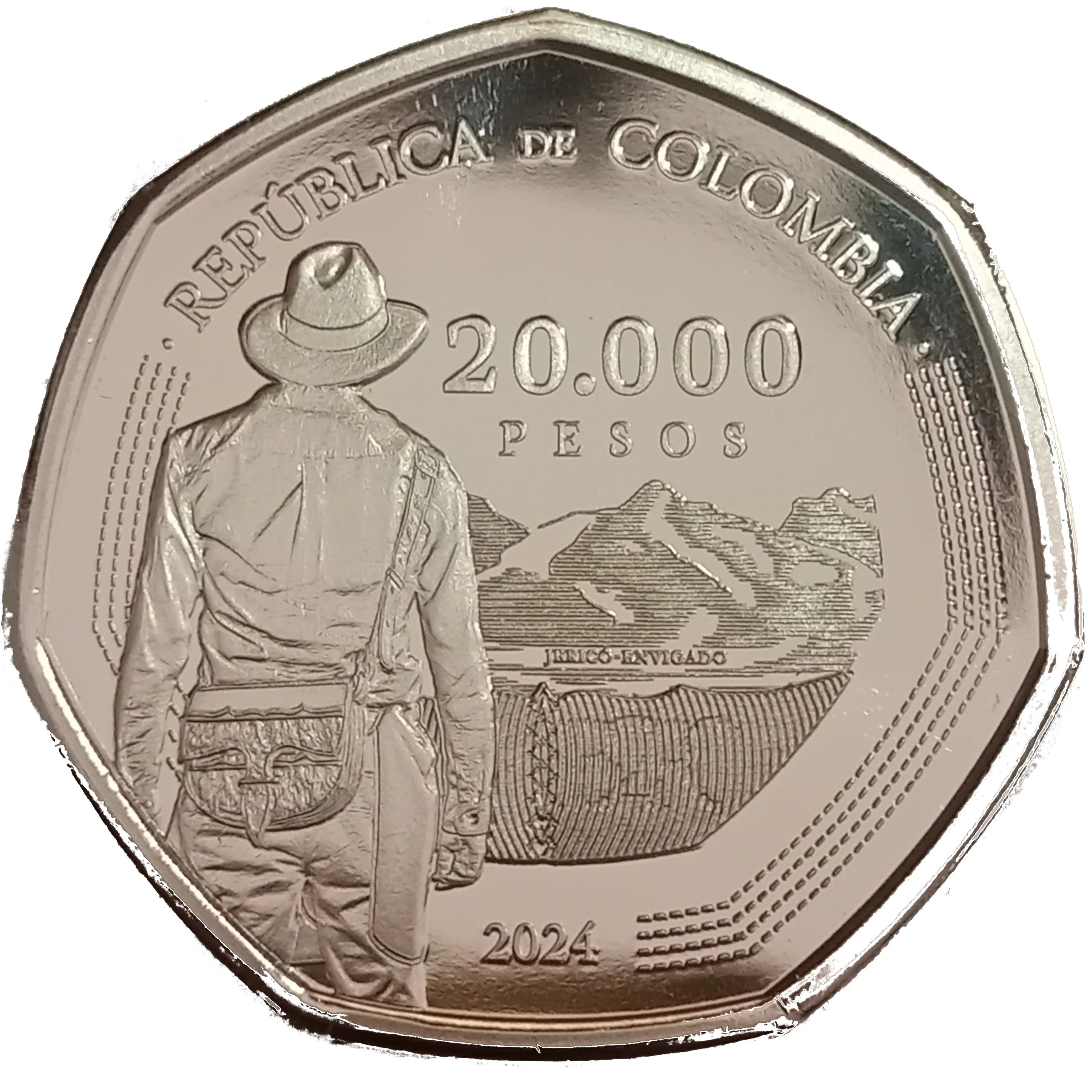
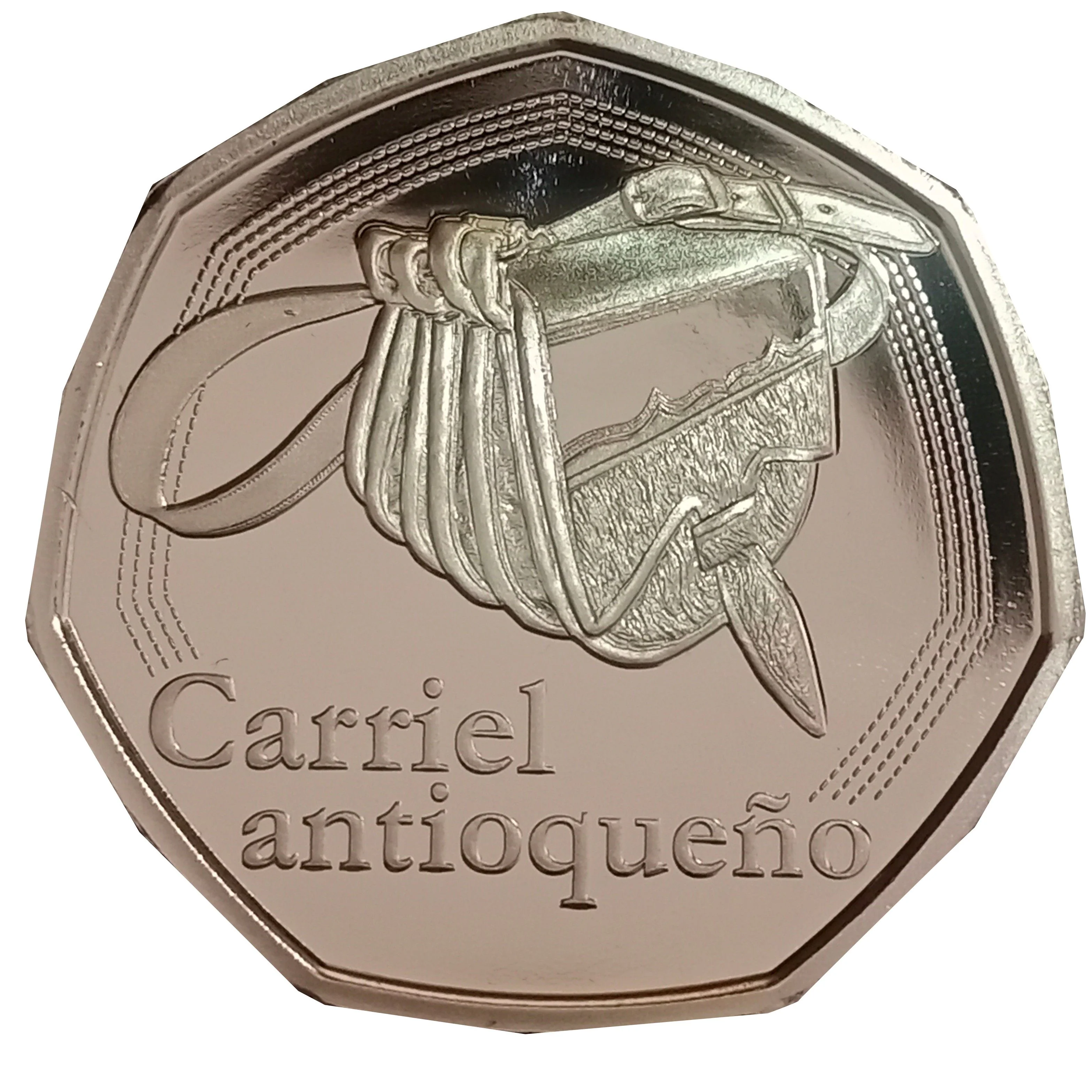
20000 pesos – Colombia
Add to wishlist
Circulating commemorative coins
Commemoration: Guarniel - Carriel Antioqueño
Colombia
Context
Year: 2024
Issuer: Colombia
Issuing organization: Bank of the Republic
Period:
(since 1886)
Currency:
(since 1847)
Total mintage: 200,000
Material
Diameter: 35 mm
Weight: 21.75 g
Thickness: 3 mm
Shape: Equilateral curve heptagon
Composition: Copper-nickel (65% Copper)
Technique: Milled
Alignment: Medal alignment
flip

References
KM: #
Numista: #442575
Value
Exchange value: 20000 COP
Inflation-adjusted value: 21768.00 COP
Obverse
Reverse
Edge
Plain
Mints
| Name | Mark |
|---|---|
| Royal Dutch Mint | — |
Mintings
| Year | Mint Mark | Mintage | Quality | Collection |
|---|---|---|---|---|
| 2024 | — | 200,000 |
Historical background
In 2024, Colombia's currency, the peso (COP), continues to operate within a context of managed flexibility, influenced by both domestic economic policy and volatile global conditions. The Banco de la República, the country's central bank, maintains a primary focus on controlling inflation, which saw a significant peak in 2023. While inflation has been on a gradual downward trajectory through 2024, it remains above the long-term target range of 3%, prompting the central bank to maintain a relatively high benchmark interest rate. This restrictive monetary stance, aimed at cooling the economy and anchoring inflation expectations, has provided some support for the peso by making Colombian assets attractive to foreign investors seeking yield.
However, the peso faces persistent downward pressures from external factors and domestic uncertainties. A primary driver is the price of oil, Colombia's largest export, which has experienced fluctuations due to global demand concerns and geopolitical tensions. Lower oil revenues directly impact the country's current account balance and reduce dollar inflows, weakening the peso. Furthermore, the government of President Gustavo Petro continues to pursue ambitious social and economic reforms, creating investor uncertainty regarding fiscal policy, the future of the extractive industries, and Colombia's investment-grade credit rating. This uncertainty can trigger capital outflows and exchange rate volatility.
Looking ahead, the currency's trajectory in the latter half of 2024 will hinge on the interplay between the central bank's potential interest rate cuts as inflation recedes and the materialization of global and domestic risks. A sustained decline in global oil prices or a significant deterioration in investor confidence could lead to further depreciation of the peso. Conversely, a successful taming of inflation, a stable political environment, and a rebound in commodity prices could bolster the currency. The Banco de la República retains intervention mechanisms to smooth excessive volatility, but the overall trend will be dictated by these fundamental economic and political currents.
However, the peso faces persistent downward pressures from external factors and domestic uncertainties. A primary driver is the price of oil, Colombia's largest export, which has experienced fluctuations due to global demand concerns and geopolitical tensions. Lower oil revenues directly impact the country's current account balance and reduce dollar inflows, weakening the peso. Furthermore, the government of President Gustavo Petro continues to pursue ambitious social and economic reforms, creating investor uncertainty regarding fiscal policy, the future of the extractive industries, and Colombia's investment-grade credit rating. This uncertainty can trigger capital outflows and exchange rate volatility.
Looking ahead, the currency's trajectory in the latter half of 2024 will hinge on the interplay between the central bank's potential interest rate cuts as inflation recedes and the materialization of global and domestic risks. A sustained decline in global oil prices or a significant deterioration in investor confidence could lead to further depreciation of the peso. Conversely, a successful taming of inflation, a stable political environment, and a rebound in commodity prices could bolster the currency. The Banco de la República retains intervention mechanisms to smooth excessive volatility, but the overall trend will be dictated by these fundamental economic and political currents.
⭐ Somewhat Rare