

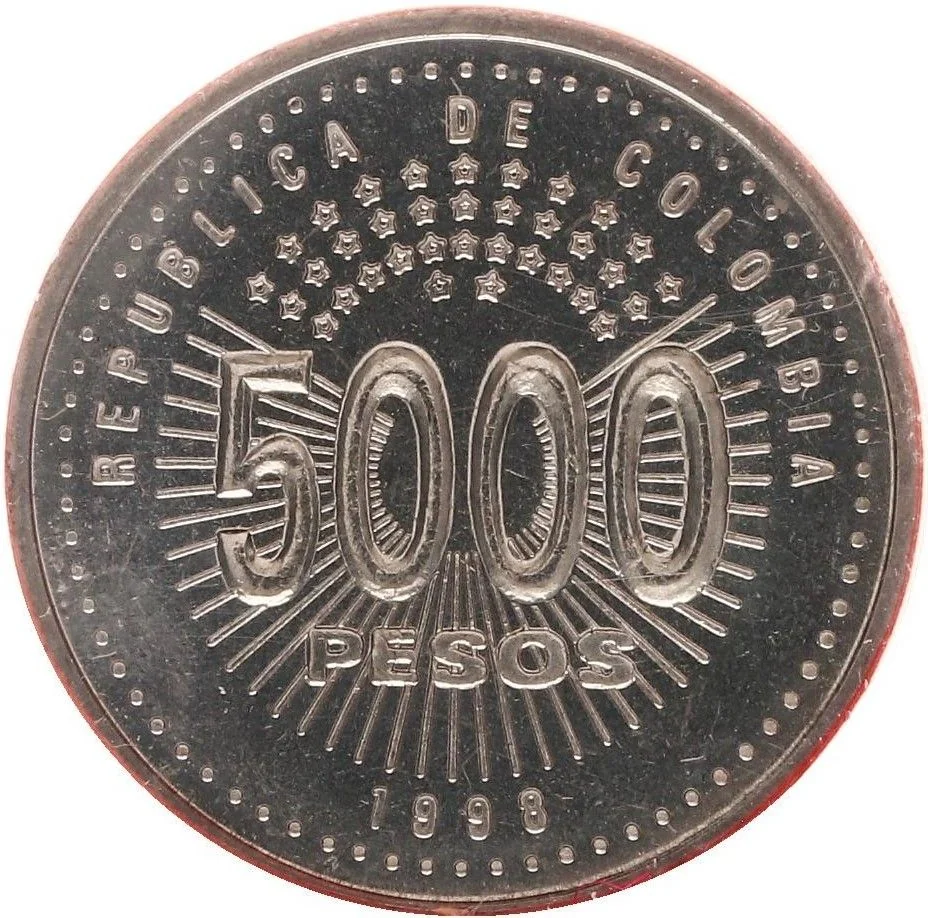
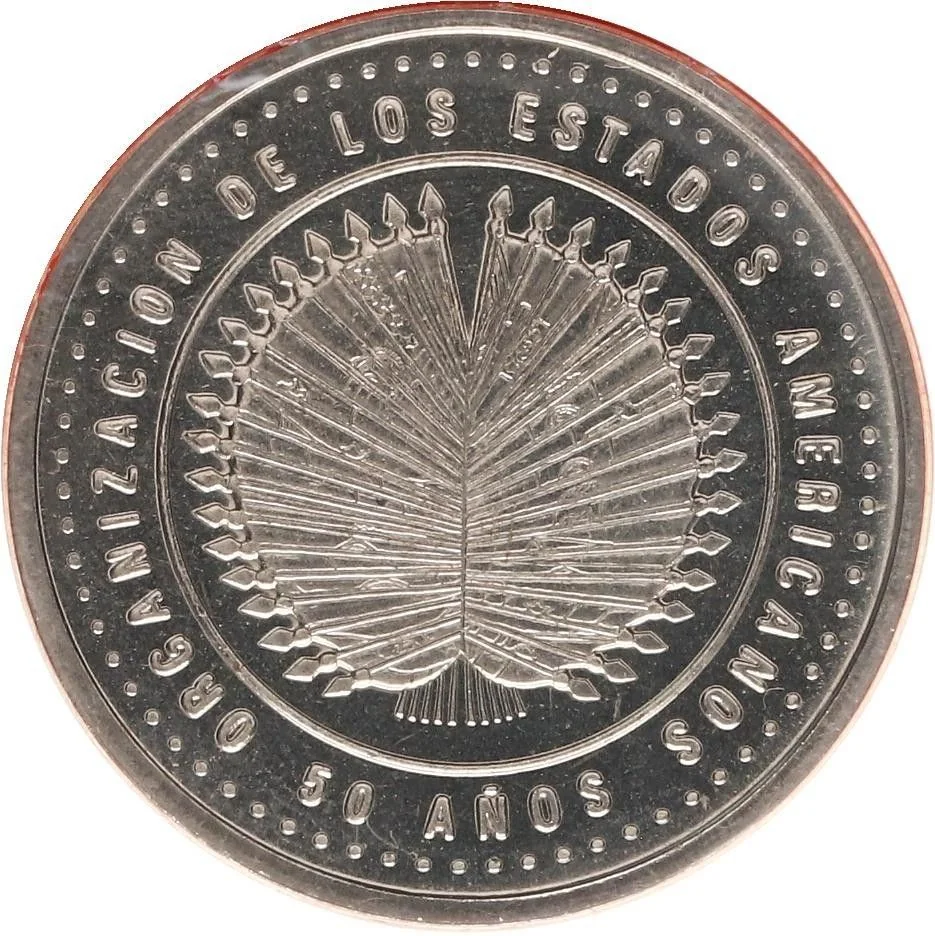
5000 pesos (Organization of American States) – Colombia
Add to wishlist
Circulating commemorative coins
Commemoration: 50th Anniversary Organization of American States
Colombia
Context
Material
Diameter: 28 mm
Weight: 15.3 g
Thickness: 3.25 mm
Shape: Round
Composition: Nickel
Standard: Silver half ounce
Magnetic: Yes
Technique: Milled
Alignment: Coin alignment
flip
References
KM: #
Numista: #21706
Value
Exchange value: 5000 COP
Inflation-adjusted value: 24985.20 COP
Obverse
Reverse
Edge
Unabridged legend:Cincuentenario organización de estados americanos
Mintings
| Year | Mint Mark | Mintage | Quality | Collection |
|---|---|---|---|---|
| 1998 | — | 50,000 |
Historical background
In 1998, Colombia found itself in a severe currency crisis, the culmination of external shocks and domestic vulnerabilities. The year was dominated by the "Efecto Tequila," the regional fallout from the 1997 Asian financial crisis and the 1994 Mexican peso crisis, which triggered a massive flight of foreign capital from emerging markets like Colombia. This occurred alongside a sharp decline in global prices for key exports—coffee and oil—creating a perfect storm of a widening current account deficit and plummeting investor confidence. The central bank's foreign reserves were being rapidly depleted as it attempted to defend the peso's value within its crawling band exchange rate system.
The government, led by President Ernesto Samper, initially responded with a sharp hike in interest rates and continued intervention, but market pressure proved overwhelming. By mid-September 1998, with reserves critically low, the new administration of President Andrés Pastrana was forced to abandon the crawling band. The peso was allowed to float freely, leading to an immediate and dramatic devaluation; it lost over 25% of its value against the U.S. dollar in the latter half of the year. This sharp correction, while necessary to halt the reserve hemorrhage, had severe inflationary consequences and dramatically increased the peso value of Colombia's substantial external debt, pushing the banking sector toward a concurrent crisis.
The 1998 currency crisis was therefore a pivotal economic event, marking the end of a managed exchange rate regime and ushering in a period of financial instability. It exposed the economy's sensitivity to volatile capital flows and terms of trade, forcing a painful structural adjustment. The devaluation, combined with a deep recession and a systemic banking crisis, defined the challenging economic landscape that the Pastrana administration had to navigate, setting the stage for significant reforms and a turn to the International Monetary Fund for a $2.7 billion loan in 1999.
The government, led by President Ernesto Samper, initially responded with a sharp hike in interest rates and continued intervention, but market pressure proved overwhelming. By mid-September 1998, with reserves critically low, the new administration of President Andrés Pastrana was forced to abandon the crawling band. The peso was allowed to float freely, leading to an immediate and dramatic devaluation; it lost over 25% of its value against the U.S. dollar in the latter half of the year. This sharp correction, while necessary to halt the reserve hemorrhage, had severe inflationary consequences and dramatically increased the peso value of Colombia's substantial external debt, pushing the banking sector toward a concurrent crisis.
The 1998 currency crisis was therefore a pivotal economic event, marking the end of a managed exchange rate regime and ushering in a period of financial instability. It exposed the economy's sensitivity to volatile capital flows and terms of trade, forcing a painful structural adjustment. The devaluation, combined with a deep recession and a systemic banking crisis, defined the challenging economic landscape that the Pastrana administration had to navigate, setting the stage for significant reforms and a turn to the International Monetary Fund for a $2.7 billion loan in 1999.
🌟 Limited