

20000 pesos (Santa Marta) – Colombia
Add to wishlist
Circulating commemorative coins
Commemoration: 500 years of the founding of Santa Marta
Colombia
Context
Year: 2025
Issuer: Colombia
Issuing organization: Bank of the Republic of Colombia
Period:
(since 1886)
Currency:
(since 1847)
Total mintage: 200,000
Material
Diameter: 35 mm
Weight: 21.75 g
Shape: Round
Composition: Nickel silver (65% Copper)
Techniques: Latent image, Milled
Alignment: Coin alignment
flip
References
Numista: #476542
Value
Exchange value: 20000 COP
Obverse
Description:
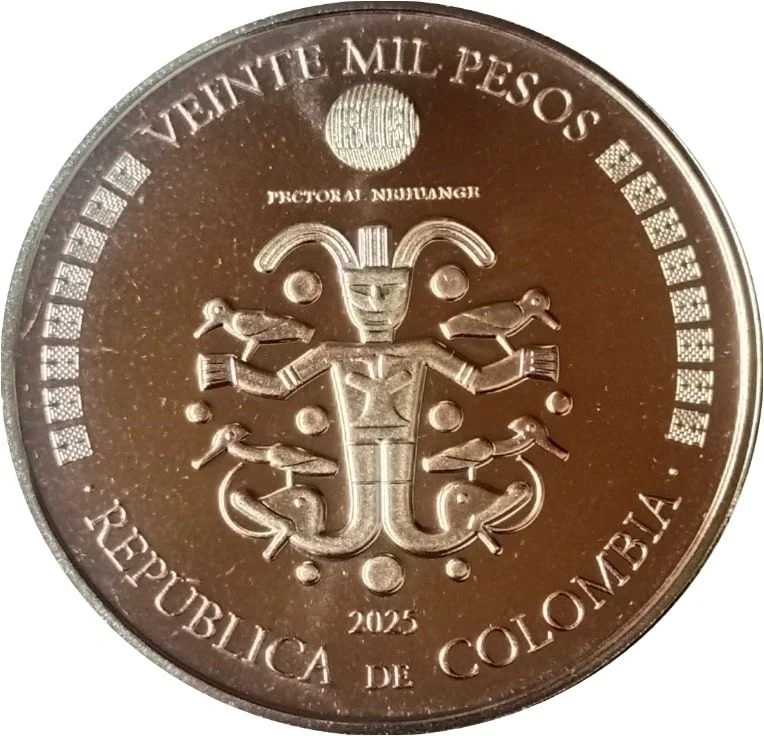
A pectoral from the Sierra Nevada de Santa Marta. Top: denomination with a border and a latent security image showing "BR" or "20" from different angles. Central portion: legend above the figure. Bottom: year and issuer's name.
Inscription:
VEINTE MIL PESOS
BR (40)
PECTORAL NEHUANGE
2025
REPÚBLICA DE COLOMBIA
BR (40)
PECTORAL NEHUANGE
2025
REPÚBLICA DE COLOMBIA
Translation:
TWENTY THOUSAND PESOS
BR (40)
PECTORAL NEHUANGE
2025
REPUBLIC OF COLOMBIA
BR (40)
PECTORAL NEHUANGE
2025
REPUBLIC OF COLOMBIA
Script: Latin
Language: Spanish
Reverse
Description:
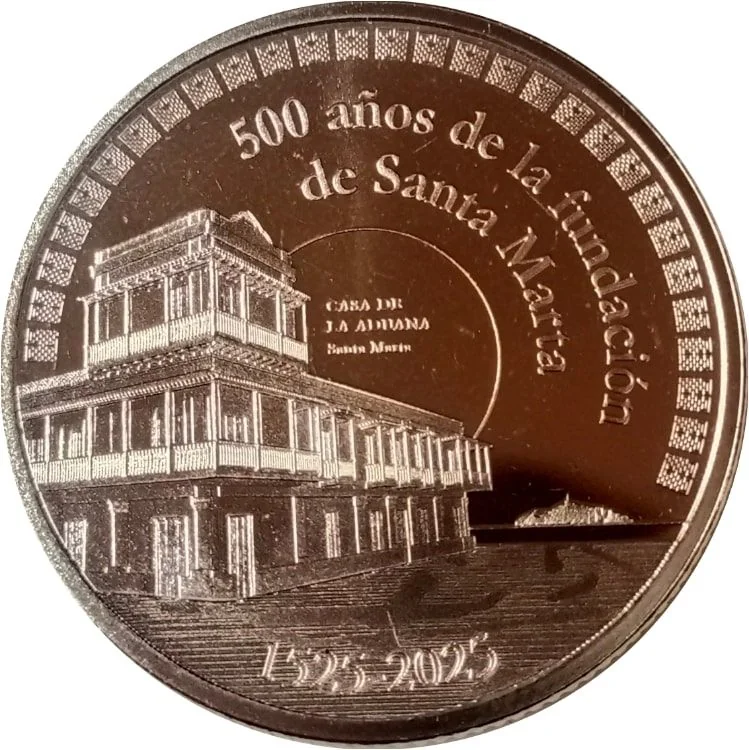
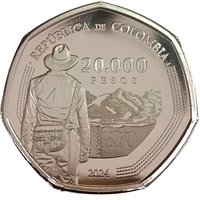
Santa Marta's customs house, with El Morro islet and lighthouse in the bay. A top border evokes indigenous Sierra Nevada backpack patterns and the legend "500 years since the founding of Santa Marta." Text in center and bottom.
Inscription:
500 años de la fundación de Santa Marta
CASA DE LA ADUANA
Santa Marta
1525 - 2025
CASA DE LA ADUANA
Santa Marta
1525 - 2025
Translation:
500 years since the foundation of Santa Marta
CUSTOM HOUSE
Santa Marta
1525 - 2025
CUSTOM HOUSE
Santa Marta
1525 - 2025
Script: Latin
Language: Spanish
Edge
Reeded
Categories
| Building> Governmental building |
| Building> Lighthouse |
| Map |
| Symbol> Allegory |
Mintings
| Year | Mint Mark | Mintage | Quality | Collection |
|---|---|---|---|---|
| 2025 | — | 200,000 |
Historical background
In 2025, Colombia's currency, the peso (COP), continues to navigate a complex landscape defined by cautious stability amid persistent external pressures. The exchange rate against the US dollar has found a volatile equilibrium in a range slightly stronger than the historic lows of 2022-2023, largely due to the sustained high global prices for its key exports—oil, coal, and coffee. This inflow of dollars, coupled with the Banco de la República's maintained high-interest rate policy to combat inflation, has provided a floor for the peso. However, this relative strength presents a double-edged sword, as exporters and the government remain concerned about reduced competitiveness for non-commodity goods and lower peso-value oil revenues for the national budget.
The primary challenges to the peso's stability are twofold. First, global financial conditions and the monetary policy path of the U.S. Federal Reserve continue to be dominant external drivers, with any shift toward easing potentially weakening the dollar and offering the peso room to appreciate. Second, domestic fiscal concerns linger as the government of President Gustavo Petro pursues ambitious social reforms and a transition away from fossil fuel dependence, creating investor uncertainty about long-term debt sustainability and economic direction. This has led to episodic bouts of volatility, with the peso sensitive to both international risk sentiment and domestic political announcements.
Looking ahead, the currency's trajectory in 2025 hinges on balancing these forces. The central bank faces the delicate task of gradually lowering interest rates to stimulate growth without triggering capital outflows or reigniting inflation, which could sharply depreciate the peso. Success will depend significantly on the government's ability to demonstrate credible fiscal discipline and attract foreign direct investment into new sectors, thereby diversifying the sources of dollar inflows beyond traditional commodities and creating a more structurally resilient currency foundation for the latter half of the decade.
The primary challenges to the peso's stability are twofold. First, global financial conditions and the monetary policy path of the U.S. Federal Reserve continue to be dominant external drivers, with any shift toward easing potentially weakening the dollar and offering the peso room to appreciate. Second, domestic fiscal concerns linger as the government of President Gustavo Petro pursues ambitious social reforms and a transition away from fossil fuel dependence, creating investor uncertainty about long-term debt sustainability and economic direction. This has led to episodic bouts of volatility, with the peso sensitive to both international risk sentiment and domestic political announcements.
Looking ahead, the currency's trajectory in 2025 hinges on balancing these forces. The central bank faces the delicate task of gradually lowering interest rates to stimulate growth without triggering capital outflows or reigniting inflation, which could sharply depreciate the peso. Success will depend significantly on the government's ability to demonstrate credible fiscal discipline and attract foreign direct investment into new sectors, thereby diversifying the sources of dollar inflows beyond traditional commodities and creating a more structurally resilient currency foundation for the latter half of the decade.

💎 Very Rare